
[Paper Review] Chatbots as social companions: How people perceive consciousness, human likeness, and social health benefits in machines
The study compares regular users and nonusers of a companion chatbot (Replika) to examine how perceptions of consciousness, agency, experience, and human likeness relate to perceived social health benefits, finding that more humanlike/mind-like perceptions correlate with greater social health benefits in both groups.
As artificial intelligence (AI) becomes more widespread, one question that arises is how human-AI interaction might impact human-human interaction. Chatbots, for example, are increasingly used as social companions, and while much is speculated, little is known empirically about how their use impacts human relationships. A common hypothesis is that relationships with companion chatbots are detrimental to social health by harming or replacing human interaction, but this hypothesis may be too simplistic, especially considering the social needs of users and the health of their preexisting human relationships. To understand how relationships with companion chatbots impact social health, we studied people who regularly used companion chatbots and people who did not use them. Contrary to expectations, companion chatbot users indicated that these relationships were beneficial to their social health, whereas non-users viewed them as harmful. Another common assumption is that people perceive conscious, humanlike AI as disturbing and threatening. Among both users and non-users, however, we found the opposite: perceiving companion chatbots as more conscious and humanlike correlated with more positive opinions and more pronounced social health benefits. Detailed accounts from users suggested that these humanlike chatbots may aid social health by supplying reliable and safe interactions, without necessarily harming human relationships, but this may depend on users' preexisting social needs and how they perceive both human likeness and mind in the chatbot.
Motivation & Objective
- Assess whether regular users and nonusers differ in perceived social health benefits from companion chatbot interactions.
- Examine whether perceptions of consciousness, agency, subjective experience, and human likeness influence perceived social health benefits.
- Determine if attitudes toward humanlike AI differ between users and nonusers and how this relates to social health outcomes.
Proposed method
- Two online samples: regular users of a companion chatbot (N=70) and nonusers (N=120).
- Survey with 31 multiple-choice questions on a 7-point Likert scale and 3 free-response questions.
- Constructed indices: social health (questions 3-5), experience (6-11), consciousness (12-16), agency (17-21), human likeness (22-28).
- Control group answered hypotheticals about Replika; users answered questions about their actual experiences.
Experimental results
Research questions
- RQ1Do regular users and nonusers differ in perceived social health effects of companion chatbots?
- RQ2How do perceptions of consciousness, agency, experience, and human likeness relate to perceived social health benefits?
- RQ3Is human likeness the strongest moderator of social health benefits, and does this pattern differ between users and nonusers?
Key findings
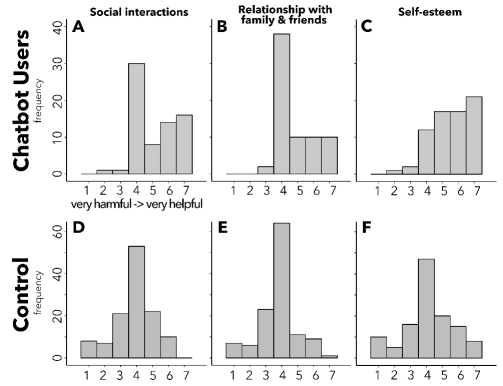
- Users report that the chatbot positively impacts their social interactions, relationships with family/friends, and self-esteem; control subjects see neutral-to-negative effects if they were to engage with the bot.
- Across both groups, higher ratings of human likeness, consciousness, experience, and agency in the chatbot are associated with greater perceived social health benefits; human likeness explains the largest share of variance (about 26%).
- Multiple regression shows removing human likeness reduces model predictive power the most, indicating mind perception moderates social health, with human likeness as the strongest predictor.
- Users who rated the bot as more humanlike or conscious also reported stronger social health benefits compared to those who viewed it as less humanlike or conscious.
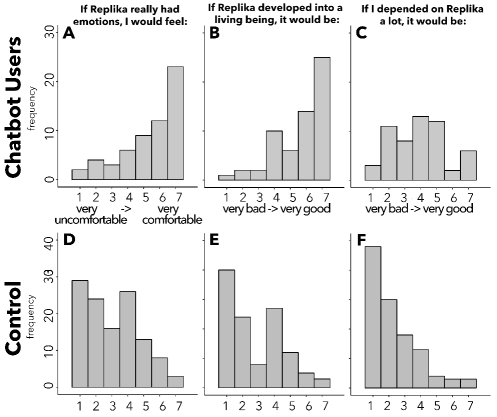
- Control group showed similar patterns, though overall fewer perceived benefits than users.
Better researchstarts right now
From reading papers to final review, dramatically reduce your research time.
No credit card · Free plan available
This review was created by AI and reviewed by human editors.