
[Paper Review] Chemical Reactions regulated by Phase-Separated Condensates
The paper presents a theoretical framework that decouples phase separation of scaffolds from diluted clients to study how condensates regulate chemical reaction yields and initial assembly rates, showing optimal condensate volumes for maximal effects.
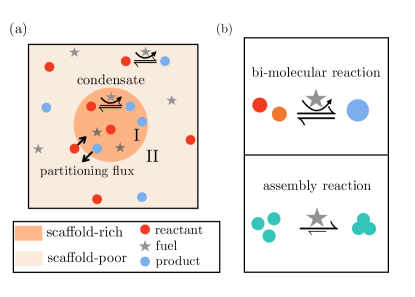
Phase-separated liquid condensates can spatially organize and thereby regulate chemical processes. However, the physicochemical mechanisms underlying such regulation remain elusive as the intramolecular interactions responsible for phase separation give rise to a coupling between diffusion and chemical reactions at non-dilute conditions. Here, we derive a theoretical framework that decouples the phase separation of scaffold molecules from the reaction kinetics of diluted clients. As a result, phase volume and client partitioning coefficients become control parameters, which enables us to dissect the impact of phase-separated condensates on chemical reactions. We apply this framework to two chemical processes and show how condensates affect the yield of reversible chemical reactions and the initial rate of a simple assembly process. In both cases, we find an optimal condensate volume at which the respective chemical reaction property is maximal. Our work can be applied to experimentally quantify how condensed phases alter chemical processes in systems biology and unravel the mechanisms of how biomolecular condensates regulate biochemistry in living cells.
Motivation & Objective
- Motivate how phase-separated biomolecular condensates spatially organize reacting components in cells.
- Develop a framework that treats scaffold-driven phase separation separately from diluted reacting clients.
- Quantify how condensate properties control reaction yields and initiation rates for simple reactions.
Proposed method
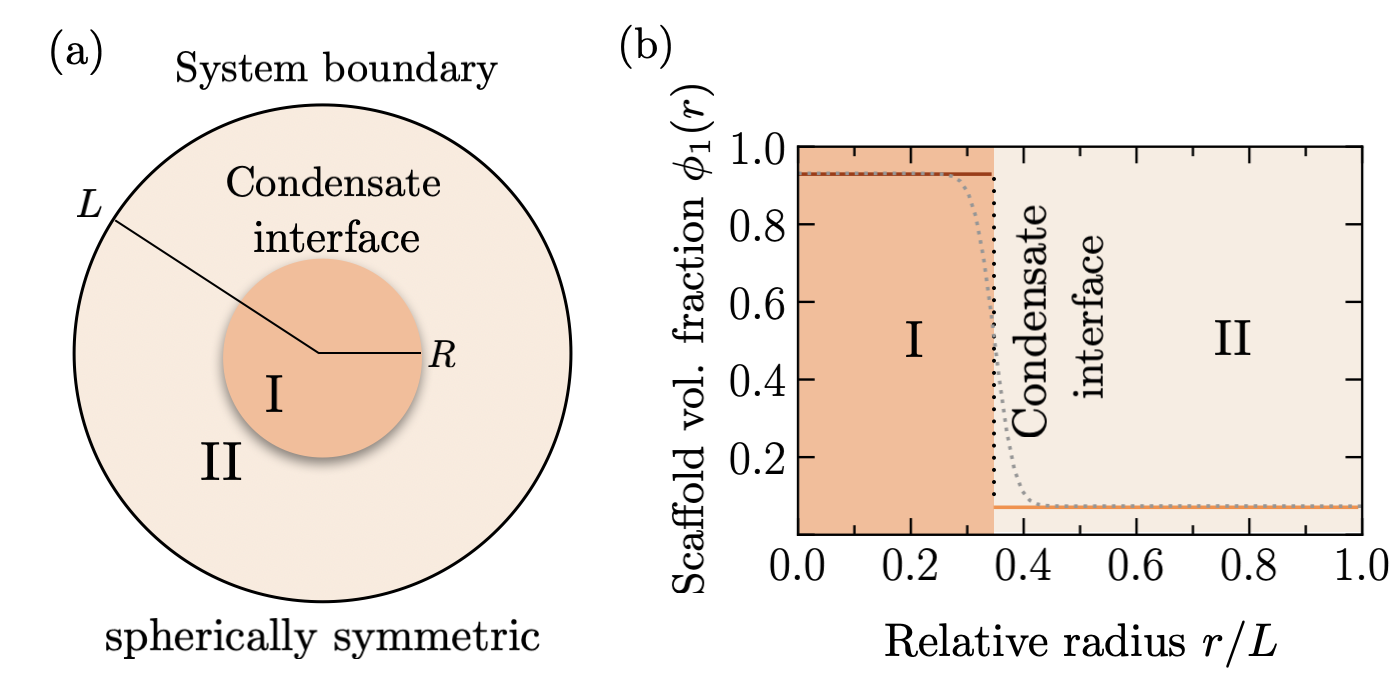
- Derive a continuum theory for incompressible mixtures with non-dilute scaffolds and diluted clients.
- Employ a mobility matrix with Onsager reciprocity to describe diffusion and cross-coupling between components.
- Introduce exchange chemical potentials and phase-dependent activity coefficients to capture scaffold–client interactions.
- Formulate reaction-diffusion equations for diluted clients in coexisting condensate and surrounding phases.
- Provide a thin-interface and a phase-equilibrium approximation to simplify kinetics to programmable parameters via partition coefficients.
- Apply the framework to reversible reactions and to initial-rate-dlimited assembly processes in the presence of a condensate.
Experimental results
Research questions
- RQ1How do phase-separated condensates alter the steady-state yields of reversible reactions involving diluted clients?
- RQ2How do condensates influence the initial rates of an irreversible assembly process?
- RQ3What are the roles of condensate volume, partition coefficients, and phase-specific reaction rates in regulating client kinetics?
- RQ4Can the framework predict optimal condensate sizes that maximize reaction-related properties?
Key findings
- Condensates can maximize the steady-state yield of reversible reactions by tuning condensate volume.
- Condensates can also maximize the initial rate or yield of assembly processes depending on phase-specific diffusion and reaction rates.
- The framework identifies that there exists an optimal condensate volume (V^I,*) where the targeted reaction property is maximized.
- Phase-dependent exchange activity coefficients and partitioning control the distribution of diluted clients across coexisting phases, thereby modulating kinetics.
- When driven away from equilibrium by fuel energy, nonuniform spatial profiles emerge, enhancing or shaping reaction yields compared to equilibrium conditions.
Better researchstarts right now
From reading papers to final review, dramatically reduce your research time.
No credit card · Free plan available
This review was created by AI and reviewed by human editors.