
[论文解读] Chemistry Beyond the Scale of Exact Diagonalization on a Quantum-Centric Supercomputer
paper demonstrates a quantum-centric supercomputing workflow combining a superconducting quantum processor with classical distributed computing to approximate ground-state energies for chemistry problems beyond exact diagonalization, using up to 6400 classical nodes and up to 77 qubits.
A universal quantum computer can simulate diverse quantum systems, with electronic structure for chemistry offering challenging problems for practical use cases around the hundred-qubit mark. While current quantum processors have reached this size, deep circuits and large number of measurements lead to prohibitive runtimes for quantum computers in isolation. Here, we demonstrate the use of classical distributed computing to offload all but an intrinsically quantum component of a workflow for electronic structure simulations. Using a Heron superconducting processor and the supercomputer Fugaku, we simulate the ground-state dissociation of N$_2$ and the [2Fe-2S] and [4Fe-4S] clusters, with circuits up to 77 qubits and 10,570 gates. The proposed algorithm processes quantum samples to produce upper bounds for the ground-state energy and sparse approximations to the ground-state wavefunctions. Our results suggest that, for current error rates, a quantum-centric supercomputing architecture can tackle challenging chemistry problems beyond sizes amenable to exact diagonalization.
研究动机与目标
- 激励并实现经典分布式计算如何协助量子处理器解决超出精确对角化的化学问题。
- 将电子结构哈密顿量映射到量子比特,并准备近似分子本征态的量子线路。
- 开发自洽、问题信息驱动的配置恢复以及子空间投影/对角化方法以获得基态能量。
- 在大型基组化学体系上评估该方法,以评估实际量子优势。
提出的方法
- 在基组中表示电子结构哈密顿量,并通过 Jordan-Wigner 变换映射到量子比特。
- 使用截断的局部幺正簇 Jastrow (LUCJ) 路线来制备量子态,以近似分子本征态。
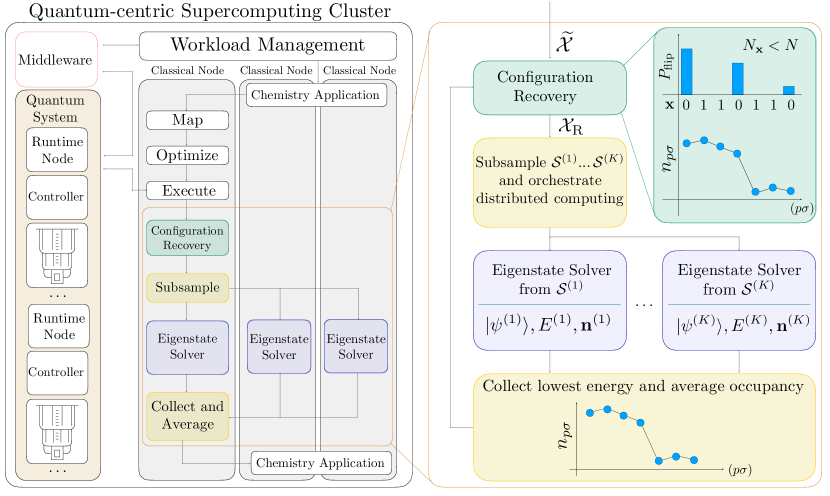
- 收集有噪声的量子样本并应用自洽配置恢复,聚焦于物理相关的配置。
- 通过采样配置生成多个子空间,然后在经典节点上使用 Davidson 方法对哈密顿量进行投影与对角化。
- 从对角化态迭代更新轨道占据数并重复,直到收敛。
- 将量子推导的能量与可用时的经典近似(如 Heat-Bath Configuration Interaction (HCI) 和 DMRG)进行比较。
实验结果
研究问题
- RQ1以量子为中心的体系是否能够在超出精确对角化范围的化学问题上提供准确的基态能量?
- RQ2如何使用配置恢复和子空间对角化工作流处理有噪声的量子样本以提取有意义的能量?
- RQ3使用这种混合方法处理 N2、[2Fe-2S] 和 [4Fe-4S] 等体系时,实际需要的比特数、门以及经典资源等规模是多少?
- RQ4相较于经典方法,LUCJ 电路作为解离曲线与多参考态的实际近似态表现如何?
- RQ5在现实化学系统中,这种混合框架下量子优势的指标是什么?
主要发现
- 混合量子-经典工作流可以为超出精确对角化可处理规模的实际化学问题产生良好的近似解。
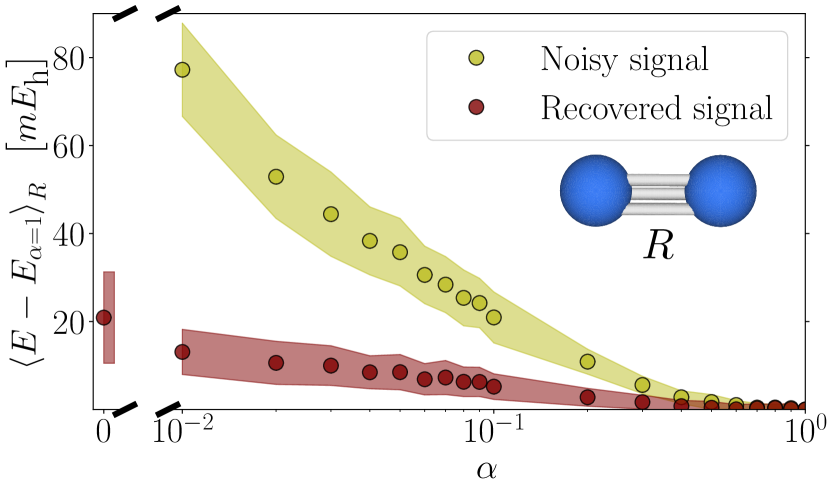
- 自洽配置恢复显著提升对噪声的鲁棒性,使从有噪声的量子样本得到可用的能量成为可能。
- 对于 N2 解离,通过恢复与子空间投影,具有适度信号的能量可以提升到接近无噪声的结果;对于更大体系,该方法仍可与经典 SCI 基准相竞争。
- 在高达77个量子比特、最多300万次电路执行的实验运行证明了在当前硬件条件下该方法的可行性。
- 该方法在所测试的体系中得到的能量与最佳经典参考(HCI)相差数十毫哈特利之内,显示出对精确多体化学的有希望的量子-经典协同效应。
- 能量方差分析证实收敛模式及其在区分如 [2Fe-2S] 与 [4Fe-4S] 等复杂簇中的多个本征态的作用。
阅读本论文
在 Nubint 阅读器中打开原文,边读边就任意段落提问。
在 Nubint 中阅读本论文本解读由 AI 根据论文原文生成,引用前请核对原文。