
[Paper Review] CHGNet: Pretrained universal neural network potential for charge-informed atomistic modeling
CHGNet is a graph neural network interatomic potential pretrained on Materials Project Trajectory Dataset to include magnetic moments as a proxy for atomic charge, enabling charge-informed MD and phase-diagram calculations for heterogeneous, valence-variable systems.
The simulation of large-scale systems with complex electron interactions remains one of the greatest challenges for the atomistic modeling of materials. Although classical force fields often fail to describe the coupling between electronic states and ionic rearrangements, the more accurate extit{ab-initio} molecular dynamics suffers from computational complexity that prevents long-time and large-scale simulations, which are essential to study many technologically relevant phenomena, such as reactions, ion migrations, phase transformations, and degradation. In this work, we present the Crystal Hamiltonian Graph neural Network (CHGNet) as a novel machine-learning interatomic potential (MLIP), using a graph-neural-network-based force field to model a universal potential energy surface. CHGNet is pretrained on the energies, forces, stresses, and magnetic moments from the Materials Project Trajectory Dataset, which consists of over 10 years of density functional theory static and relaxation trajectories of $\sim 1.5$ million inorganic structures. The explicit inclusion of magnetic moments enables CHGNet to learn and accurately represent the orbital occupancy of electrons, enhancing its capability to describe both atomic and electronic degrees of freedom. We demonstrate several applications of CHGNet in solid-state materials, including charge-informed molecular dynamics in Li$_x$MnO$_2$, the finite temperature phase diagram for Li$_x$FePO$_4$ and Li diffusion in garnet conductors. We critically analyze the significance of including charge information for capturing appropriate chemistry, and we provide new insights into ionic systems with additional electronic degrees of freedom that can not be observed by previous MLIPs.
Motivation & Objective
- Motivate the need for accurate, large-scale atomistic modeling that captures both ionic and electronic degrees of freedom.
- Develop a universal MLIP that integrates charge information via magnetic moments to regularize latent space.
- Demonstrate CHGNet on charge-transfer phenomena, phase diagrams, and ion diffusion in solid-state materials.
- Assess the impact of including charge information on capturing realistic chemistry and phase behavior.
Proposed method
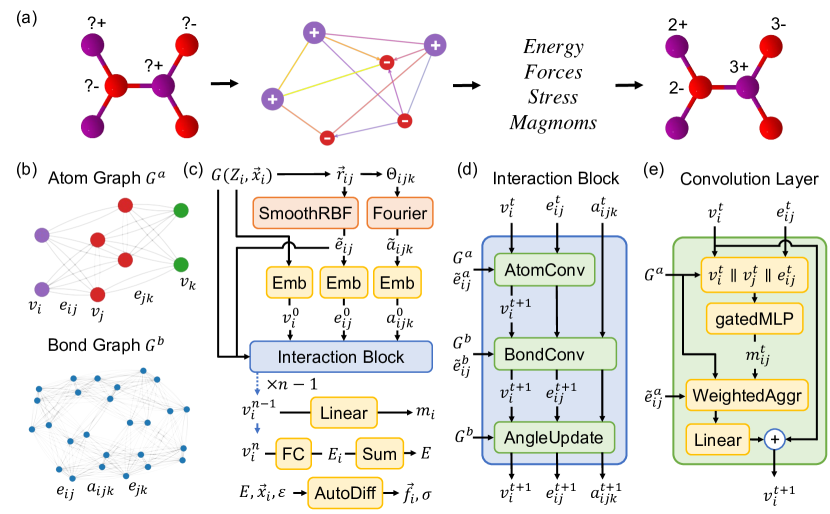
- Use a graph neural network (GNN) architecture that processes crystal structures as atom graphs with atom, bond, and angle features.
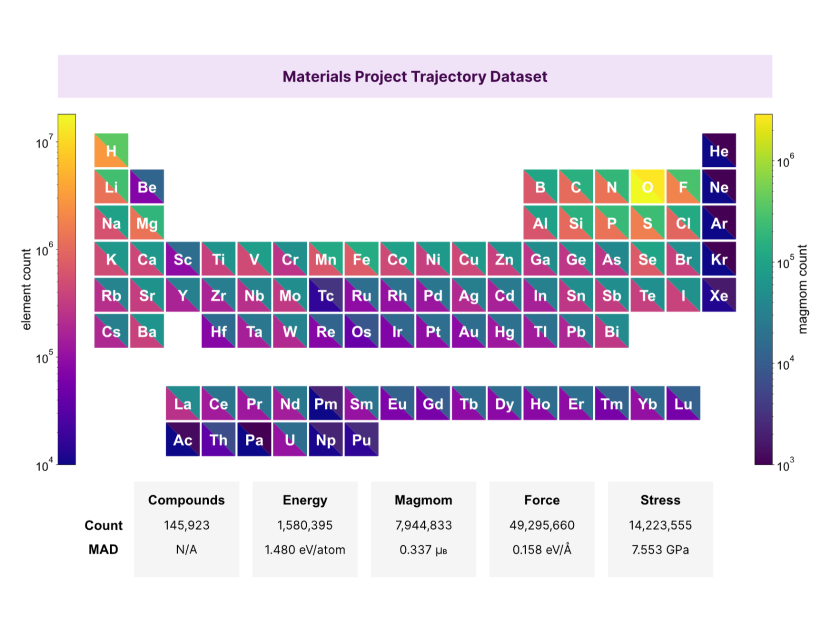
- Pretrain CHGNet on energies, forces, stresses, and magmoms from the Materials Project Trajectory Dataset (MPtrj) to learn a universal potential energy surface.
- Incorporate magnetic moments as a charge-state constraint to regularize latent space and constrain energy/force predictions.
- Construct input features via pairwise distances (r_ij) and angles (theta_ijk) with SmoothRBF and Fourier basis expansions for long-range interactions.
- Employ an interaction-block-based message passing scheme that updates atom, bond, and angle features, yielding charge-informed outputs (energy, forces, stresses, magmoms).
- Validate CHGNet on MD simulations and high-throughput stability benchmarks, and compare with DFT/AIMD references.
Experimental results
Research questions
- RQ1Can a GNN-based MLIP pretrained with magnetic moments infer atomic charge states and improve accuracy for charge-transfer phenomena?
- RQ2Does including charge information via magmoms enable reliable charge-informed MD, phase diagram calculations, and diffusion predictions across heterogeneous ionic systems?
- RQ3How does CHGNet perform on out-of-distribution materials stability tasks and in reproducing DFT/AIMD-derived properties?
- RQ4What insights into ionic systems with electronic degrees of freedom emerge when explicitly incorporating charge information into the potential?
- RQ5Is latent space regularization via magmoms critical for capturing valence-state dependent chemistry?
Key findings
- CHGNet achieves MAEs on the MPtrj test set comparable to or better when trained with magmoms (e.g., energy 30 meV/atom vs 33 meV/atom without magmoms).
- The model attains state-of-the-art performance in Matbench Discovery for stable inorganic crystal discovery among eight competing models.
- MD simulations with CHGNet reproduce room-temperature conductivities and activation energies in Li-superionic conductors within AIMD error bars and distinguish faster vs slower conductors.
- Charge constraints via magmoms enable CHGNet to distinguish valence states (e.g., Fe2+ vs Fe3+ in Li_xFePO4 and V3+/V4+ in Na4V2(PO4)3) and reveal latent-space clustering correlated with magmoms.
- CHGNet captures charge-disproportionation–driven phase transformations in LiMnO2, correlating structural evolution (XRD) with electronic state changes and showing agreement with DFT magmoms.
- Including electronic entropy via charge decoration in Li_xFePO4 phase diagrams qualitatively matches experimental phase behavior, unlike non-charge-decorated models.
Better researchstarts right now
From reading papers to final review, dramatically reduce your research time.
No credit card · Free plan available
This review was created by AI and reviewed by human editors.