
[Paper Review] Classical benchmarking of zero noise extrapolation beyond the exactly-verifiable regime
This paper benchmarks zero-noise extrapolation (ZNE) against various classical simulations of kicked Ising circuits, showing ZNE remains accurate beyond verifiable regimes and comparing multiple classical methods.
In a recent work a quantum error mitigation protocol was applied to the expectation values obtained from circuits on the IBM Eagle quantum processor with up $127$ - qubits with up to $60 \; - \; \mbox{CNOT}$ layers. To benchmark the efficacy of this quantum protocol a physically motivated quantum circuit family was considered that allowed access to exact solutions in different regimes. The family interpolated between Clifford circuits and was additionally evaluated at low depth where exact validation is practical. It was observed that for highly entangling parameter regimes the circuits are beyond the validation of matrix product state and isometric tensor network state approximation methods. Here we compare the experimental results to matrix product operator simulations of the Heisenberg evolution, find they provide a closer approximation than these pure-state methods by exploiting the closeness to Clifford circuits and limited operator growth. Recently other approximation methods have been used to simulate the full circuit up to its largest extent. We observe a discrepancy of up to $20\%$ among the different classical approaches so far, an uncertainty comparable to the bootstrapped error bars of the experiment. Based on the different approximation schemes we propose modifications to the original circuit family that challenge the particular classical methods discussed here.
Motivation & Objective
- Motivate evaluating quantum error mitigation (QEM) techniques like zero noise extrapolation (ZNE) on circuits that exceed exact classical verification regimes.
- Compare experimental ZNE results to a range of classical simulation methods that approximate Heisenberg evolution or state dynamics.
- Assess which classical approaches best reproduce ZNE-corrected observables in verifiable and beyond-verifiable regimes.
- Propose circuit and modeling extensions that challenge the classical methods and illuminate their limitations.
Proposed method
- Approximate the Heisenberg evolution of observables with matrix-product-operator (MPO) representations to simulate O(D) = (U†)D O U^D dynamics.
- Map the 2D heavy-hex lattice to a 1D chain using snake ordering and perform interleaved unitary conjugation with variational MPO compression between layers.
- Use fixed bond dimension χ to control truncation errors and compute expectation values after D steps for a given initial product state.
- Compare MPO-Heisenberg results to exact calculations, pure-state MPS dynamics, isometric tensor networks (isoTNS), BP-TNS, CPT, and smaller-device simulations.
- Analyze operator growth via operator entanglement entropy (OEE) and OTOCs to understand MPO efficacy and lightcone dynamics.
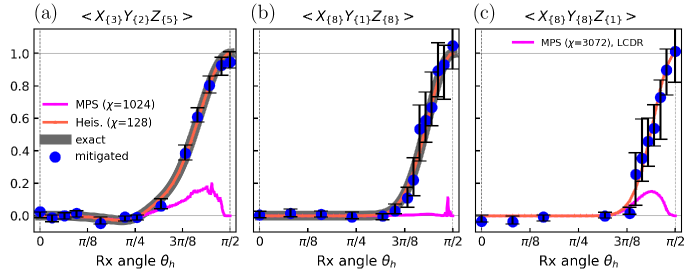
![Figure 1: Comparison of classical approximations for $\langle Z_{62}\rangle$ at Trotter depth $D=20$ against experimental ZNE results: (1) matrix-product-state (MPS) representation of the pure state within a lightcone-reduced volume [ 3 ] ; (2) extrapolation of the MPS results with respect to the es](https://ar5iv.labs.arxiv.org/html/2306.17839/assets/x1.png)
Experimental results
Research questions
- RQ1How well does ZNE reproduce exact results in regimes where classical verification is possible?
- RQ2Do alternative classical methods (MPS, MPO, BP-TNS, CPT) extend accurately beyond verifiable regimes, and how do they compare to ZNE?
- RQ3What are the limitations and scaling of MPO-based Heisenberg evolution for large-depth, high-entanglement circuits on heavy-hex lattices?
- RQ4How do circuit variants (non-Clifford gates, non-commuting gate layers) affect the performance and comparability of ZNE and classical simulations?
- RQ5Can operator-based classical simulations provide reliable benchmarks or improvements for predicting ZNE outcomes on near-term devices?
Key findings
- ZNE reproduces exact results within bootstrap error bars in regimes verifiable by classical means.
- MPS and 2D isoTNS pure-state methods struggle to reproduce observables across the full range of parameters, especially away from Clifford points.
- Heisenberg MPO evolution agrees with ZNE results across ranges of parameters beyond exact verification, up to 20 Trotter steps (60 CNOT layers).
- Different classical approaches agree within roughly 20% near certain regimes, a spread comparable to ZNE error bars, indicating remaining classical uncertainty.
- Operator growth is slower than worst-case expectations, with OEE growing quadratically in depth and OTOCs indicating lightcone-limited spreading, aiding MPO efficiency; BP-TNS shows limitations at large depths and loop-like entanglement.
Better researchstarts right now
From reading papers to final review, dramatically reduce your research time.
No credit card · Free plan available
This review was created by AI and reviewed by human editors.