
[Paper Review] Coding Versus ARQ in Fading Channels: How reliable should the PHY be?
This paper investigates the tradeoff between physical layer (PHY) coding and ARQ in Rayleigh block-fading channels, showing that optimal throughput is achieved not with high PHY reliability but with a relatively high error probability (e.g., 10% or more). The study derives the optimal packet error probability as a decreasing function of SNR and fading diversity, demonstrating that overly reliable PHY layers reduce goodput due to excessive rate reduction outweighing retransmission savings.
This paper studies the tradeoff between channel coding and ARQ (automatic repeat request) in Rayleigh block-fading channels. A heavily coded system corresponds to a low transmission rate with few ARQ re-transmissions, whereas lighter coding corresponds to a higher transmitted rate but more re-transmissions. The optimum error probability, where optimum refers to the maximization of the average successful throughput, is derived and is shown to be a decreasing function of the average signal-to-noise ratio and of the channel diversity order. A general conclusion of the work is that the optimum error probability is quite large (e.g., 10% or larger) for reasonable channel parameters, and that operating at a very small error probability can lead to a significantly reduced throughput. This conclusion holds even when a number of practical ARQ considerations, such as delay constraints and acknowledgement feedback errors, are taken into account.
Motivation & Objective
- To determine the optimal level of physical layer reliability (i.e., packet error probability) that maximizes average successful throughput in Rayleigh block-fading channels.
- To analyze the tradeoff between high-rate transmission with frequent ARQ retransmissions and low-rate, heavily coded transmission with few retransmissions.
- To evaluate how practical constraints—such as limited retransmission rounds and unreliable feedback—affect the optimal error probability.
- To challenge the conventional assumption that high PHY reliability is always beneficial, showing that it can significantly reduce goodput.
- To provide a general framework for understanding how optimal PHY reliability depends on average SNR and channel diversity order.
Proposed method
- Models a Rayleigh block-fading channel where the channel gain remains constant over L blocks (diversity order L), with i.i.d. fading across blocks.
- Uses the mutual information outage probability to approximate the packet error probability ε(SNR, L, R) as the probability that the average mutual information per block falls below the transmission rate R.
- Replaces the rate R with Rε to explicitly express the relationship between transmission rate and error probability for fixed SNR and L.
- Derives the average goodput as the product of the transmission rate and the success probability (1−ε), and optimizes this quantity over ε.
- Analyzes the concavity of the goodput function to prove the existence and uniqueness of the optimal error probability ε*.
- Extends the analysis to practical ARQ constraints, including a maximum number of retransmissions and unreliable feedback (ACK/NACK errors), deriving the expected number of ARQ rounds under these conditions.
Experimental results
Research questions
- RQ1What is the optimal packet error probability at the physical layer that maximizes average successful throughput in a Rayleigh block-fading channel?
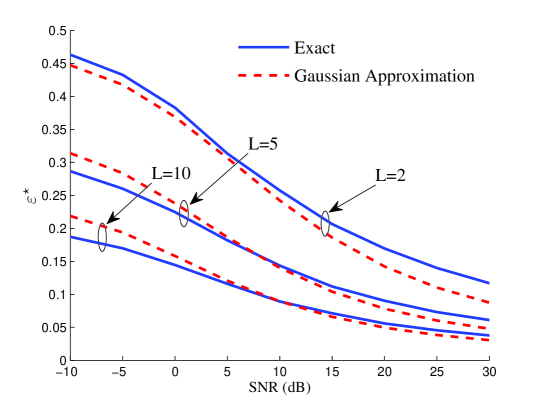
- RQ2How does the optimal error probability depend on average SNR and channel diversity order (L)?
- RQ3Does the optimal strategy require high physical layer reliability, or is a relatively high error probability (e.g., 10%) sufficient?
- RQ4How do practical ARQ constraints—such as limited retransmission rounds and feedback errors—affect the optimal choice of PHY reliability?
- RQ5Can traditional diversity metrics, which focus on error probability decay, still be valid when ARQ is used for error control?
Key findings
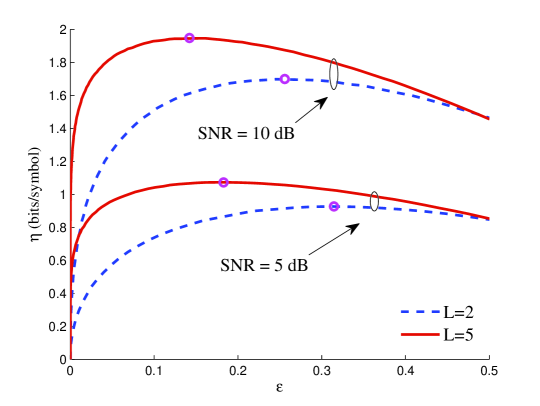
- The optimal packet error probability is a decreasing function of both average SNR and channel diversity order L, but remains relatively high (e.g., 10% or more) for typical system parameters.
- Operating with a high error probability (e.g., 10%) leads to near-optimal goodput, while striving for very low error probabilities (e.g., 1%) can significantly reduce throughput due to excessive rate reduction.
- The goodput function is strictly concave in the error probability ε, ensuring a unique optimal point, and the optimal ε increases with the retransmission cost (modeled via κ).
- Even under practical constraints such as a maximum of d retransmissions and unreliable feedback (with error probability ε_fb), the optimal error probability remains relatively high, indicating that unreliable PHY is still preferred.
- The study shows that traditional diversity metrics, which emphasize rapid error decay, may be misleading in ARQ-aided systems, as they do not account for the tradeoff between rate and retransmissions.
- The results hold even when feedback errors are considered, confirming that the conclusion is robust to realistic system imperfections.
Better researchstarts right now
From reading papers to final review, dramatically reduce your research time.
No credit card · Free plan available
This review was created by AI and reviewed by human editors.