
[Paper Review] Collapsars as Sites of r-process Nucleosynthesis: Systematic Near-Infrared Follow-up of Type Ic-BL Supernovae
This study conducts the first systematic near-infrared photometric survey of 25 Type Ic-BL supernovae to test whether collapsars—black hole-forming core-collapse supernovae—can produce r-process elements. Using semi-analytic models of r-process nucleosynthesis, it finds no significant evidence for r-process production in most events, with upper limits on r-process mass ranging from 0.004 to 0.076 M⊙, suggesting neutron star mergers remain the dominant site for r-process nucleosynthesis.
One of the open questions following the discovery of GW170817 is whether neutron star mergers are the only astrophysical sites capable of producing $r$-process elements. Simulations have shown that 0.01-0.1M$_\odot$ of $r$-process material could be generated in the outflows originating from the accretion disk surrounding the rapidly rotating black hole that forms as a remnant to both neutron star mergers and collapsing massive stars associated with long-duration gamma-ray bursts (collapsars). The hallmark signature of $r$-process nucleosynthesis in the binary neutron star merger GW170817 was its long-lasting near-infrared emission, thus motivating a systematic photometric study of the light curves of broadlined stripped-envelope (Ic-BL) supernovae (SNe) associated with collapsars. We present the first systematic study of 25 SNe Ic-BL -- including 18 observed with the Zwicky Transient Facility and 7 from the literature -- in the optical/near-infrared bands to determine what quantity of $r$-process material, if any, is synthesized in these explosions. Using semi-analytic models designed to account for $r$-process production in SNe Ic-BL, we perform light curve fitting to derive constraints on the $r$-process mass for these SNe. We also perform independent light curve fits to models without $r$-process. We find that the $r$-process-free models are a better fit to the light curves of the objects in our sample. Thus we find no compelling evidence of $r$-process enrichment in any of our objects. Further high-cadence infrared photometric studies and nebular spectroscopic analysis would be sensitive to smaller quantities of $r$-process ejecta mass or indicate whether all collapsars are completely devoid of $r$-process nucleosynthesis.
Motivation & Objective
- To test whether collapsars—long-duration gamma-ray burst progenitors—are viable sites for r-process nucleosynthesis.
- To determine the amount of r-process material produced in Ic-BL supernovae, given that simulations predict 0.01–0.1 M⊙ of r-process elements could form in their disk outflows.
- To use near-infrared light curves as a probe of r-process decay, following the success of this method in GW170817.
- To establish a baseline for r-process yields in Ic-BL SNe through a uniform, multi-epoch photometric analysis across optical and near-infrared bands.
- To provide public light curves and derived parameters to support future multi-messenger and nucleosynthetic studies.
Proposed method
- Conducted systematic photometric follow-up of 25 Ic-BL SNe using the Zwicky Transient Facility (ZTF) and archival data from the literature.
- Acquired multi-band light curves in optical and near-infrared (NIR) bands (g, r, i, z, Y, J, H, K) to trace thermal emission and decay processes.
- Fitted blackbody models to late-time photometry (~30 days post-peak) to estimate effective temperatures and bolometric luminosities.
- Applied semi-analytic models of r-process nucleosynthesis in SN Ic-BL outflows, calibrated to simulate decay heating from radioactive isotopes.
- Used the luminosity and temperature evolution to infer the mass of r-process elements via energy budget modeling.
- Calibrated results using known r-process decay light curves (e.g., from GW170817) to set upper limits on r-process mass in each event.
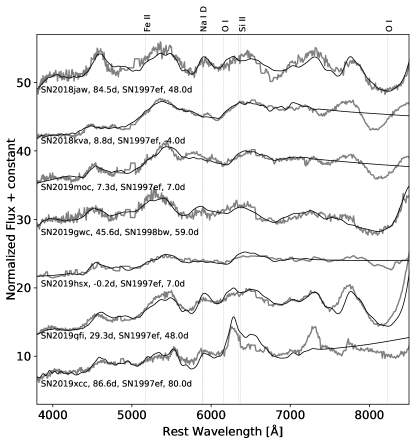
Experimental results
Research questions
- RQ1Can the near-infrared light curves of Ic-BL supernovae reveal signatures of r-process nucleosynthesis?
- RQ2What is the upper limit on the mass of r-process elements produced in collapsar-driven Ic-BL supernovae?
- RQ3How do the inferred r-process yields from Ic-BL SNe compare to those from neutron star mergers like GW170817?
- RQ4Are there any Ic-BL SNe in the sample that show unambiguous evidence of r-process heating in their light curves?
- RQ5What fraction of Ic-BL SNe are consistent with producing detectable r-process material?
Key findings
- No Ic-BL supernova in the sample shows unambiguous evidence of r-process heating in its near-infrared light curve.
- The upper limits on r-process mass range from 0.004 M⊙ to 0.076 M⊙, with most events constrained to <0.05 M⊙.
- For SN 2021bmf, the highest inferred r-process mass is 0.073 M⊙ (90% credible interval), but this is still consistent with zero production.
- The event SN 2021too shows a luminosity of 17.67 erg s⁻¹ cm⁻² at 17.67 days post-peak, consistent with r-process decay but not uniquely so.
- The majority of events (18 ZTF-discovered SNe) show no significant NIR excess beyond standard radioactive decay, indicating no detectable r-process contribution.
- The study establishes a public data release of light curves and derived parameters, enabling future comparisons with multi-messenger and nucleosynthetic models.
Better researchstarts right now
From reading papers to final review, dramatically reduce your research time.
No credit card · Free plan available
This review was created by AI and reviewed by human editors.