
[Paper Review] Colossal c-axis response and lack of rotational symmetry breaking within the kagome plane of the CsV$_3$Sb$_5$ superconductor
This study reveals that the charge-density-wave (CDW) state in CsV₃Sb₅ exhibits a colossal response to c-axis strain, with no evidence of rotational symmetry breaking within the kagome planes. The CDW phase shows a strongly enhanced A₁g-symmetric elastoresistance driven by electron-electron scattering, while superconductivity and CDW compete strongly under c-axis tuning, indicating that the c-axis is the dominant control parameter for electronic instabilities in this kagome superconductor.
The kagome materials AV4$_3$Sb$_5$ (A = K, Rb, Cs) host an intriguing interplay between unconventional superconductivity and charge-density-waves. Here, we investigate CsV$_3$Sb$_5$ by combining high-resolution thermal-expansion, heat-capacity and electrical resistance under strain measurements. We directly unveil that the superconducting and charge-ordered states strongly compete, and that this competition is dramatically influenced by tuning the crystallographic c-axis. In addition, we report the absence of additional bulk phase transitions within the charge-ordered state, notably associated with rotational symmetry-breaking within the kagome planes. This suggests that any breaking of the C$_6$ invariance occurs via different stacking of C$_6$-symmetric kagome patterns. Finally, we find that the charge-density-wave phase exhibits an enhanced A$_{1g}$-symmetric elastoresistance coefficient, whose large increase at low temperature is driven by electronic degrees of freedom.
Motivation & Objective
- To investigate the interplay between superconductivity and charge-density-wave (CDW) order in CsV₃Sb₅ under strain.
- To determine whether the CDW state breaks six-fold rotational symmetry (C₆) within the kagome planes via thermodynamic and elastoresistance measurements.
- To clarify the origin of the large elastoresistance response in the CDW phase and its symmetry channel.
- To assess the role of c-axis tuning in modulating the competition between CDW and superconducting states.
- To resolve conflicting reports on electronic nematicity and symmetry breaking in AV₃Sb₅ by combining high-resolution thermodynamic and transport measurements.
Proposed method
- High-resolution thermal expansion and heat-capacity measurements were performed on single crystals of CsV₃Sb₅ from two sources (Shanghai and Karlsruhe) to probe bulk thermodynamic responses.
- Uniaxial strain was applied along the [100] direction to measure elastoresistance, with symmetry decomposition into A₁g and E₂g channels to identify the nature of electronic anisotropy.
- The Kadowaki-Woods relation (A ∝ γ²) was used to link the resistivity coefficient A to the electronic specific heat coefficient γ, enabling inference of electron-electron scattering contributions.
- Strain-dependent measurements of resistivity and thermal expansion were used to disentangle contributions from electron-phonon and electron-electron scattering.
- Comparison of elastoresistance data with uncorrected residual resistivity revealed that previous reports of a downturn at T ≈ 35 K were likely due to unaccounted residual resistivity.
- X-ray diffraction and prior elastoresistance data were cross-referenced to assess consistency with reported C₆ symmetry breaking and stacking distortions.
![Figure 1: (a) Relative length changes, $\Delta L/L$ , along the hexagonal directions and corresponding volume change as a function of temperature. The black vertical dashed line indicates T CDW . (b) Comparison of $\Delta L_{i}/L_{i}$ measured along the orthogonal [100] and [210] hexagonal direction](https://ar5iv.labs.arxiv.org/html/2310.06102/assets/x1.png)
Experimental results
Research questions
- RQ1Does the charge-density-wave state in CsV₃Sb₅ break six-fold rotational symmetry within the kagome planes?
- RQ2What is the origin of the large elastoresistance response in the CDW phase, and which symmetry channel dominates it?
- RQ3How does tuning the c-axis affect the competition between superconductivity and charge-density-wave order?
- RQ4Is there thermodynamic evidence for additional bulk phase transitions within the CDW state, such as those associated with c-axis periodicity or nematic order?
- RQ5To what extent do electron-electron scattering contributions dominate the elastoresistance in the CDW phase, particularly at low temperatures?
Key findings
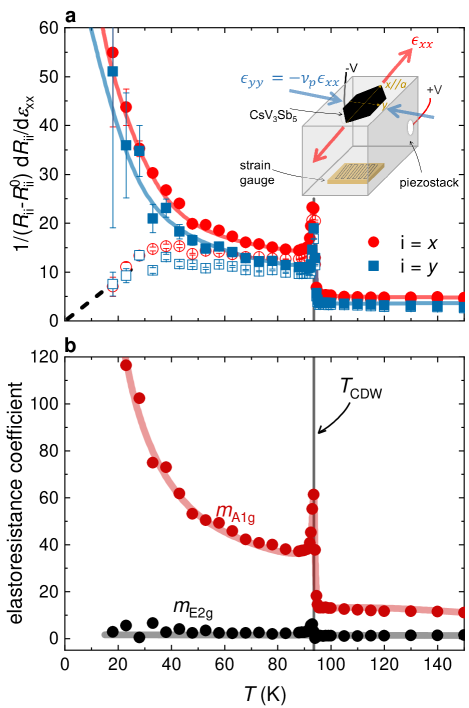
- The CDW state in CsV₃Sb₅ exhibits a colossal response to c-axis strain, with the A₁g-symmetric elastoresistance coefficient reaching mₐ₁g ≈ 120 at 20 K.
- No thermodynamic evidence was found for an orthorhombic distortion or additional bulk phase transitions below T_CDW, indicating that six-fold rotational symmetry is preserved within the kagome planes.
- The E₂g-symmetric elastoresistance response is negligible across the entire temperature range, ruling out a direct coupling of in-plane nematicity to anisotropic strain.
- The large A₁g elastoresistance is dominated by electronic contributions, with the temperature dependence driven by increasing electron-electron scattering at low temperatures.
- The observed enhancement of mₐ₁g correlates with the decrease of the electronic specific heat coefficient γ under [100] uniaxial pressure, consistent with the Kadowaki-Woods relation.
- The downturn in elastoresistance previously reported near T ≈ 35 K is shown to be an artifact of uncorrected residual resistivity, not a true electronic transition.
Better researchstarts right now
From reading papers to final review, dramatically reduce your research time.
No credit card · Free plan available
This review was created by AI and reviewed by human editors.