
[Paper Review] Combatting deepfakes: Policies to address national security threats and rights violations
This paper proposes a comprehensive, supply chain-wide regulatory framework to combat deepfakes by holding model developers, providers, and compute platforms accountable for preventing deepfake creation and proliferation. It advocates for liability based on negligence, requiring technical safeguards against non-consensual pornography, fraud, and illegal content, with the key outcome being systemic prevention across all stages of the deepfake lifecycle.
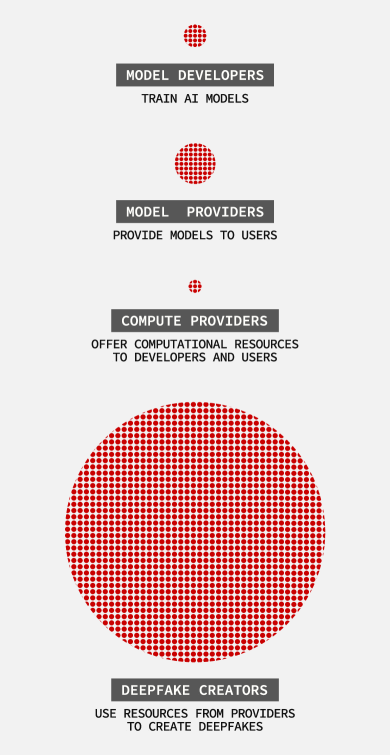
This paper provides policy recommendations to address threats from deepfakes. First, we provide background information about deepfakes and review the harms they pose. We describe how deepfakes are currently used to proliferate sexual abuse material, commit fraud, manipulate voter behavior, and pose threats to national security. Second, we review previous legislative proposals designed to address deepfakes. Third, we present a comprehensive policy proposal that focuses on addressing multiple parts of the deepfake supply chain. The deepfake supply chain begins with a small number of model developers, model providers, and compute providers, and it expands to include billions of potential deepfake creators. We describe this supply chain in greater detail and describe how entities at each step of the supply chain ought to take reasonable measures to prevent the creation and proliferation of deepfakes. Finally, we address potential counterpoints of our proposal. Overall, deepfakes will present increasingly severe threats to global security and individual liberties. To address these threats, we call on policymakers to enact legislation that addresses multiple parts of the deepfake supply chain.
Motivation & Objective
- Address the growing threat of deepfakes to individual rights, national security, and democratic institutions.
- Identify systemic vulnerabilities in the deepfake supply chain, from model developers to end users.
- Propose enforceable legislative measures that extend liability beyond end creators to upstream providers.
- Counter the limitations of technical solutions like watermarking by advocating for regulatory intervention.
- Provide actionable policy blueprints for governments to prevent deepfake harms before they proliferate.
Proposed method
- Establish a negligence-based liability model for model developers, requiring them to implement technical controls that prevent deepfake generation.
- Mandate that model developers ensure training data is free of illegal content, such as child sexual abuse material.
- Require model providers and compute platforms to monitor user behavior and detect attempts to generate deepfakes.
- Implement access controls that restrict malicious users from using AI tools to create harmful content.
- Integrate the proposed framework with existing legal regimes, such as the UK’s Online Safety Act, while expanding responsibility upstream.
- Advocate for legislation that criminalizes deepfake creation and dissemination, with remedies for victims.
Experimental results
Research questions
- RQ1How can regulatory frameworks effectively reduce deepfake proliferation across the entire AI supply chain?
- RQ2What technical and legal measures can model developers implement to prevent their models from being used to generate non-consensual deepfake pornography?
- RQ3Why is watermarking insufficient as a primary solution to deepfake harms, and what are its technical limitations?
- RQ4How can liability be assigned to upstream actors like compute providers and model providers to prevent deepfake creation?
- RQ5What policy mechanisms can balance innovation in AI with the need to protect individual rights and national security?
Key findings
- Deepfake sexual content increased by over 400% between 2022 and 2023, with 99% of victims being women and 99.6% of child sexual abuse deepfakes involving females.
- Deepfake fraud incidents rose by 3,000% during the same period, highlighting a growing threat to financial and corporate security.
- Watermarking is not a viable standalone solution, as research shows watermarks can be trivially removed by determined adversaries.
- Existing laws in the US lack federal legislation specifically targeting deepfakes, and current laws are often inadequate to address non-consensual deepfake pornography.
- The Department of Defense and Department of Homeland Security have both identified deepfakes as major threats to national security and cyber infrastructure.
- A supply chain approach—holding developers, providers, and platforms to standards of reasonable care—offers a more effective and enforceable path than targeting only end users.
Better researchstarts right now
From reading papers to final review, dramatically reduce your research time.
No credit card · Free plan available
This review was created by AI and reviewed by human editors.