
[Paper Review] Confirmation and refutation of very luminous galaxies in the early universe
JWST/NIRSpec spectroscopy confirms two z>11 galaxies and refutes a z~16 candidate by revealing a z=4.9 interloper; highlights need for spectroscopic validation of photometric high-z candidates and implications for early galaxy formation.
During the first 500 million years of cosmic history, the first stars and galaxies formed, seeding the Universe with heavy elements and eventually reionizing the intergalactic medium. Observations with JWST have uncovered a surprisingly high abundance of candidates for early star-forming galaxies, with distances (redshifts, $z$), estimated from multi-band photometry, as large as $z\approx 16$, far beyond pre-JWST limits. While generally robust, such photometric redshifts can suffer from degeneracies and occasionally catastrophic errors. Spectroscopic measurement is required to validate these sources and to reliably quantify physical properties that can constrain galaxy formation models and cosmology. Here we present JWST spectroscopy that confirms redshifts for two very luminous galaxies with $z > 11$, but also demonstrates that another candidate with suggested $z\approx 16$ instead has $z = 4.9$, with an unusual combination of nebular line emission and dust reddening that mimics the colors expected for much more distant objects. These results reinforce evidence for the early, rapid formation of remarkably luminous galaxies, while also highlighting the necessity of spectroscopic verification. The large abundance of bright, early galaxies may indicate shortcomings in current galaxy formation models, or deviation from physical properties (such as the stellar initial mass function) that are generally believed to hold at later times.
Motivation & Objective
- Validate photometric high-redshift galaxy candidates with JWST spectroscopy.
- Measure spectroscopic redshifts and key emission lines to confirm or refute proposed early-universe sources.
- Infer physical properties of confirmed z>11 galaxies and compare with theoretical expectations.
Proposed method
- JWST NIRSpec prism spectroscopy for low-resolution, wide-wavelength coverage (0.6–5.3 μm) to detect continuum breaks and emission lines.
- Identify Lyα breaks and emission lines such as [O II] to determine redshifts.
- Photometric reduction and spectroscopy flux calibration cross-checked with NIRCam photometry.
- Model stellar populations jointly with spectra and photometry to derive stellar mass, SFR, A_V, and sSFR.
- Use NOEMA 1.1 mm observations to assess associated dust emission at the CEERS-93316 location (no detection at target position).
- Compare observed properties with previous literature to place results in context of early galaxy formation.
Experimental results
Research questions
- RQ1Do JWST photometric high-z candidates at z>11 represent real galaxies after spectroscopic confirmation?
- RQ2What are the spectroscopic redshifts of the bright z>11 candidates (Maisie’s Galaxy, CEERS2_588, CEERS-93316) and how do these compare with their photometric estimates?
- RQ3What are the physical properties (stellar mass, SFR, dust attenuation) of spectroscopically confirmed z>11 galaxies and how do they inform early galaxy formation models?
- RQ4Can extreme-band photometric colors at z>9 be mimicked by lower-redshift dusty or line-emission galaxies, and how can spectroscopy distinguish them?
- RQ5What does the prevalence of bright galaxies at z>>10 imply for galaxy formation theories and IMF assumptions?
Key findings
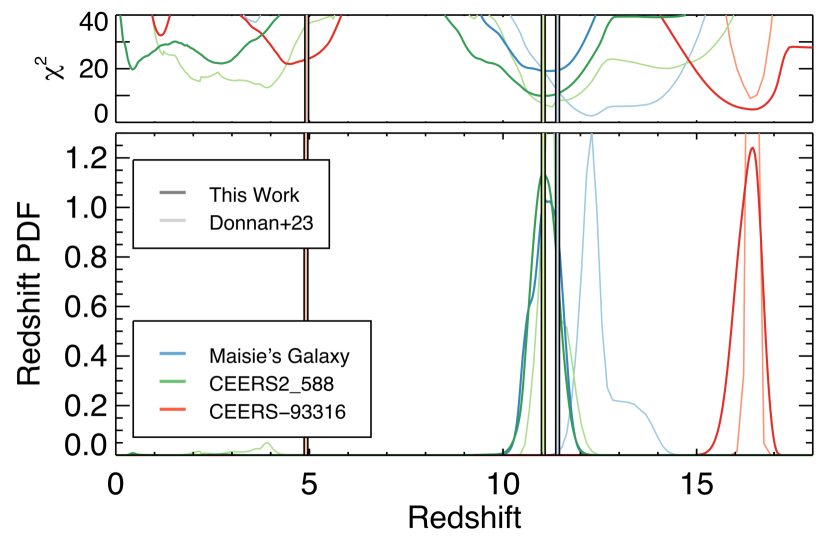
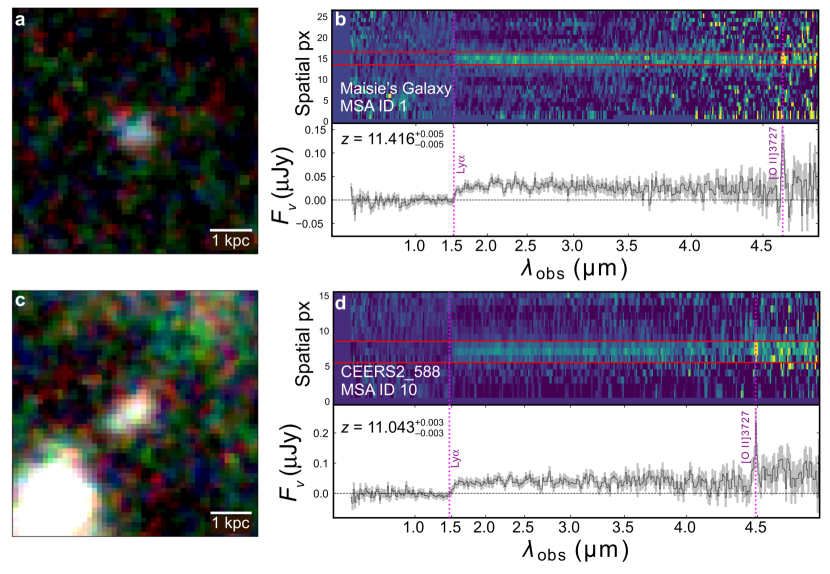
- Two galaxies have confirmed spectroscopic redshifts z=11.416±0.005 and z=11.043±0.003 (Maisie’s Galaxy and CEERS2_588).
- A third candidate, CEERS-93316, previously thought to be at z~16, is spectroscopically at z=4.912±0.001, with strong nebular lines and dust reddening that mimic higher-z colors.
- Maisie’s Galaxy and CEERS2_588 are the most UV-luminous known with z>11, having M_UV = −20.1 and −20.3 respectively; both show Lyα breaks and weak [O II] detection.
- CEERS-93316 exhibits strong Hα, [NII], and [O III] lines at z=4.912, with large Balmer decrement (Hα/Hβ=5.2±0.5) indicating nebular reddening (E(B−V)=0.60±0.10).
- NOEMA 1.1 mm observations yield no 1.1 mm continuum detection at CEERS-93316, but reveal a nearby z~4.9 galaxy as the likely source of previous submillimeter detection.
- Stellar population modeling (fixing spectroscopic redshifts) for the confirmed z>11 galaxies yields M_star≈10^8.6–10^8.7 M_sun, low A_V≈0.1–0.2 mag, SFR≈2–10 M_sun/yr, and sSFR≈−8.3 to −7.7 yr^−1, consistent with other z>11 galaxies.
Better researchstarts right now
From reading papers to final review, dramatically reduce your research time.
No credit card · Free plan available
This review was created by AI and reviewed by human editors.