
[Paper Review] Constraints on the Faint End of the Galaxy Stellar Mass Function at z ~ 4-8 from Deep JWST Data
This study uses deep JWST data from the HUDF and UKIDSS UDS fields to derive the first robust individual stellar mass estimates for high-redshift galaxies down to $\sim10^8\,\mathrm{M_\odot}$ at $z \simeq 4$--$8$. It reveals a steepening faint-end slope of the galaxy stellar mass function ($\alpha = -1.98 \pm 0.14$ at $z \simeq 7$) and significant evolution in normalization, with a 130-fold increase in density from $z \simeq 7$ to $z \simeq 4$, using a novel Eddington bias correction that accounts for mass- and redshift-dependent error skewness.
We analyze a sample of 3300 galaxies between redshifts z~3.5 and z~8.5 selected from JWST images in the Hubble Ultra Deep Field (HUDF) and UKIDSS Ultra Deep Survey field, including objects with stellar masses as low as ~ 10^8 Msun up to z~8. The depth and wavelength coverage of the JWST data allow us, for the first time, to derive robust stellar masses for such high-z, low stellar-mass galaxies on an individual basis. We compute the galaxy stellar mass function (GSMF), after complementing our sample with ancillary data from CANDELS to constrain the GMSF at high stellar masses (M > M*). Our results show a steepening of the low stellar-mass end slope (a) with redshift, with a = -1.61 (+/-0.05) at z~4 and a = -1.98 (+/-0.14) at z~7. We also observe an evolution of the normalization phi* from z~7 to z~4, with phi*(z~4)/phi*(z~7)= 130 (+210/-50). Our study incorporates a novel method for the estimation of the Eddington bias that takes into account its possible dependence both on stellar mass and redshift, while allowing for skewness in the error distribution. We finally compute the resulting cosmic stellar mass density and find a flatter evolution with redshift than previous studies.
Motivation & Objective
- To measure the galaxy stellar mass function (GSMF) at high redshift ($z \simeq 4$--$8$) with unprecedented depth and accuracy for low-mass galaxies.
- To overcome the limitations of previous surveys by deriving individual stellar mass estimates for galaxies as faint as $\sim10^8\,\mathrm{M_\odot}$ at $z \simeq 8$ using JWST's deep mid-infrared coverage.
- To develop and apply a novel Eddington bias correction method that accounts for both stellar mass and redshift dependence in photometric error distributions, including skewness.
- To constrain the evolution of the GSMF's faint-end slope ($\alpha$) and normalization ($\phi^*$) across cosmic time, providing critical tests for galaxy formation models.
- To compute the cosmic stellar mass density evolution from $z \simeq 4$ to $z \simeq 8$, resolving discrepancies in prior studies.
Proposed method
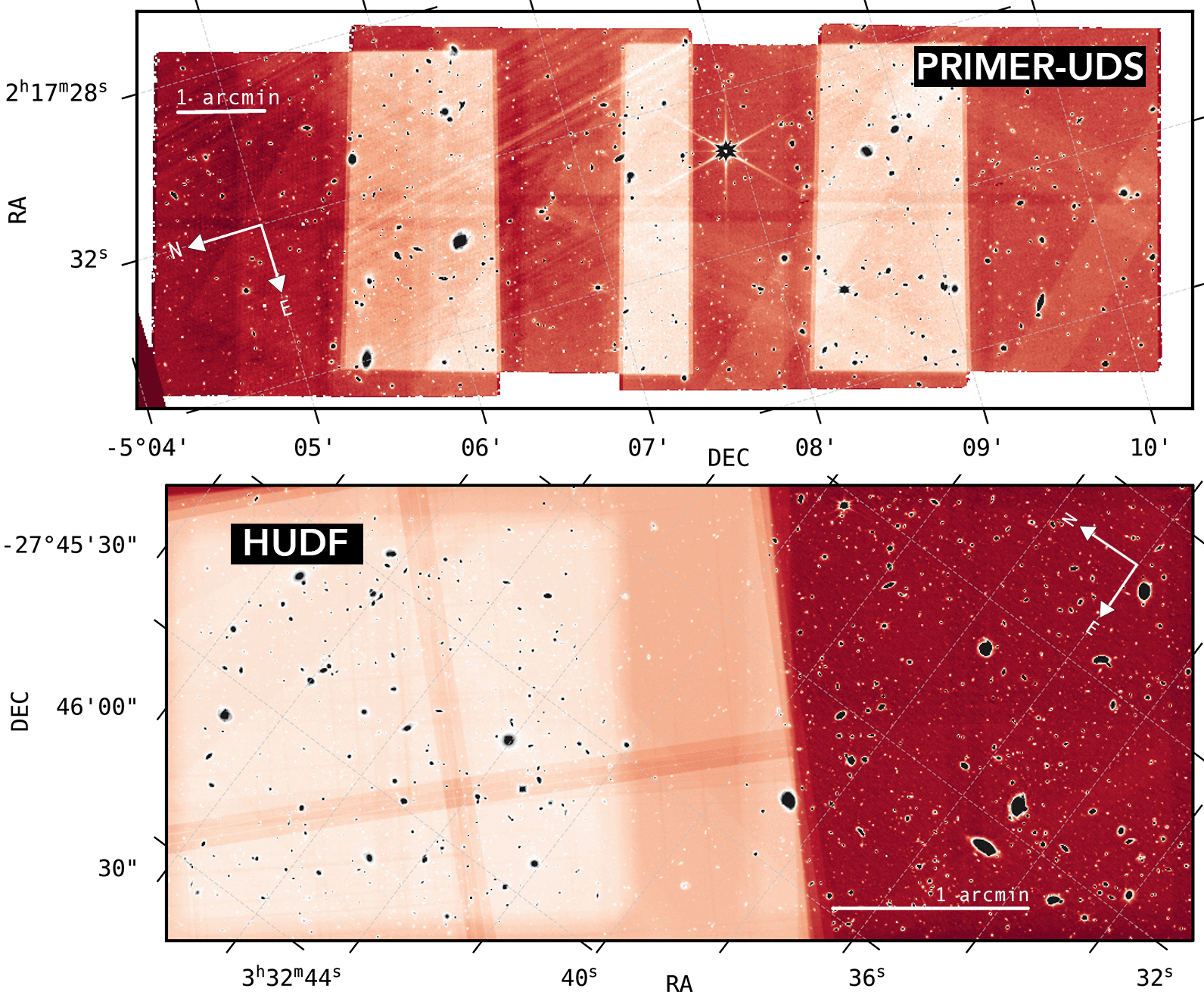
- The authors analyze a sample of 3,300 galaxies from JWST imaging in the HUDF and UKIDSS UDS fields, covering $3.5 \leq z \leq 8.5$ and stellar masses down to $\sim10^8\,\mathrm{M_\odot}$.
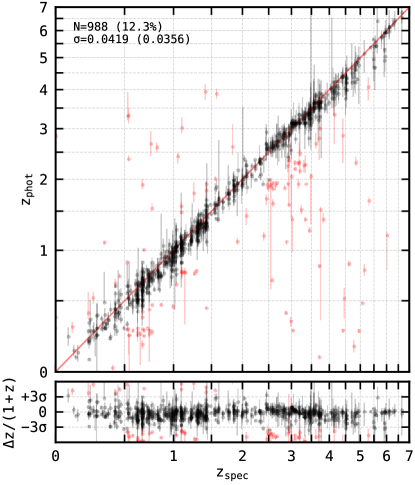
- Stellar masses are derived using SED fitting with LePHARE, incorporating photometry from near- to mid-infrared wavelengths enabled by JWST.
- A novel Eddington bias correction is applied using a convolution kernel composed of a Gaussian multiplied by a Student-T distribution, allowing for asymmetric, mass- and redshift-dependent error distributions.
- The kernel is fitted to error distributions derived from 30 realizations of photometry with randomized uncertainties, capturing skewness and scatter evolution with mass and redshift.
- The GSMF is modeled as a Schechter function, with $\alpha$, $M^*$, and $\phi^*$ derived after correcting for Eddington bias and complemented with CANDELS data for high-mass constraints.
- The cosmic stellar mass density is computed from the corrected GSMF, enabling comparison with previous studies and assessing redshift evolution.
Experimental results
Research questions
- RQ1What is the shape of the galaxy stellar mass function (GSMF) at the faint end for galaxies at $z \simeq 4$--$8$, particularly for those with $M \lesssim 10^8\,\mathrm{M_\odot}$?
- RQ2How does the faint-end slope ($\alpha$) of the GSMF evolve from $z \simeq 7$ to $z \simeq 4$, and what does this imply for early galaxy assembly?
- RQ3How does the normalization ($\phi^*$) of the GSMF evolve with redshift, and what is the implied evolution in cosmic stellar mass density?
- RQ4To what extent do photometric uncertainties and their asymmetries (skewness) affect the observed GSMF, and how can this be corrected robustly?
- RQ5How does the inclusion of mass- and redshift-dependent error distributions improve the accuracy of Eddington bias correction compared to standard methods?
Key findings
- The faint-end slope of the GSMF steepens significantly with increasing redshift, with $\alpha = -1.61 \pm 0.05$ at $z \simeq 4$ and $\alpha = -1.98 \pm 0.14$ at $z \simeq 7$.
- The normalization $\phi^*$ increases by a factor of $130^{+210}_{-50}$ from $z \simeq 7$ to $z \simeq 4$, indicating a dramatic rise in the number density of low-mass galaxies at earlier times.
- The Eddington bias correction method developed in this work accounts for non-symmetric, mass- and redshift-dependent error distributions, improving accuracy over standard symmetric approximations.
- The error distributions for stellar masses are skewed toward lower masses, especially in shallower fields like PRIMER-UDS, and this skewness decreases in deeper fields like HUDF.
- The cosmic stellar mass density evolves more weakly with redshift than previously reported, suggesting a flatter evolution than in earlier studies that did not account for proper bias corrections.
- The combination of HUDF and PRIMER-UDS fields results in less skewed error distributions than either field alone, highlighting the benefit of combining deep datasets.
Better researchstarts right now
From reading papers to final review, dramatically reduce your research time.
No credit card · Free plan available
This review was created by AI and reviewed by human editors.