
[Paper Review] Construction of perfect tensors using biunimodular vectors
This paper presents a novel analytical and numerical construction of perfect tensors and dual unitary gates in local dimension six—specifically, AME(4,6) states—using biunimodular vectors, which are unimodular 2D arrays whose discrete Fourier transforms are also unimodular. The method yields perfect tensors realizable as controlled unitary circuits, resolving the long-standing open problem of AME(4,6) existence beyond code-based or graph-state constructions.
Dual unitary gates are highly non-local two-qudit unitary gates that have been studied extensively in quantum many-body physics and quantum information in the recent past. A special class of dual unitary gates consists of rank-four perfect tensors that are equivalent to highly entangled multipartite pure states called absolutely maximally entangled (AME) states. In this work, numerical and analytical constructions of dual unitary gates and perfect tensors that are diagonal in a special maximally entangled basis are presented. The main ingredient in our construction is a phase-valued (unimodular) two-dimensional array whose discrete Fourier transform is also unimodular. We obtain perfect tensors for several local Hilbert space dimensions, particularly, in dimension six. A perfect tensor in local dimension six is equivalent to an AME state of four qudits, denoted as AME(4,6). Such a state cannot be constructed from existing constructions of AME states based on error-correcting codes and graph states. An explicit construction of AME(4,6) states is provided in this work using two-qudit controlled and single-qudit gates making it feasible to generate such states experimentally.
Motivation & Objective
- To resolve the open problem of the existence of AME(4,6) states, which had resisted prior constructions based on error-correcting codes, combinatorial designs, and graph states.
- To develop a new method for constructing perfect tensors and dual unitary gates that are diagonal in a maximally entangled basis, particularly for local dimension d=6.
- To provide an explicit, circuit-friendly construction of perfect tensors in dimension six using biunimodular vectors and controlled unitary operations.
- To explore the structure of biunimodular vectors in even dimensions, especially d=6, where factorizable solutions fail.
- To establish a connection between biunimodular vectors and 2-unitary complex Hadamard matrices of size 36, a previously unachieved construction.
Proposed method
- Leverages biunimodular vectors—2D unimodular arrays with unimodular discrete Fourier transforms—as the core ingredient for constructing perfect tensors.
- Constructs dual unitary gates as unitary operators diagonal in a Weyl-Heisenberg maximally entangled basis, parameterized by a biunimodular vector Λ.
- Employs a circuit decomposition involving the Fourier gate F₆, a generalized CNOT (controlled permutation) gate P, and a diagonal unitary D(Λ), leading to the form 𝒰(Λ) = P(F₆⊗I)D(Λ)(F₆†⊗I)Pᵀ.
- Introduces a symmetric variant 𝒰′(Λ) = P(F₆⊗I)D(Λ)(F₆⊗I)P for simpler quantum circuit implementation, though it loses diagonalizability in the maximally entangled basis.
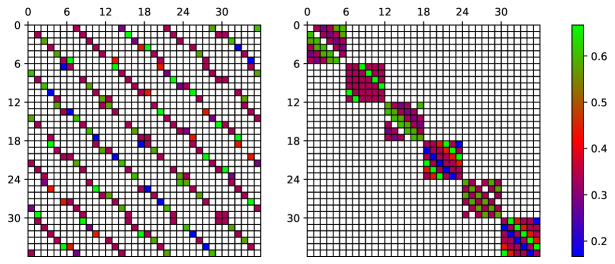
- Derives 2-unitary complex Hadamard matrices of size 36 via conjugation: 𝒰_CHM(Λ) = (F₆⊗I)𝒰(Λ)(F₆†⊗I), achieving 2-unitarity where prior constructions failed.
- Uses numerical and analytical techniques to verify that no factorizable biunimodular vectors of length 6 lead to perfect tensors in d=6, confirming the non-triviality of the solution.
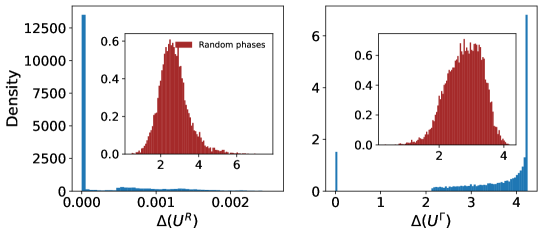
Experimental results
Research questions
- RQ1Can perfect tensors in local dimension six, equivalent to AME(4,6) states, be constructed using biunimodular vectors when existing code-based and combinatorial methods fail?
- RQ2What is the role of biunimodular vectors in generating dual unitary gates that are diagonal in a maximally entangled basis?
- RQ3Why do factorizable biunimodular vectors fail to yield perfect tensors in even dimensions like d=6, despite working in odd dimensions?
- RQ4Can 2-unitary complex Hadamard matrices of size 36 be explicitly constructed, and do they arise from biunimodular vectors?
- RQ5Is there a structural correspondence between biunimodular arrays and difference sets in abelian groups, generalizing known results for binary sequences?
Key findings
- The paper provides the first explicit construction of perfect tensors in local dimension six, resolving the existence of AME(4,6) states that were previously unresolved.
- All 48 biunimodular vectors of length 6 were numerically checked, and none of the 48² = 2,304 factorizable combinations yielded a perfect tensor, confirming the non-triviality of the solution in d=6.
- The constructed perfect tensors admit a quantum circuit representation using controlled unitary gates, with the form 𝒰′(Λ) = P(F₆⊗I)D(Λ)(F₆⊗I)P, enabling experimental realization.
- The construction yields 2-unitary complex Hadamard matrices of size 36 via conjugation with the Fourier gate, a result not achievable by prior methods.
- For odd dimensions such as d=3 and d=5, factorizable biunimodular vectors lead to perfect tensors, but this fails in even dimensions, highlighting a structural distinction.
- The method establishes a unifying framework via biunitary compositions, showing that perfect tensors can be built from sequences of biunitary operations including controlled unitaries and Fourier gates.
Better researchstarts right now
From reading papers to final review, dramatically reduce your research time.
No credit card · Free plan available
This review was created by AI and reviewed by human editors.