
[Paper Review] Cosmic chronometers to calibrate the ladders and measure the curvature of the Universe. A model-independent study
This study uses cosmic chronometers (CCH) and Pantheon+ SNIa data with Gaussian Processes to perform a model-independent reconstruction of the SNIa absolute magnitude $M(z)$, curvature parameter $\Omega_k(z)$, and sound horizon $r_d(z)$, finding them consistent with constant values. It derives $H_0 = 71.5 \pm 3.1$ km/s/Mpc (excluding SH0ES host galaxies) and $H_0 = 74.0 \pm 1.0$ km/s/Mpc (including Cepheid-calibrated SNIa), offering a calibration-independent test of the Hubble tension.
We use the state-of-the-art data on cosmic chronometers (CCH) and the Pantheon+ compilation of supernovae of Type Ia (SNIa) to test the constancy of the SNIa absolute magnitude, $M$, and the robustness of the cosmological principle (CP) at $z\lesssim 2$ with a model-agnostic approach. We do so by reconstructing $M(z)$ and the curvature parameter $Ω_{k}(z)$ using Gaussian Processes. Moreover, we use CCH in combination with data on baryon acoustic oscillations (BAO) from various galaxy surveys (6dFGS, BOSS, eBOSS, WiggleZ, DES Y3) to measure the sound horizon at the baryon-drag epoch, $r_d$, from each BAO data point and check their consistency. Given the precision allowed by the CCH, we find that $M(z)$, $Ω_k(z)$ and $r_d(z)$ are fully compatible (at $<68\%$ C.L.) with constant values. This justifies our final analyses, in which we put constraints on these constant parameters under the validity of the CP, the metric description of gravity and standard physics in the vicinity of the stellar objects, but otherwise in a model-independent way. If we exclude the SNIa contained in the host galaxies employed by SH0ES, our results read $M=(-19.314^{+0.086}_{-0.108})$ mag, $r_d=(142.3\pm 5.3)$ Mpc and $Ω_k=-0.07^{+0.12}_{-0.15}$, with $H_0=(71.5\pm 3.1)$ km/s/Mpc ($68\%$ C.L.). These values are independent from the main data sets involved in the $H_0$ tension, namely, the cosmic microwave background and the first two rungs of the cosmic distance ladder. If, instead, we also consider the SNIa in the host galaxies, calibrated with Cepheids, we measure $M=(-19.252^{+0.024}_{-0.036})$ mag, $r_d=(141.9^{+5.6}_{-4.9})$ Mpc, $Ω_k=-0.10^{+0.12}_{-0.15}$ and $H_0=(74.0^{+0.9}_{-1.0})$ km/s/Mpc.
Motivation & Objective
- To test the constancy of the SNIa absolute magnitude $M$ and the cosmological principle (CP) at $z \lesssim 2$ using a model-agnostic approach.
- To reconstruct the curvature parameter $\Omega_k(z)$ and the sound horizon $r_d(z)$ from CCH and BAO data without assuming a specific cosmological model.
- To calibrate the cosmic distance ladder independently of the CMB and the first rung (Cepheid-based) by using CCH data, avoiding model dependence.
- To provide a robust, independent constraint on $H_0$ free from the tensions arising in the standard distance ladder and CMB-based estimates.
- To assess the consistency of $M(z)$, $\Omega_k(z)$, and $r_d(z)$ with constant values using non-parametric Gaussian Process reconstruction.
Proposed method
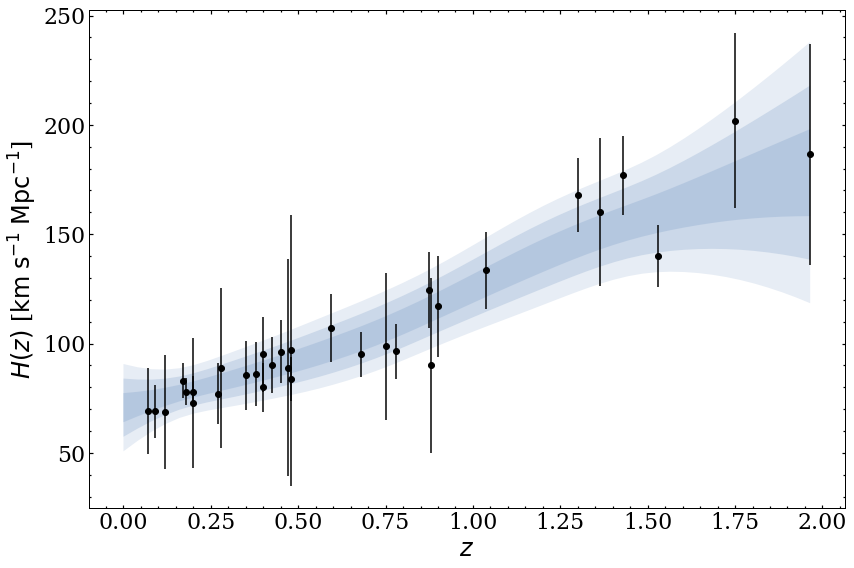
- Reconstruct $M(z)$, $\Omega_k(z)$, and $r_d(z)$ using Gaussian Processes (GPs) on cosmic chronometer (CCH) and Pantheon+ SNIa data, enabling model-independent inference.
- Use BAO data from 6dFGS, BOSS, eBOSS, WiggleZ, and DES Y3 to measure $r_d$ at each redshift point, testing internal consistency.
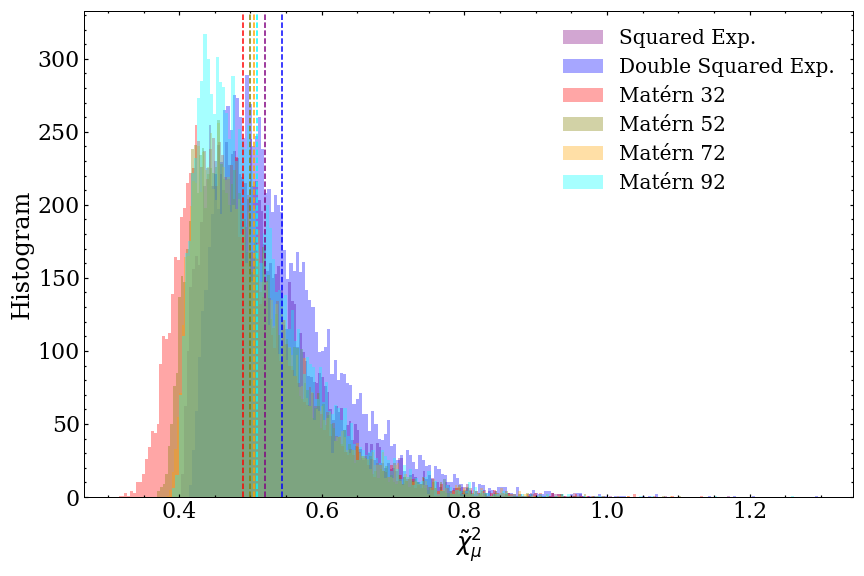
- Apply a kernel selection procedure to objectively choose the most appropriate GP kernel (Matérn 3/2) based on data fit and smoothness criteria.
- Perform robustness checks using alternative kernels (e.g., Gaussian, Matérn 5/2) to verify stability of results under kernel choice.
- Constrain constant parameters $M$, $r_d$, $\Omega_k$, and $H_0$ under the assumption of CP, metric gravity, and standard physics, but without assuming a specific cosmological model.
- Compare results with and without inclusion of SH0ES SNIa calibrated via Cepheids to assess impact on $H_0$ and calibrator values.
Experimental results
Research questions
- RQ1Is the SNIa absolute magnitude $M$ constant at low redshift ($z \lesssim 2$) within the precision of current CCH and SNIa data?
- RQ2Are the curvature parameter $\Omega_k(z)$ and sound horizon $r_d(z)$ consistent with constant values across $z \lesssim 2$?
- RQ3Can cosmic chronometers provide a model-independent calibration of the distance ladder, avoiding reliance on CMB or Cepheid-based runs?
- RQ4How do the inferred values of $M$, $r_d$, and $H_0$ compare to those from SH0ES and Planck, and what does this imply for the Hubble tension?
- RQ5To what extent do future surveys (e.g., Euclid, LSST) improve the precision of these model-independent calibrations?
Key findings
- The reconstructed $M(z)$, $\Omega_k(z)$, and $r_d(z)$ are all consistent with constant values at the 68% credible level, supporting the assumption of constancy in the analysis.
- Excluding SH0ES host-galaxy SNIa, the study finds $M = (-19.314^{+0.086}_{-0.108})$ mag, $r_d = (142.3 \pm 5.3)$ Mpc, $\Omega_k = (-0.07^{+0.12}_{-0.15})$, and $H_0 = (71.5 \pm 3.1)$ km/s/Mpc at 68% C.L.
- Including Cepheid-calibrated SNIa from SH0ES, the results shift to $M = (-19.252^{+0.024}_{-0.036})$ mag, $r_d = (141.9^{+5.6}_{-4.9})$ Mpc, $\Omega_k = (-0.10^{+0.12}_{-0.15})$, and $H_0 = (74.0^{+0.9}_{-1.0})$ km/s/Mpc at 68% C.L.
- The results are robust under different GP kernel choices, with only minor shifts in error bars and central values, confirming the stability of the inference.
- The method shows potential to resolve the Hubble tension with future data, as a 3/2 reduction in CCH uncertainty could reduce calibrator errors by 30–40%.
- The study provides a calibration-independent estimate of $H_0$ that avoids the main sources of tension—CMB and the first rung of the distance ladder—offering a new path to test the Hubble tension.
Better researchstarts right now
From reading papers to final review, dramatically reduce your research time.
No credit card · Free plan available
This review was created by AI and reviewed by human editors.