
[Paper Review] Critical behaviors of the $O(4)$ and $Z(2)$ symmetries in the QCD phase diagram
This study investigates the critical behaviors of O(4) and Z(2) universality classes in the QCD phase diagram using the functional renormalization group (fRG) within a two-flavor quark-meson effective theory. By employing Chebyshev polynomial expansions to solve the fRG flow equations, the authors compute critical exponents for chiral phase transitions and find quantitative agreement with conformal bootstrap, Monte Carlo, and perturbative results, while revealing a very narrow critical regime in the phase diagram.
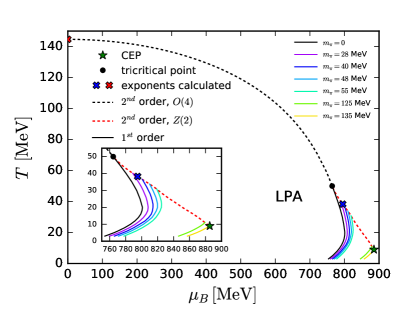
In this work we have studied the QCD phase structure and critical dynamics related to the 3-$d$ $O(4)$ and $Z(2)$ symmetry universality classes in the two-flavor quark-meson low energy effective theory within the functional renormalization group approach. We have employed the expansion of Chebyshev polynomials to solve the flow equation for the order-parameter potential. The chiral phase transition line of $O(4)$ symmetry in the chiral limit, and the $Z(2)$ line of critical end points related to the explicit chiral symmetry breaking are depicted in the phase diagram. Various critical exponents related to the order parameter, chiral susceptibilities and correlation lengths have been calculated for the 3-$d$ $O(4)$ and $Z(2)$ universality classes in the phase diagram, respectively. We find that the critical exponents obtained in the computation, where a field-dependent mesonic nontrivial dispersion relation is taken into account, are in quantitative agreement with results from other approaches, e.g., the conformal bootstrap, Monte Carlo simulations and $d=3$ perturbation expansion, etc. Moreover, the size of the critical regime in the QCD phase diagram is found to be very small.
Motivation & Objective
- To investigate the critical dynamics of O(4) and Z(2) universality classes in the QCD phase diagram under finite temperature and baryon chemical potential.
- To compute critical exponents for chiral phase transitions in the chiral limit (O(4)) and at the critical end point with explicit chiral symmetry breaking (Z(2)).
- To employ a Chebyshev polynomial expansion to solve the fRG flow equations for the effective potential, enabling accurate treatment of field-dependent mesonic dispersion relations.
- To assess the size of the critical regime in the QCD phase diagram, particularly in the context of the critical end point (CEP) search.
Proposed method
- The functional renormalization group (fRG) approach is applied to the two-flavor quark-meson low-energy effective theory to study critical phenomena in QCD.
- The effective potential is expanded in Chebyshev polynomials to numerically solve the integrodifferential fRG flow equations, enabling high-precision computation of the order parameter and its derivatives.
- Field-dependent mesonic nontrivial dispersion relations are incorporated via the fRG flow equations, improving the accuracy of critical exponent calculations.
- Threshold functions for bosonic and fermionic propagators are computed using the Matsubara formalism, with proper treatment of finite temperature and chemical potential.
- Critical exponents are extracted from the scaling behavior of the order parameter, chiral susceptibility, and correlation length near the critical point.
- The method is benchmarked against established results from conformal bootstrap, Monte Carlo simulations, and d=3 perturbation theory to validate accuracy.

Experimental results
Research questions
- RQ1What are the critical exponents for the 3D O(4) universality class in the chiral limit of QCD, and how do they compare to other non-perturbative methods?
- RQ2How do the critical exponents for the Z(2) universality class at the critical end point compare with results from conformal bootstrap and lattice simulations?
- RQ3What is the size of the critical regime in the QCD phase diagram, particularly near the critical end point?
- RQ4How does the inclusion of field-dependent mesonic dispersion relations affect the critical behavior in the fRG framework?
- RQ5Can the Chebyshev polynomial expansion method accurately capture the critical dynamics in the O(4) and Z(2) universality classes?
Key findings
- The critical exponents for the 3D O(4) and Z(2) universality classes computed via the fRG with Chebyshev expansion are in quantitative agreement with results from the conformal bootstrap, Monte Carlo simulations, and d=3 perturbation theory.
- The critical regime in the QCD phase diagram is found to be extremely narrow, indicating that critical phenomena are highly constrained in the physical parameter space.
- The chiral phase transition line in the chiral limit exhibits O(4) symmetry universality, consistent with axial anomaly considerations and lattice QCD findings.
- The critical end point (CEP) associated with Z(2) symmetry is located in the region 450 MeV ≤ μ_B ≤ 650 MeV, as predicted by functional approaches.
- The method successfully captures non-trivial mesonic dispersion effects, which are essential for accurate critical exponent computation.
- The use of Chebyshev polynomials enables high-precision solution of the fRG flow equations for the effective potential, validating its use in non-perturbative studies of QCD criticality.
Better researchstarts right now
From reading papers to final review, dramatically reduce your research time.
No credit card · Free plan available
This review was created by AI and reviewed by human editors.