
[Paper Review] Crucial Role of Obliquely Propagating Gravity Waves in the Quasi-Biennial Oscillation Dynamics
This study demonstrates that obliquely propagating gravity waves—previously neglected in climate models—play a crucial role in driving the quasi-biennial oscillation (QBO) in the tropical stratosphere. Using a 3D transient gravity wave parametrization (MS-GWaM), the authors show these waves enhance momentum fluxes that sustain easterly jet descent and amplify the QBO in the lower stratosphere, resolving a long-standing model bias in QBO amplitude and phase progression.
In climate modelling, the reality of simulated flows in the middle atmosphere is largely affected by the model's representation of gravity wave processes that are unresolved, while these processes are usually simplified to facilitate computations. The simplification commonly applied in existing climate models is to neglect wave propagation in horizontal direction and time. Here we use a model that fully represents the propagation of unresolved waves in all directions, thereby elucidating its dynamical effect upon the most important climate mode in the tropical stratosphere, namely the quasi-biennial oscillation. Our simulation shows that the waves at the equatorial stratosphere, which are known to drive this climate mode, can originate far away from the equator in the troposphere. The waves propagating obliquely toward the equator are found to play a huge role in the phase progression of the quasi-biennial oscillation as well as in its penetration into the lower stratosphere. Such waves will require further attention, given that current climate models are struggling to simulate the quasi-biennial oscillation down to the lower stratosphere, which may be needed to reproduce its observed impacts on the surface climate.
Motivation & Objective
- To investigate the dynamical impact of obliquely propagating gravity waves on the quasi-biennial oscillation (QBO) in the tropical stratosphere.
- To address the persistent model bias in climate models where the QBO easterly phase is underestimated in the lower stratosphere.
- To evaluate whether fully representing 3D, transient gravity wave propagation improves QBO simulation fidelity compared to conventional 1D steady-state parametrizations.
- To quantify the role of equatorward-propagating waves originating far from the equator in driving QBO phase progression and descent.
Proposed method
- Employed a novel gravity wave parametrization (MS-GWaM) that fully resolves 3D wave propagation and transient behavior in phase space.
- Solved ray equations (1) and wave-action density transport (2) in 6D phase space (x, k, t) using a Lagrangian approach with discretized ray volumes.
- Tracked wave-action density evolution via wave-action conservation with source/sink terms for wave generation and dissipation.
- Used a multi-scale convective source with horizontal and temporal scales of 100 km and 12 min to generate large-scale gravity waves.
- Compared simulations using 3D transient (3d-TR) and conventional 1D steady-state (1d-ST) parametrizations under identical model conditions.
- Derived momentum fluxes and forcing fields from the wave-action density to assess wave impacts on large-scale flow.
Experimental results
Research questions
- RQ1What is the dynamical contribution of obliquely propagating gravity waves to the quasi-biennial oscillation (QBO) in the tropical stratosphere?
- RQ2How does including 3D, transient wave propagation in gravity wave parametrization affect the simulation of QBO phase descent and amplitude?
- RQ3To what extent do equatorward-propagating waves originating from off-equatorial convection contribute to the QBO's easterly phase development?
- RQ4Why do current climate models fail to reproduce the observed QBO amplitude in the lower stratosphere, and can this be attributed to wave propagation simplifications?
Key findings
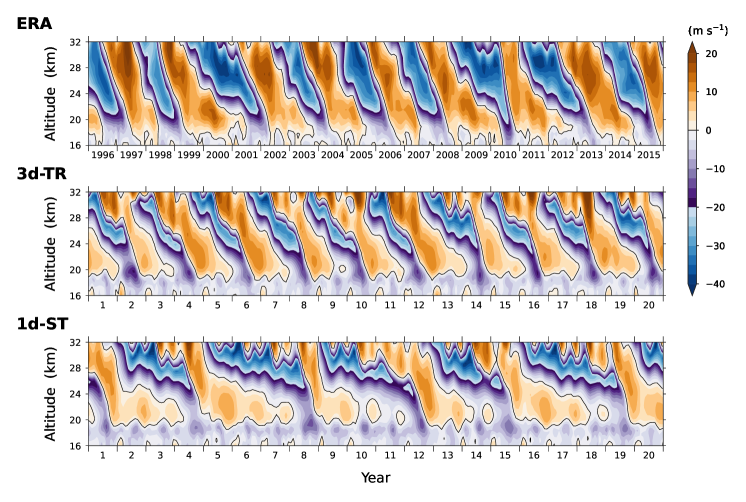
- The 3d-TR simulation with full 3D transient wave propagation reproduces the QBO period (2 years) and peak amplitudes more accurately than the 1d-ST simulation, which exhibits longer periods (3–4 years).
- The easterly phase descent is significantly slower and weaker in the 1d-ST simulation, with reduced amplitude between 27 and 19 km, indicating a failure to sustain lower stratospheric easterlies.
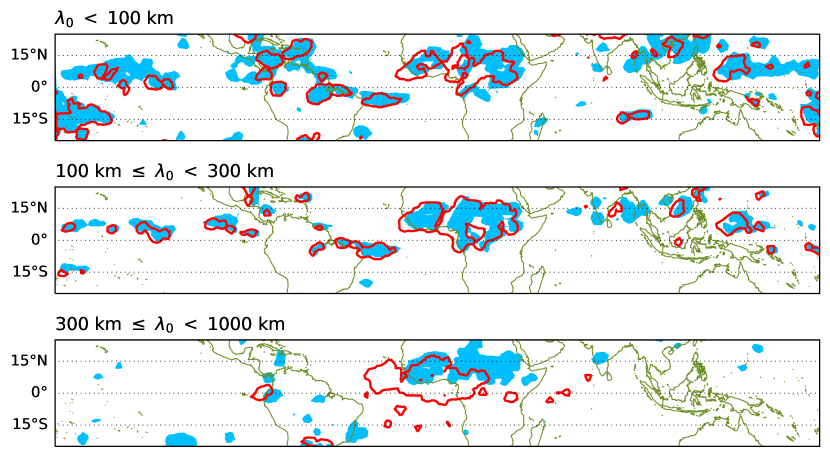
- Obliquely propagating waves, particularly equatorward-propagating components, provide essential momentum forcing that enables the descent and amplification of the easterly QBO phase in the lower stratosphere.
- The 3d-TR simulation shows better agreement with ERA-Interim reanalysis in both vertical and meridional wind profiles, especially in the lower stratosphere.
- The inclusion of larger-scale convective sources (100 km horizontal scale, 12 min time scale) generates long-wavelength gravity waves (>300 km) critical for lower stratospheric forcing.
- The conventional 1D steady-state parametrization (1d-ST) fails to capture the full wave momentum flux required for realistic QBO dynamics, leading to systematic underestimation of easterly jet strength.
Better researchstarts right now
From reading papers to final review, dramatically reduce your research time.
No credit card · Free plan available
This review was created by AI and reviewed by human editors.