
QUICK REVIEW
[Paper Review] Data-Driven Identification of Quadratic Representations for Nonlinear Hamiltonian Systems using Weakly Symplectic Liftings
Süleyman Yıldız, Pawan Goyal|arXiv (Cornell University)|Aug 2, 2023
TL;DR
This paper proposes a data-driven framework to identify quadratic Hamiltonian systems for nonlinear dynamical systems by lifting the state space using weakly symplectic autoencoders. It enables structure-preserving, low-complexity modeling with long-term stability, achieving accurate dynamics in both low- and high-dimensional systems through learned cubic Hamiltonians in transformed coordinates.
ABSTRACT
This repository contains the Python implementation using the PyTorch framework to learn Quadratic Hamiltonian systems.
Motivation & Objective
- To develop a data-driven method for identifying quadratic Hamiltonian systems from trajectory data without requiring knowledge of the original equations.
- To enforce Hamiltonian structure in a lifted coordinate system while minimizing model complexity through a cubic Hamiltonian formulation.
- To enable dimensionality reduction for high-dimensional Hamiltonian systems by learning a low-dimensional latent dynamics with preserved symplectic structure.
- To ensure long-term stability and accurate extrapolation in unseen initial conditions through structure-preserving learning.
- To combine weakly enforced symplectic transformations with strongly enforced Hamiltonian dynamics for non-intrusive, nonlinear model order reduction.
Proposed method
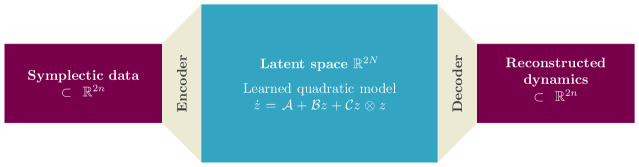
- Lift the original state space into a higher-dimensional coordinate system using a neural network-based autoencoder, where the dynamics become quadratic.
- Enforce the symplectic structure of the transformation weakly via a regularization term in the loss function, ensuring the mapping preserves the symplectic form approximately.
- Learn a cubic Hamiltonian function in the lifted space, which gives rise to quadratic dynamics, enabling low-complexity modeling.
- Use a deep neural network architecture with skip connections and SELU activations to improve training stability and reconstruction accuracy.
- Train the autoencoder end-to-end with a composite loss combining reconstruction error, symplecticity regularization, and dynamics consistency via Hamiltonian structure enforcement.
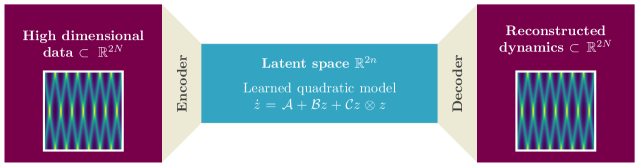
- For high-dimensional data, apply the same framework to learn a reduced latent space, achieving efficient, structure-preserving model order reduction.
Experimental results
Research questions
- RQ1Can nonlinear Hamiltonian systems be effectively represented as quadratic systems in a lifted coordinate space?
- RQ2How can symplectic structure be weakly enforced in a data-driven autoencoder to preserve geometric properties of the dynamics?
- RQ3Can a cubic Hamiltonian in the lifted space yield a low-complexity, stable quadratic dynamical system?
- RQ4To what extent can this framework enable accurate long-term extrapolation of trajectories from unseen initial conditions?
- RQ5How effective is the method for high-dimensional Hamiltonian systems, particularly in reducing dimensionality while preserving structure?
Key findings
- The method successfully learns quadratic Hamiltonian dynamics from data, achieving long-term stability in extrapolation beyond the training horizon.
- For low-dimensional systems, the framework identifies a 4-dimensional lifted space where the dynamics are quadratic and the Hamiltonian is cubic, ensuring low model complexity.
- In high-dimensional systems such as the nonlinear Schrödinger equation and wave equation, the method learns a 2- or 4-dimensional latent space that preserves the Hamiltonian structure and enables accurate dynamics prediction.
- The weakly symplectic autoencoder achieves balanced loss reduction across reconstruction, symplecticity, and dynamics consistency, with hyperparameters tuned experimentally.
- The model generalizes well to unseen initial conditions, demonstrating robustness in trajectory prediction under similar data distributions.
- The approach enables non-intrusive, structure-preserving model order reduction by learning latent dynamics directly from data without access to the original system equations.
Better researchstarts right now
From reading papers to final review, dramatically reduce your research time.
No credit card · Free plan available
This review was created by AI and reviewed by human editors.