
[Paper Review] Data for "Pauli Spectrum and Non-stabilizerness of Typical Quantum Many-Body States"
This paper introduces the Pauli spectrum as a tool to quantify magic—non-stabilizerness—in typical quantum many-body states, demonstrating that Haar-random, random circuit, and chaotic Hamiltonian eigenstates all exhibit a universal Pauli spectrum with exponentially suppressed tails. It proposes filtered stabilizer entropy to distinguish typical (high-magic) states from atypical ones, showing that typical states maximize magic across all Rényi indices.
An important question of quantum information is to characterize genuinely quantum (beyond-Clifford) resources necessary for universal quantum computing. Here, we use the Pauli spectrum to quantify how ``magic'', beyond Clifford, typical many-qubit states are. We first present a phenomenological picture of the Pauli spectrum based on quantum typicality and then confirm it for Haar random states. We then introduce filtered stabilizer entropy, a magic measure that can resolve the difference between typical and atypical states. We proceed with the numerical study of the Pauli spectrum of states created by random circuits as well as for eigenstates of chaotic Hamiltonians. We find that in both cases Pauli spectrum approaches the one of Haar random states, up to exponentially suppressed tails. We discuss how the Pauli spectrum changes when ergodicity is broken due to disorder. Our results underscore the difference between typical and atypical states from the point of view of quantum information.
Motivation & Objective
- To characterize the non-stabilizerness (magic) of typical many-body quantum states beyond the stabilizer formalism.
- To develop a measure that distinguishes typical high-magic states from atypical low-magic states such as product states.
- To establish a phenomenological picture of the Pauli spectrum based on quantum typicality.
- To confirm this picture via exact results for Haar random states and numerical simulations of random circuits and chaotic Hamiltonian eigenstates.
- To introduce and validate filtered stabilizer entropy as a refined magic quantifier that resolves differences between typical and atypical states.
Proposed method
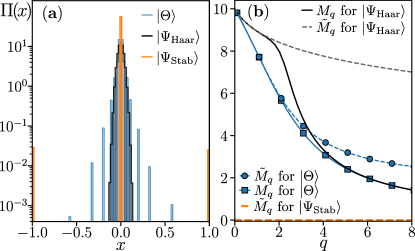
- Define the Pauli spectrum as the set of expectation values ⟨Ψ|P|Ψ⟩ for all Pauli strings P ∈ 𝒫_N, treating it as a probability distribution Π(x).
- Use quantum typicality to argue that for typical states, ⟨Ψ|P|Ψ⟩ ≈ 0 for P ≠ I, with fluctuations distributed as a zero-mean Gaussian with uniform variance b.
- Derive the exact Pauli spectrum for Haar random states, showing it converges to a semicircular distribution in the large-N limit.
- Introduce filtered stabilizer entropy M̃_q as a modified Rényi entropy that excludes the identity operator's contribution, enhancing sensitivity to non-stabilizer content.
- Perform extensive numerical simulations on random circuit states and mid-spectrum eigenstates of chaotic spin chains to compare with theoretical predictions.
- Use Monte Carlo sampling to compute stabilizer Rényi entropy and validate the behavior of the Pauli spectrum in finite-size systems.
Experimental results
Research questions
- RQ1How does the Pauli spectrum of typical quantum many-body states behave, and can it be described by quantum typicality?
- RQ2To what extent do random circuit states and eigenstates of chaotic Hamiltonians resemble Haar random states in their Pauli spectrum?
- RQ3Can filtered stabilizer entropy effectively distinguish typical states from atypical states like product states?
- RQ4What structural differences in the Pauli spectrum reveal the underlying dynamics or integrability of a system?
- RQ5How does the Pauli spectrum relate to ergodicity and magic in quantum many-body systems?
Key findings
- The Pauli spectrum of Haar random states follows a semicircular distribution, with the identity operator dominating the stabilizer Rényi entropy for q > 2.
- For typical states, the filtered stabilizer entropy M̃_q reaches its maximum value of 1 at all Rényi indices q, indicating maximal magic.
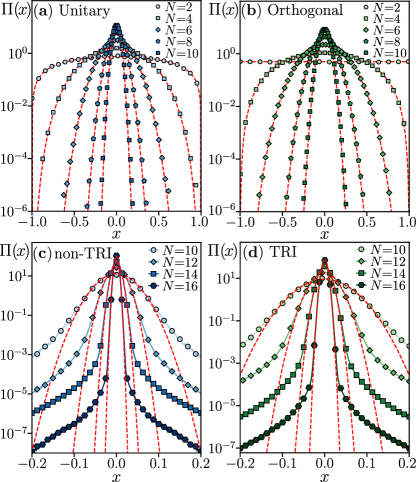
- Random circuit states and mid-spectrum eigenstates of chaotic Hamiltonians exhibit Pauli spectra indistinguishable from Haar random states up to exponentially suppressed tails.
- The Pauli spectrum of chaotic Hamiltonian eigenstates shows exponentially small tails not present in Haar random states, revealing richer structure from the Hamiltonian.
- Filtered stabilizer entropy successfully resolves differences between typical and atypical states, such as product states, which have significantly lower magic.
- The Pauli spectrum provides a more refined characterization of magic than stabilizer Rényi entropy alone, capturing non-Gaussian features of the operator space distribution.
Better researchstarts right now
From reading papers to final review, dramatically reduce your research time.
No credit card · Free plan available
This review was created by AI and reviewed by human editors.