
QUICK REVIEW
[Paper Review] Dataset for 'Mapping twist-tuned multi-band topology in bilayer WSe$_2$'
Benjamin A. Foutty, Carlos R. Kometter|arXiv (Cornell University)|Apr 19, 2023
Topological Materials and Phenomena12 references24 citations
TL;DR
Local electronic compressibility measurements reveal multiple topological bands and tunable Chern insulators in twisted bilayer WSe2 near a magic angle, including displacement-field driven topological transitions.
ABSTRACT
Datasets and code for the manuscript 'Mapping twist-tuned multi-band topology in bilayer WSe2.' See 'README.txt' for further details.
Motivation & Objective
- Map topological bands and correlated ground states in twisted bilayer WSe2 at small twist angles.
- Identify Chern insulators near a magic angle around 1.23° at zero magnetic field.
- Explore displacement-field induced topological phase transitions at nu = -1.
- Examine how ground states depend on local moiré wavelength by varying twist angle.
- Establish the topological phase diagram of a generalized Kane-Mele-Hubbard model in tWSe2.
Proposed method
- Use scanning single electron transistor (SET) microscopy to measure inverse compressibility dμ/dn and chemical potential μ(n).
- Vary twist angle locally from 1.1° to 1.6° to map moiré wavelength effects.
- Apply a locally controlled displacement field D_eff via the SET tip to tune topology and induce phase transitions.
- Compare measurements with Hartree-Fock continuum-model predictions for Kane-Mele-Hubbard–like physics.
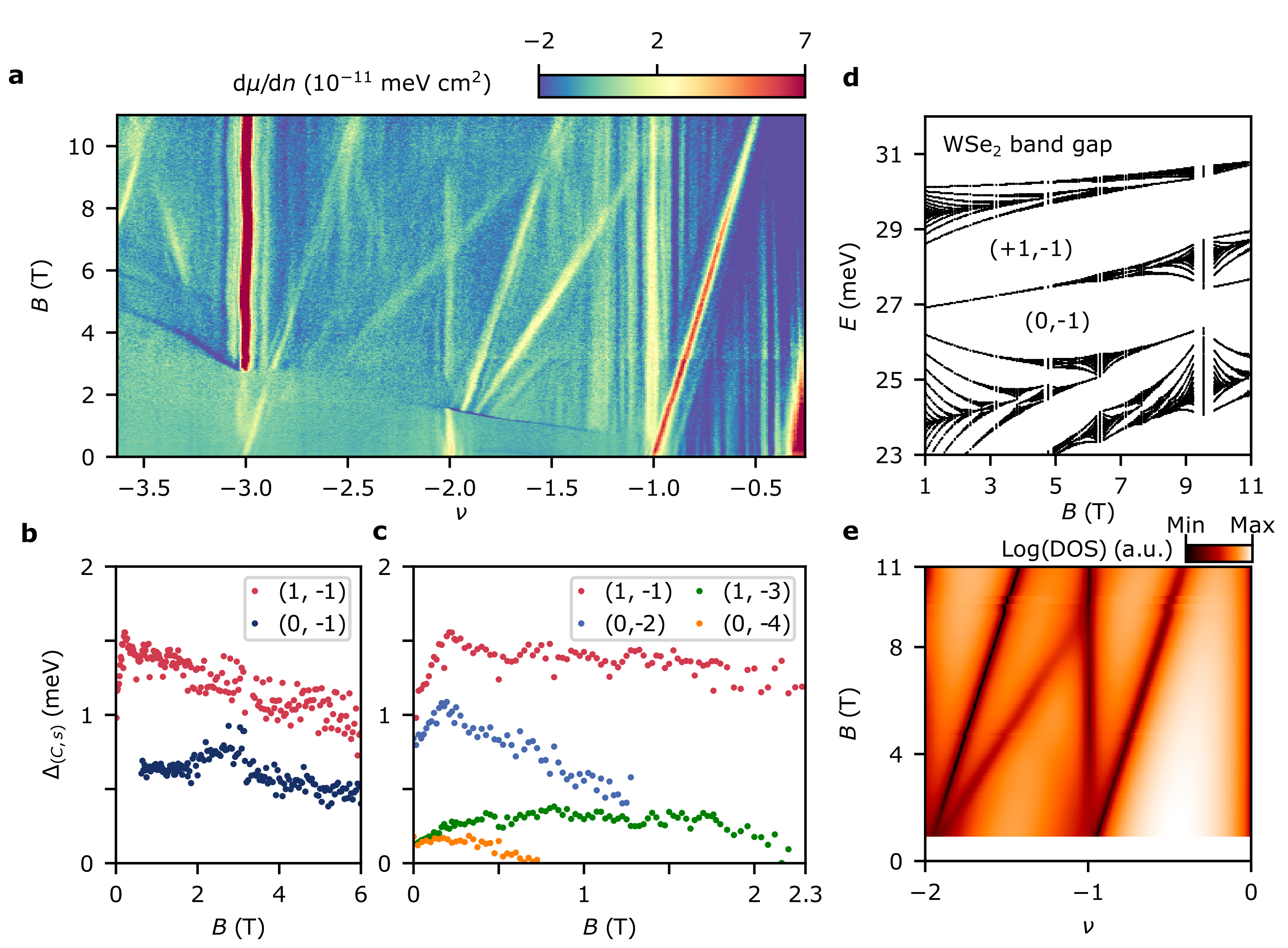
- Study magnetic-field dependent spectra up to B ≈ 11 T to observe Hofstadter-like features.
Experimental results
Research questions
- RQ1Do twisted WSe2 bilayers host multiple topological bands with nonzero Chern numbers at small twist angles?
- RQ2How does moiré wavelength affect correlated ground states and gaps at integer fillings?
- RQ3Can displacement-field tuning drive topological phase transitions at integer fillings such as ν = -1?
- RQ4What is the magnetic-field dependence of the gaps and Hofstadter states in these systems?
Key findings
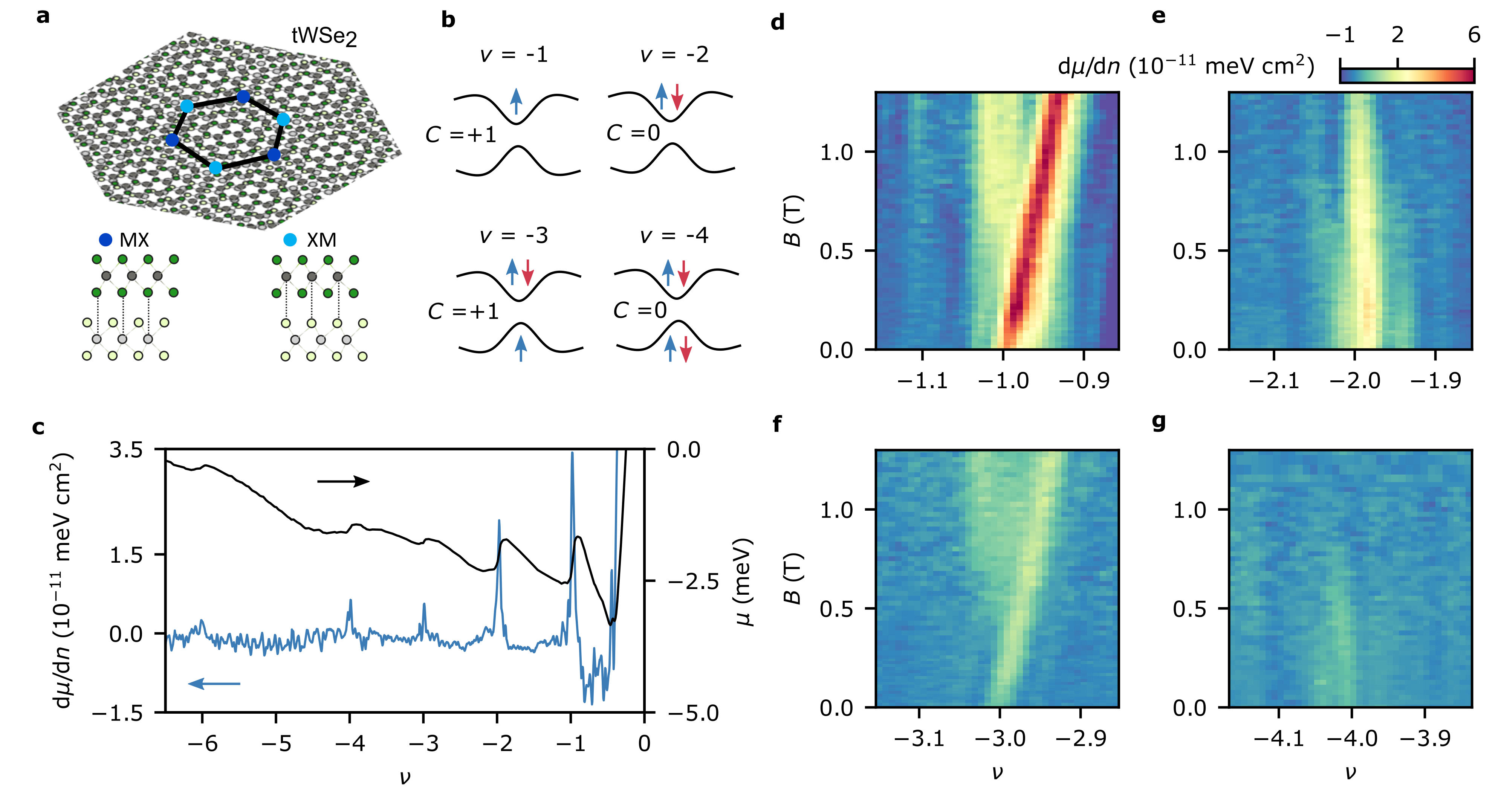
- Multiple topological bands with Chern number C = +1 gaps observed at ν = -1 and ν = -3 that persist to zero magnetic field.
- Gaps at ν = -1 and ν = -3 have total Chern number C = +1, while ν = -2 and ν = -4 have C = 0, indicating distinct topological ground states.
- At a local twist angle around 1.23°, a series of quantum anomalous Hall (QAH) insulators is observed at zero field.
- Displacement-field tuning via the SET tip induces a topological phase transition at ν = -1 between a QAH state and a topologically trivial layer-polarized state.
- Twist-angle dependence shows topological gaps appear only in a narrow range (≈1.2°–1.25°), with broader angles yielding weaker or no zero-field topological states.
- Hartree-Fock continuum-model calculations support a landscape with spin-valley polarized Chern insulators and transitions to trivial states under varying D and θ.
Better researchstarts right now
From reading papers to final review, dramatically reduce your research time.
No credit card · Free plan available
This review was created by AI and reviewed by human editors.