
[Paper Review] Decay-assisted collinear resonance ionization spectroscopy: Application to neutron-deficient francium
This study presents decay-assisted collinear resonance ionization spectroscopy to measure hyperfine structure and nuclear properties of neutron-deficient francium isotopes 202–206Fr at the CRIS experiment at CERN. By combining high-resolution laser spectroscopy with alpha-decay tagging, the technique enabled the first unambiguous identification of hyperfine components and isomeric states in 202,204Fr, yielding precise magnetic moments and mean-square charge radii, with evidence of collectivity onset at 203Fr.
This paper reports on the hyperfine-structure and radioactive-decay studies of the neutron-deficient francium isotopes $^{202-206}$Fr performed with the Collinear Resonance Ionization Spectroscopy (CRIS) experiment at the ISOLDE facility, CERN. The high resolution innate to collinear laser spectroscopy is combined with the high efficiency of ion detection to provide a highly-sensitive technique to probe the hyperfine structure of exotic isotopes. The technique of decay-assisted laser spectroscopy is presented, whereby the isomeric ion beam is deflected to a decay spectroscopy station for alpha-decay tagging of the hyperfine components. Here, we present the first hyperfine-structure measurements of the neutron-deficient francium isotopes $^{202-206}$Fr, in addition to the identification of the low-lying states of $^{202,204}$Fr performed at the CRIS experiment.
Motivation & Objective
- To measure hyperfine structure and nuclear properties of short-lived, neutron-deficient francium isotopes (202–206Fr) with high sensitivity.
- To resolve overlapping hyperfine components in the laser spectra of isomeric states using alpha-decay tagging.
- To determine magnetic moments, mean-square charge radii, and branching ratios for low-lying isomeric states in 202,204Fr.
- To investigate the onset of nuclear deformation and the role of proton intruder configurations in neutron-deficient francium isotopes.
- To calibrate atomic factors for the 422.7-nm transition using a King plot analysis to improve precision in future measurements.
Proposed method
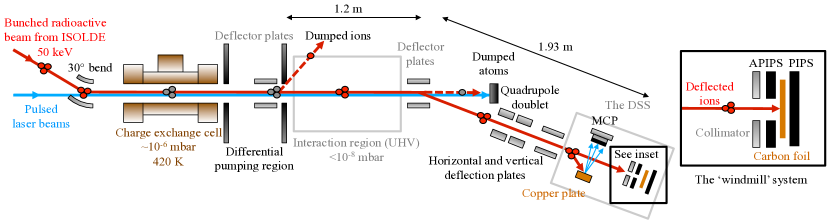
- Employed collinear resonance ionization spectroscopy (CRIS) at the ISOLDE facility, combining high-resolution laser spectroscopy with efficient ion detection.
- Utilized a decay spectroscopy station to tag alpha decays from isomeric states, enabling identification of hyperfine components in the laser scan.
- Performed laser excitation on the 7s 2S₁/₂ → 8p 2P₃/₂ transition in francium, measuring the hyperfine A-factor and calibrating atomic parameters via King plot analysis.
- Applied a 1.5 GHz laser linewidth to resolve the lower-state hyperfine splitting and extract A_S₁/₂ factors.
- Used the high detection efficiency and low background of the CRIS setup to study isotopes with yields as low as 1 atom per second.
- Integrated laser spectroscopy with nuclear decay tagging to achieve unambiguous assignment of hyperfine peaks to specific isomeric states.
Experimental results
Research questions
- RQ1What are the hyperfine structure parameters and magnetic moments of the neutron-deficient francium isotopes 202–206Fr?
- RQ2Can alpha-decay tagging resolve overlapping hyperfine components in isomeric states of 202,204Fr?
- RQ3At what neutron number does collectivity begin in the francium isotopic chain?
- RQ4What is the nature of the low-lying isomeric states in 202,204Fr, and how do their magnetic moments reflect single-particle or collective behavior?
- RQ5Can the spectroscopic quadrupole moment be extracted to determine whether deformation is static or dynamic in these nuclei?
Key findings
- The first hyperfine-structure measurements of 202–206Fr were achieved, with 202Fr measured at a yield of 100 atoms per second.
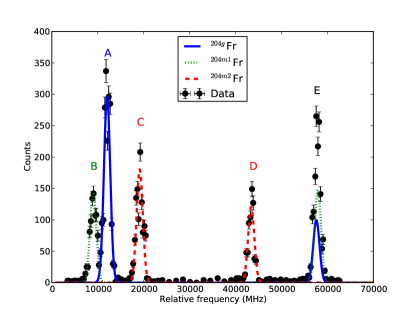
- Alpha-decay tagging enabled unambiguous identification of the three low-lying isomeric states in 204Fr and determination of their branching ratios.
- The field factor F₄₂₂ was determined as −20.670(210) GHz/fm² and the mass factor M₄₂₂ as +750(330) GHz amu for the 422.7-nm transition.
- Analysis of mean-square charge radii suggests an onset of collectivity at 203Fr (N = 116), though spectroscopic quadrupole moment measurements are needed to confirm deformation nature.
- Magnetic moments indicate a single-particle description holds for most states, except for the 10− isomeric state in 206m²Fr, which shows deviations suggesting possible collectivity.
- The 1.5 GHz laser linewidth resolved the lower-state hyperfine splitting, enabling extraction of the A_S₁/₂ factor, with future narrow-linewidth lasers expected to resolve upper-state splitting and extract B_P₃/₂ factors.
Better researchstarts right now
From reading papers to final review, dramatically reduce your research time.
No credit card · Free plan available
This review was created by AI and reviewed by human editors.