
[Paper Review] Decentralized projected Riemannian gradient method for smooth optimization on compact submanifolds
This paper proposes two decentralized Riemannian optimization algorithms—Decentralized Projected Riemannian Gradient Descent (DPRGD) and Decentralized Projected Riemannian Gradient Tracking (DPRGT)—for smooth nonconvex optimization on compact submanifolds. Leveraging proximal smoothness and novel Lipschitz-type inequalities of the projection operator, the authors establish linear convergence of the consensus step and prove DPRGT achieves $ ilde{ ext{O}}(1/K)$ convergence to a stationary point, making it the first exact-convergent decentralized algorithm on compact manifolds.
We consider the problem of decentralized nonconvex optimization over a compact submanifold, where each local agent's objective function defined by the local dataset is smooth. Leveraging the powerful tool of proximal smoothness, we establish local linear convergence of the projected gradient descent method with a unit step size for solving the consensus problem over the nonconvex compact submanifold. This serves as the basis for designing and analyzing decentralized algorithms on manifolds. Subsequently, we propose two decentralized methods: the decentralized projected Riemannian gradient descent (DPRGD) and the decentralized projected Riemannian gradient tracking (DPRGT). We establish their convergence rates of $\mathcal{O}(1/\sqrt{K})$ and $\mathcal{O}(1/K)$, respectively, to reach a stationary point. To the best of our knowledge, DPRGT is the first decentralized algorithm to achieve exact convergence for solving decentralized optimization over a compact submanifold. Beyond the linear convergence results on the consensus, two key tools developed in the proof are the Lipschitz-type inequality of the projection operator and the Riemannian quadratic upper bound for smooth functions on the compact submanifold, which could be of independent interest. Finally, we demonstrate the effectiveness of our proposed methods compared to state-of-the-art ones through numerical experiments on eigenvalue problems and low-rank matrix completion.
Motivation & Objective
- To address the challenge of decentralized nonconvex optimization over compact, nonconvex submanifolds where traditional Euclidean or convex-based methods fail.
- To establish local linear convergence of the projected Riemannian gradient method with unit step size on compact submanifolds, enabling stable consensus formation.
- To design two novel decentralized algorithms—DPRGD and DPRGT—that achieve exact convergence to a stationary point under smoothness and compactness assumptions.
- To develop general-purpose tools, such as the Lipschitz-type inequality of the Riemannian projection and Riemannian quadratic upper bound, applicable beyond the specific algorithms.
- To demonstrate the superiority of the proposed methods over state-of-the-art approaches on eigenvalue problems and low-rank matrix completion tasks.
Proposed method
- Uses the projected Riemannian gradient descent with unit step size on a compact submanifold, relying on proximal smoothness to ensure local linear convergence of the consensus iteration.
- Introduces a novel Lipschitz-type inequality for the Riemannian projection operator onto compact submanifolds, which is critical for bounding the error in decentralized consensus.
- Establishes a Riemannian quadratic upper bound for smooth functions on compact submanifolds, enabling tighter convergence analysis in non-Euclidean settings.
- Proposes the decentralized projected Riemannian gradient descent (DPRGD) by combining local Riemannian gradient steps with consensus via a fixed network topology.
- Develops the decentralized projected Riemannian gradient tracking (DPRGT) by incorporating gradient tracking to eliminate bias and achieve exact convergence with $ ilde{ ext{O}}(1/K)$ rate.
- Employs retraction and vector transport via polar decomposition for the generalized Stiefel manifold ${ m St}_B(d,r)$, ensuring numerical stability and manifold adherence.
Experimental results
Research questions
- RQ1Can the projected Riemannian gradient method with unit step size achieve linear convergence for consensus on a compact, nonconvex submanifold?
- RQ2What are the key geometric and analytic properties—such as Lipschitz-type behavior of the projection—that enable convergence analysis in non-Euclidean decentralized settings?
- RQ3Can a decentralized Riemannian algorithm achieve exact convergence (i.e., to a stationary point) with fixed step sizes on a compact submanifold, unlike standard DGD in Euclidean space?
- RQ4How does the proposed gradient tracking mechanism improve convergence rate and stability in decentralized Riemannian optimization compared to standard gradient descent?
- RQ5To what extent do the proposed algorithms outperform existing methods in practical problems like generalized eigenvalue problems and low-rank matrix completion?
Key findings
- The projected Riemannian gradient method with unit step size converges linearly to the consensus point on a compact submanifold, under proximal smoothness and bounded curvature.
- A new Lipschitz-type inequality for the Riemannian projection operator is established, which is essential for bounding the consensus error in decentralized settings.
- The Riemannian quadratic upper bound for smooth functions on compact submanifolds is derived, enabling tighter convergence analysis in nonconvex Riemannian optimization.
- DPRGD achieves a convergence rate of $ ilde{ ext{O}}(1/ ext{K}}^{1/2})$ to a stationary point, matching the best-known rate in the Stiefel manifold case.
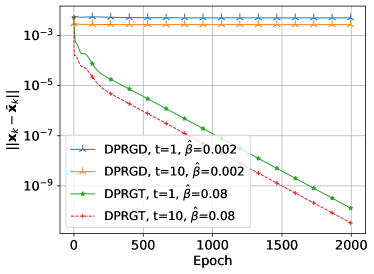
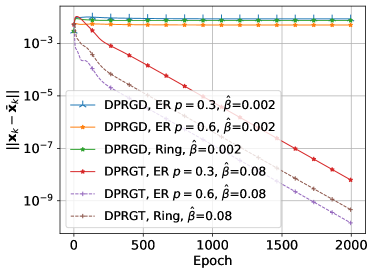
- DPRGT achieves a faster $ ilde{ ext{O}}(1/K)$ convergence rate and is the first decentralized algorithm to achieve exact convergence for smooth optimization on compact submanifolds.
- Numerical experiments on synthetic generalized eigenvalue problems and low-rank matrix completion show DPRGT outperforms DPRGD, DRDGD, and DRGTA in both objective value and distance to ground truth.
Better researchstarts right now
From reading papers to final review, dramatically reduce your research time.
No credit card · Free plan available
This review was created by AI and reviewed by human editors.