
[Paper Review] Deconfined quantum critical points: a review
This paper surveys beyond-Landau theory transitions, focusing on deconfined quantum critical points where emergent fractionalized excitations and gauge fields describe criticality beyond the Landau-Ginzburg-Wilson-Fisher paradigm.
Continuous phase transitions in equilibrium statistical mechanics were successfully described 50 years ago with the development of the renormalization group framework. This framework was initially developed in the context of phase transitions whose universal properties are captured by the long wavelength (and long time) fluctuations of a Landau order parameter field. Subsequent developments include a straightforward generalization to a class of $T = 0$ phase transitions driven by quantum fluctuations. In the last 2 decades it has become clear that there is a vast landscape of quantum phase transitions where the physics is not always usefully (or sometimes cannot be) formulated in terms of fluctuations of a Landau order parameter field. A wide class of such phase transitions - dubbed deconfined quantum critical points - involve the emergence of fractionalized degrees of freedom coupled to emergent gauge fields. Here I review some salient aspects of these deconfined critical points.
Motivation & Objective
- Motivate and review how LGWF theory fails for certain quantum phase transitions at T=0.
- Introduce deconfined quantum critical points as a framework with emergent fractionalized fields and gauge fields.
- Summarize key examples where transitions between Landau-allowed or forbidden phases exhibit non-LGWF criticality.
- Discuss the role of topological defects and anomalies in constraining RG flows and critical behavior.
Proposed method
- Discuss the Landau-Ginzburg-Wilson-Fisher paradigm and its generalization to quantum phase transitions.
- Describe the NCCP1 model as the effective theory for Neel-VBS transitions and analyze monopole irrelevance.
- Explain particle-vortex duality and its relevance to XY transitions and VBS vortices.
- Incorporate Wess-Zumino-Witten terms and topological defects to explain the quantum intertwinement of orders.
- Relate lattice symmetry, LSM constraints, and SPT boundaries to non-LGWF criticality.
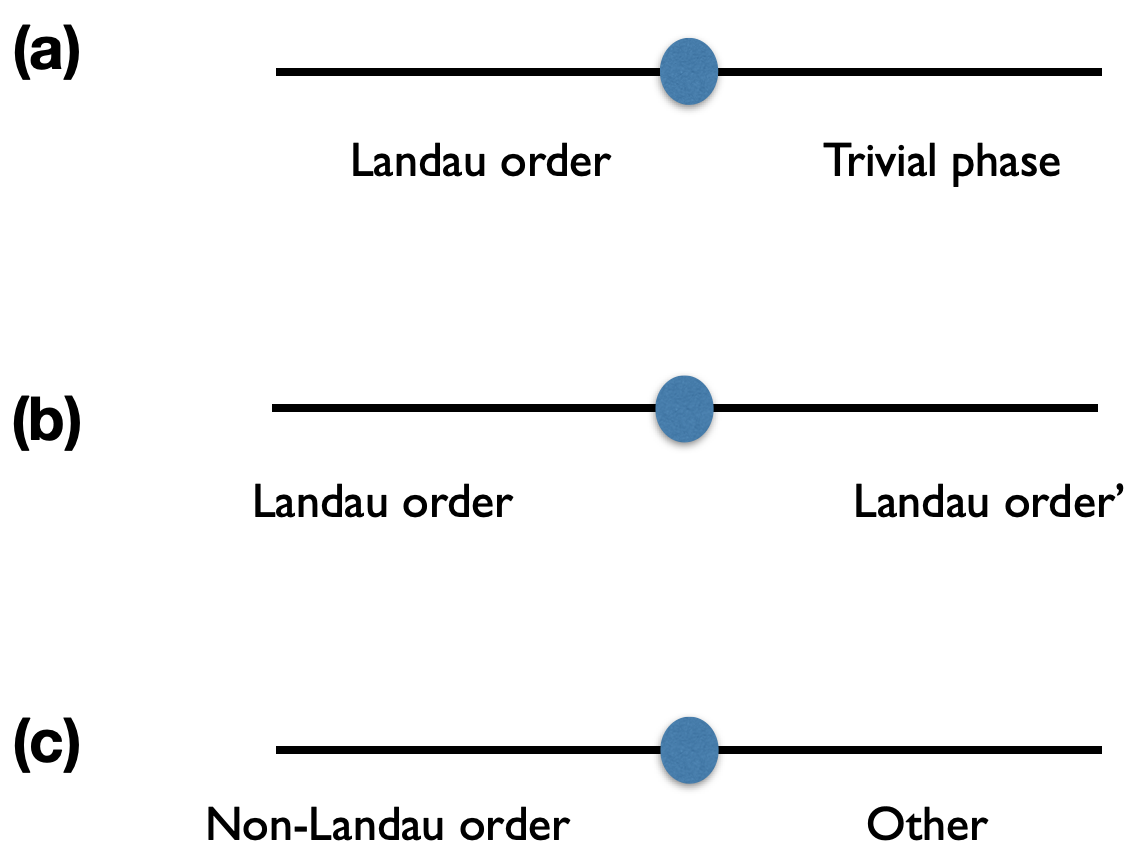
Experimental results
Research questions
- RQ1Under what conditions are phase transitions between Landau-allowed phases second order beyond LGWF?
- RQ2How do emergent gauge fields and fractionalized excitations describe deconfined quantum critical points at T=0?
- RQ3What is the role of topological defects and monopoles in determining the nature of Neel-VBS and related transitions?
- RQ4How do LSM constraints and SPT boundaries constrain possible critical theories beyond LGWF?
- RQ5Can certain transitions between symmetry-broken phases exhibit multiple universality classes or remain beyond LGWF?
Key findings
- Deconfined criticality occurs when emergent fractionalized degrees of freedom couple to gauge fields at criticality.
- The Neel-VBS transition on the square lattice can be described by the NCCP1 model with monopole operators potentially irrelevant at the fixed point.
- VBS vortices carry spin-1/2 quantum numbers, linking topological defects to symmetry breaking and enabling a beyond-LGWF description.
- A naive O(5) sigma model with a WZW term captures the intertwined nature of Neel and VBS orders and their nontrivial criticality.
- Particle-vortex duality and monopole physics explain why a direct second-order transition between certain Landau-ordered phases is possible beyond LGWF.
- LGWF* transitions can resemble standard LGWF behavior in certain limits but require gauge fields and topological terms for a full description.

Better researchstarts right now
From reading papers to final review, dramatically reduce your research time.
No credit card · Free plan available
This review was created by AI and reviewed by human editors.