
[Paper Review] Decoupling by local random unitaries without simultaneous smoothing, and applications to multi-user quantum information tasks
This paper presents a novel decoupling framework using local random unitaries and a telescoping sum technique to achieve simultaneous decoupling for multiple quantum users without relying on the unresolved simultaneous smoothing conjecture. By leveraging contractivity and tensorization of random channel coefficients, it establishes tight one-shot and finite-blocklength bounds in terms of smooth min- and Rényi entropies, enabling direct, time-sharing-free achievability proofs for multi-user quantum tasks such as randomness extraction, entanglement of assistance, quantum state merging, and multiple access channel coding—providing the first rigorous one-shot and compound-rate formulas for these problems.
We show that a simple telescoping sum trick, together with the triangle inequality and a tensorisation property of expected-contractive coefficients of random channels, allow us to achieve general simultaneous decoupling for multiple users via local actions. Employing both old [Dupuis et al. Commun. Math. Phys. 328:251-284 (2014)] and new methods [Dupuis, arXiv:2105.05342], we obtain bounds on the expected deviation from ideal decoupling either in the one-shot setting in terms of smooth min-entropies, or the finite block length setting in terms of Rényi entropies. These bounds are essentially optimal without the need to address the simultaneous smoothing conjecture, which remains unresolved. This leads to one-shot, finite block length, and asymptotic achievability results for several tasks in quantum Shannon theory, including local randomness extraction of multiple parties, multi-party assisted entanglement concentration, multi-party quantum state merging, and quantum coding for the quantum multiple access channel. Because of the one-shot nature of our protocols, we obtain achievability results without the need for time-sharing, which at the same time leads to easy proofs of the asymptotic coding theorems. We show that our one-shot decoupling bounds furthermore yield achievable rates (so far only conjectured) for all four tasks in compound settings, that is for only partially known i.i.d. source or channel, which are furthermore optimal for entanglement of assistance and state merging.
Motivation & Objective
- To resolve the challenge of simultaneous decoupling in multi-user quantum information tasks without relying on the unproven simultaneous smoothing conjecture.
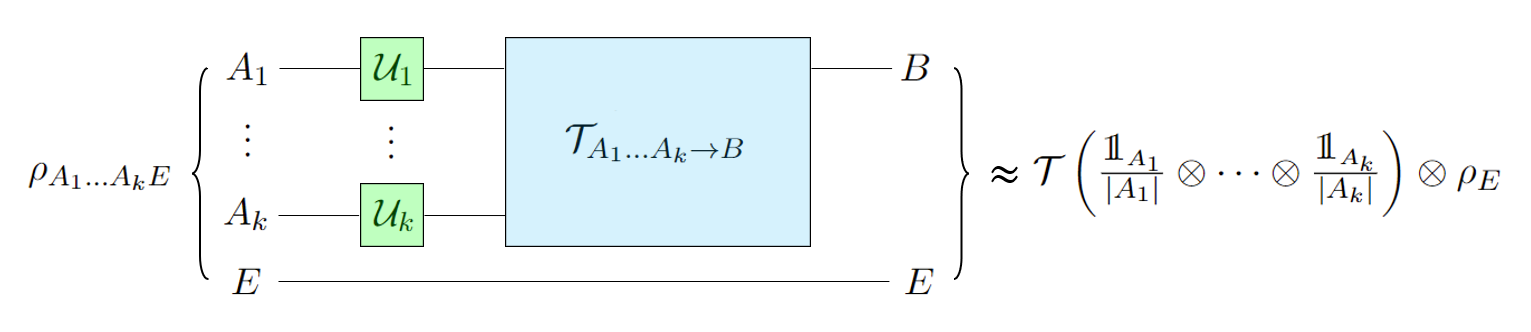
- To develop a general framework for one-shot and finite-blocklength decoupling using local random unitaries and tensorization of channel contractivity.
- To derive tight bounds on decoupling error in terms of smooth min- and Rényi entropies for multiple parties.
- To establish direct, time-sharing-free achievability results for key quantum information tasks in both one-shot and asymptotic regimes.
- To prove the first rigorous one-shot and compound-rate formulas for local randomness extraction, entanglement of assistance, quantum state merging, and quantum multiple access channel coding.
Proposed method
- Employ a telescoping sum trick to decompose the decoupling error into manageable terms, each bounded via the triangle inequality.
- Use the expected-contractive coefficient of random channels and its tensorization property to control each term independently.
- Apply both existing methods (Dupuis et al. 2014) and new techniques (Dupuis 2021) to bound decoupling error in terms of smooth min- and Rényi entropies.
- Construct a local random unitary protocol followed by a fixed completely positive trace-preserving (cptp) map to achieve decoupling across multiple subsystems.
- Leverage the one-shot nature of the bounds to avoid time-sharing and directly achieve optimal rate regions.
- Utilize the robustness of the bounds to prove achievability in compound settings where the source or channel is only partially known.
Experimental results
Research questions
- RQ1Can simultaneous decoupling for multiple quantum users be achieved without assuming the simultaneous smoothing conjecture?
- RQ2What are the tightest possible one-shot and finite-blocklength bounds for decoupling error in multi-party quantum systems?
- RQ3Can the proposed framework yield direct achievability results for quantum multiple access channel coding without time-sharing?
- RQ4Are the one-shot and compound-rate formulas for local randomness extraction and entanglement of assistance provably optimal?
- RQ5Can the framework be extended to cryptographic settings with limited min-entropy and small seed randomness?
Key findings
- The paper establishes a general one-shot decoupling theorem for multiple parties using local random unitaries, achieving error bounds in terms of smooth min- and Rényi entropies without requiring the simultaneous smoothing conjecture.
- It proves the first rigorous one-shot achievability region for quantum multiple access channel coding, matching the known asymptotic capacity region and achieving each point directly via a quantum simultaneous decoder.
- The framework yields optimal one-shot and i.i.d. rate regions for local randomness extraction across an arbitrary number of cooperating users, generalizing prior results for k=2.
- For multi-party entanglement of assistance, the method proves the conjectured optimal rate region without assuming the simultaneous smoothing conjecture, using only 2-designs for security.
- The one-shot bounds are robust enough to yield optimal compound-rate formulas for all four tasks, showing that protocols work uniformly well in a neighborhood of an ideal source or channel.
- The approach enables direct, time-sharing-free proofs of asymptotic coding theorems, simplifying prior derivations while maintaining optimality.

Better researchstarts right now
From reading papers to final review, dramatically reduce your research time.
No credit card · Free plan available
This review was created by AI and reviewed by human editors.