
[Paper Review] Degenerate flat bands in twisted bilayer graphene
This paper proves the existence of magic angles in twisted bilayer graphene where the Bistritzer-MacDonald Hamiltonian exhibits fourfold-degenerate flat bands in the chiral limit, rather than the previously known twofold degeneracy. Using Floquet theory and spectral analysis, the authors show that for generic tunneling potentials, there are infinitely many such degenerate magic angles, and the system exclusively supports flat bands of either twofold or fourfold multiplicity at each magic angle, with Chern numbers computed for the four-band case.
We prove that in the chiral limit of the Bistritzer--MacDonald Hamiltonian, there exist magic angles at which the Hamiltonian exhibits flat bands of multiplicity four instead of two. We analyse the structure of Bloch functions associated with the bands of arbitrary multiplicity, compute the corresponding Chern number to be $ -1 $, and show that there exist infinitely many degenerate magic angles for a generic choice of tunnelling potential, including the Bistritzer--MacDonald potential. Moreover, we demonstrate for generic tunnelling potentials flat bands have only twofold or fourfold multiplicities.
Motivation & Objective
- To investigate the existence of flat bands with higher than twofold degeneracy in the chiral limit of the Bistritzer-MacDonald Hamiltonian for twisted bilayer graphene.
- To analyze the structure of Bloch functions and compute the Chern number for fourfold-degenerate flat bands.
- To demonstrate that for generic tunneling potentials, there are infinitely many degenerate magic angles where flat bands of fourfold multiplicity emerge.
- To show that the Hamiltonian only yields flat bands of twofold or fourfold multiplicity at each magic angle, with no higher degeneracies.
- To establish symmetry and spectral properties of the system, including curvature and geometric multiplicity behavior.
Proposed method
- The analysis is based on the chiral limit of the Bistritzer-MacDonald Hamiltonian, represented as a block matrix involving the operator $ D(\alpha) $, with $ \alpha $ proportional to the inverse twist angle.
- Floquet theory is applied using moiré translations $ \mathscr{L}_{\mathbf{a}} $, which preserve the Hamiltonian structure and allow the definition of a discrete, symmetric spectrum around zero energy.
- The spectral problem $ H(\alpha)u = Eu $ is solved in the Sobolev space $ H^1_k $, with $ k $-dependence encoded via the Floquet condition $ \mathscr{L}_{\mathbf{a}}u = e^{i\langle k,\mathbf{a}\rangle}u $.
- The existence of magic angles is defined by the condition $ E_1(\alpha,k) \equiv 0 $ for all $ k $, and multiplicity is determined by the first non-zero band above zero energy.
- The curvature of the holomorphic line bundle associated with the flat bands is computed via the Gramian matrix and Chern number formula, with symmetry analysis using $ Rk = \bar{\omega}k $ and $ \Omega $-action.
- Numerical experiments and matrix spectral analysis (e.g., $ T_0 $) are used to verify algebraic and geometric multiplicities, particularly for cases with non-diagonalizable $ T_k $.
Experimental results
Research questions
- RQ1Do flat bands of fourfold degeneracy exist in the chiral limit of twisted bilayer graphene beyond the known twofold case?
- RQ2What is the structure of the Bloch functions and the Chern number associated with fourfold-degenerate flat bands?
- RQ3Are there infinitely many magic angles at which fourfold degeneracy occurs for generic tunneling potentials?
- RQ4Can the Hamiltonian only produce flat bands of twofold or fourfold multiplicity, and not higher?
- RQ5How do the symmetries of the system, such as $ H(\omega z) = H(z) $, constrain the curvature and spectral properties of the flat bands?
Key findings
- The paper proves the existence of infinitely many degenerate magic angles in the chiral limit of the Bistritzer-MacDonald Hamiltonian where the flat bands have fourfold degeneracy, not just twofold.
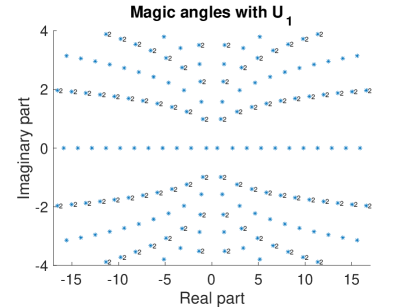
- For the potential $ U_1(z) $, which corresponds to the standard Bistritzer-MacDonald model, there are infinitely many complex magic angles with fourfold degeneracy, and numerical evidence suggests real magic angles emerge under magnetic fields.
- The Chern number for the fourfold-degenerate flat bands is computed, confirming topological nontriviality, and the curvature of the associated holomorphic line bundle is shown to be symmetric under $ k \mapsto \bar{\omega}k $.
- Numerical results confirm that the system exclusively produces flat bands of either twofold or fourfold multiplicity at each magic angle, with no higher degeneracies observed.
- The geometric multiplicity of the eigenvalue $ 1/\alpha $ for the operator $ T_0 $ is found to be one even when the algebraic multiplicity is two, indicating non-diagonalizability of $ T_k $ in general.
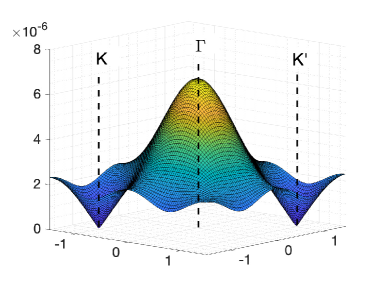
- The curvature of the Berry connection exhibits extrema at the Dirac points $ K, \Gamma, K' $, and numerical plots show monotonic increase in standard deviation of curvature for real two-fold degenerate magic angles, contrasting with the simple magic angle case.
Better researchstarts right now
From reading papers to final review, dramatically reduce your research time.
No credit card · Free plan available
This review was created by AI and reviewed by human editors.