
[Paper Review] Demonstration of Robust and Efficient Quantum Property Learning with Shallow Shadows
This paper introduces the robust shallow shadows protocol, a noise-mitigated quantum property learning framework that uses Bayesian inference to model and correct for experimental noise in shallow random quantum circuits. It enables accurate estimation of quantum state properties—such as fidelity, entanglement entropy, and expectation values—on noisy superconducting hardware with lower sample complexity than standard random single-qubit measurements.
Extracting information efficiently from quantum systems is a major component of quantum information processing tasks. Randomized measurements, or classical shadows, enable predicting many properties of arbitrary quantum states using few measurements. While random single-qubit measurements are experimentally friendly and suitable for learning low-weight Pauli observables, they perform poorly for nonlocal observables. Prepending a shallow random quantum circuit before measurements maintains this experimental friendliness, but also has favorable sample complexities for observables beyond low-weight Paulis, including high-weight Paulis and global low-rank properties such as fidelity. However, in realistic scenarios, quantum noise accumulated with each additional layer of the shallow circuit biases the results. To address these challenges, we propose the \emph{robust shallow shadows protocol}. Our protocol uses Bayesian inference to learn the experimentally relevant noise model and mitigate it in postprocessing. This mitigation introduces a bias-variance trade-off: correcting for noise-induced bias comes at the cost of a larger estimator variance. Despite this increased variance, as we demonstrate on a superconducting quantum processor, our protocol correctly recovers state properties such as expectation values, fidelity, and entanglement entropy, while maintaining a lower sample complexity compared to the random single qubit measurement scheme. We also theoretically analyze the effects of noise on sample complexity and show how the optimal choice of the shallow shadow depth varies with noise strength. This combined theoretical and experimental analysis positions the robust shallow shadow protocol as a scalable, robust, and sample-efficient protocol for characterizing quantum states on current quantum computing platforms.
Motivation & Objective
- Address the gap in experimental validation of shallow shadows under realistic noise conditions.
- Overcome the bias introduced by noise in shallow quantum circuits during quantum property estimation.
- Maintain low sample complexity while enabling robust estimation of nonlocal and global observables like fidelity and entanglement entropy.
- Develop a postprocessing framework that learns the noise model from calibration data to correct for measurement bias.
- Demonstrate scalability and efficiency of the protocol on a real 127-qubit superconducting processor (ibm_kyiv).
Proposed method
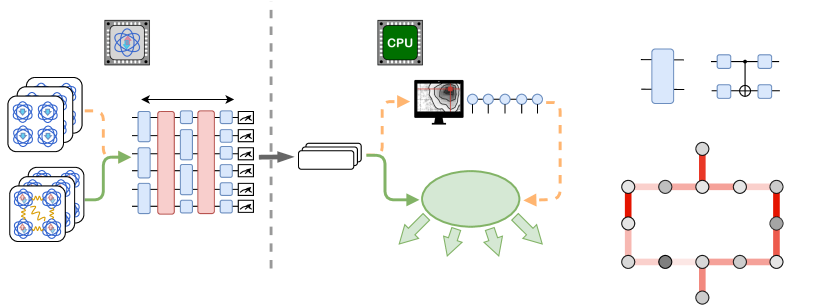
- Prepend a shallow random quantum circuit to single-qubit measurements to enable efficient learning of nonlocal and global observables.
- Use Bayesian inference to learn the device-specific noise model from experimental calibration data collected on the quantum processor.
- Apply postprocessing mitigation to correct for noise-induced bias in estimator expectations, balancing bias and variance.
- Construct a spatially correlated noise model to capture realistic noise effects in multi-qubit circuits.
- Leverage classical shadows framework to enable 'measure once, learn many' property estimation from a single dataset.
- Theoretical analysis quantifies the impact of noise on optimal circuit depth and sample complexity, guiding protocol design.
Experimental results
Research questions
- RQ1How does noise in shallow quantum circuits affect the accuracy of quantum property estimation using classical shadows?
- RQ2What is the optimal depth of shallow random circuits under realistic noise conditions, and how does it scale with noise strength?
- RQ3Can Bayesian inference effectively learn and mitigate device-specific noise in postprocessing to restore estimator accuracy?
- RQ4To what extent does the robust shallow shadows protocol reduce sample complexity compared to single-qubit random measurements?
- RQ5Can the protocol reliably recover global properties like fidelity and entanglement entropy on noisy, near-term quantum hardware?
Key findings
- The robust shallow shadows protocol successfully recovers quantum state properties—including expectation values, fidelity, and entanglement entropy—on a 127-qubit superconducting processor (ibm_kyiv) despite significant noise.
- The protocol maintains lower sample complexity than standard single-qubit random measurement schemes, even under realistic noise conditions.
- Theoretical analysis shows that optimal shallow circuit depth decreases with increasing noise strength, and this trade-off is quantitatively characterized.
- Bayesian noise modeling enables effective mitigation of noise-induced bias, though at the cost of increased estimator variance, which is empirically manageable.
- Monte Carlo simulations and experimental data on the AKLT state and Bell states confirm consistent performance across different quantum states and circuit depths.
- The protocol achieves accurate estimation of low-rank global observables such as fidelity and entanglement entropy, which are poorly estimated by single-qubit random measurements.
Better researchstarts right now
From reading papers to final review, dramatically reduce your research time.
No credit card · Free plan available
This review was created by AI and reviewed by human editors.