
[Paper Review] Density and Affinity Dependent Social Segregation and Arbitrage Equilibrium in a Multi-class Schelling Game
This paper proposes a game-theoretic model based on statistical teleodynamics to explain density- and affinity-dependent social segregation in multi-class Schelling-type systems. By modeling agents' utility as a function of neighborhood composition and density, the framework predicts phase separation into distinct socioeconomic clusters, with arbitrage equilibrium ensuring equal effective utility across all agents—offering a mathematical explanation for why denser cities may paradoxically increase segregation despite higher interaction potential.
Contrary to the widely believed hypothesis that larger, denser cities promote socioeconomic mixing, a recent study (Nilforoshan et al. 2023) reports the opposite behavior, i.e. more segregation. Here, we present a game-theoretic model that predicts such a density-dependent segregation outcome in both one- and two-class systems. The model provides key insights into the analytical conditions that lead to such behavior. Furthermore, the arbitrage equilibrium outcome implies the equality of effective utilities among all agents. This could be interpreted as all agents being equally "happy" in their respective environments in our ideal society. We believe that our model contributes towards a deeper mathematical understanding of social dynamics and behavior, which is important as we strive to develop more harmonious societies.
Motivation & Objective
- To explain the counterintuitive empirical observation that denser cities exhibit increased socioeconomic segregation rather than integration.
- To develop a mathematical framework that models social segregation as a result of utility-driven agent behavior in multi-class systems.
- To identify the analytical conditions under which phase separation (i.e., segregation) emerges in one- and two-class Schelling games.
- To demonstrate that arbitrage equilibrium leads to equal effective utility across all agents, implying a state of 'equal happiness' despite segregation.
- To establish a formal link between statistical mechanics and game theory in modeling self-organization in sociological systems.
Proposed method
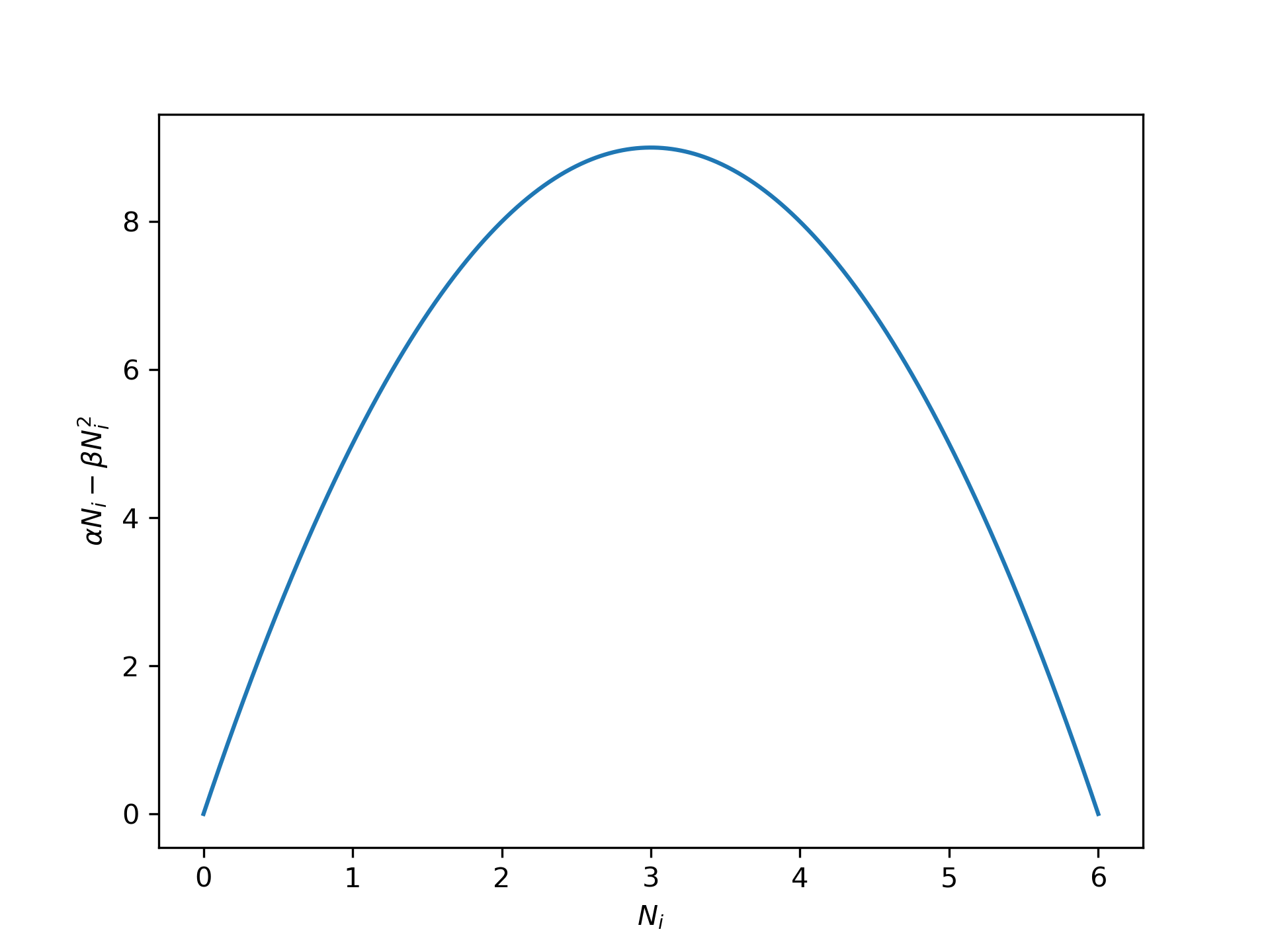
- Formalizing effective utility as a function of neighborhood density and agent affinity, incorporating benefits of similarity and costs of overcrowding.
- Applying statistical teleodynamics—a synthesis of population game theory and statistical mechanics—to model agent self-organization and equilibrium states.
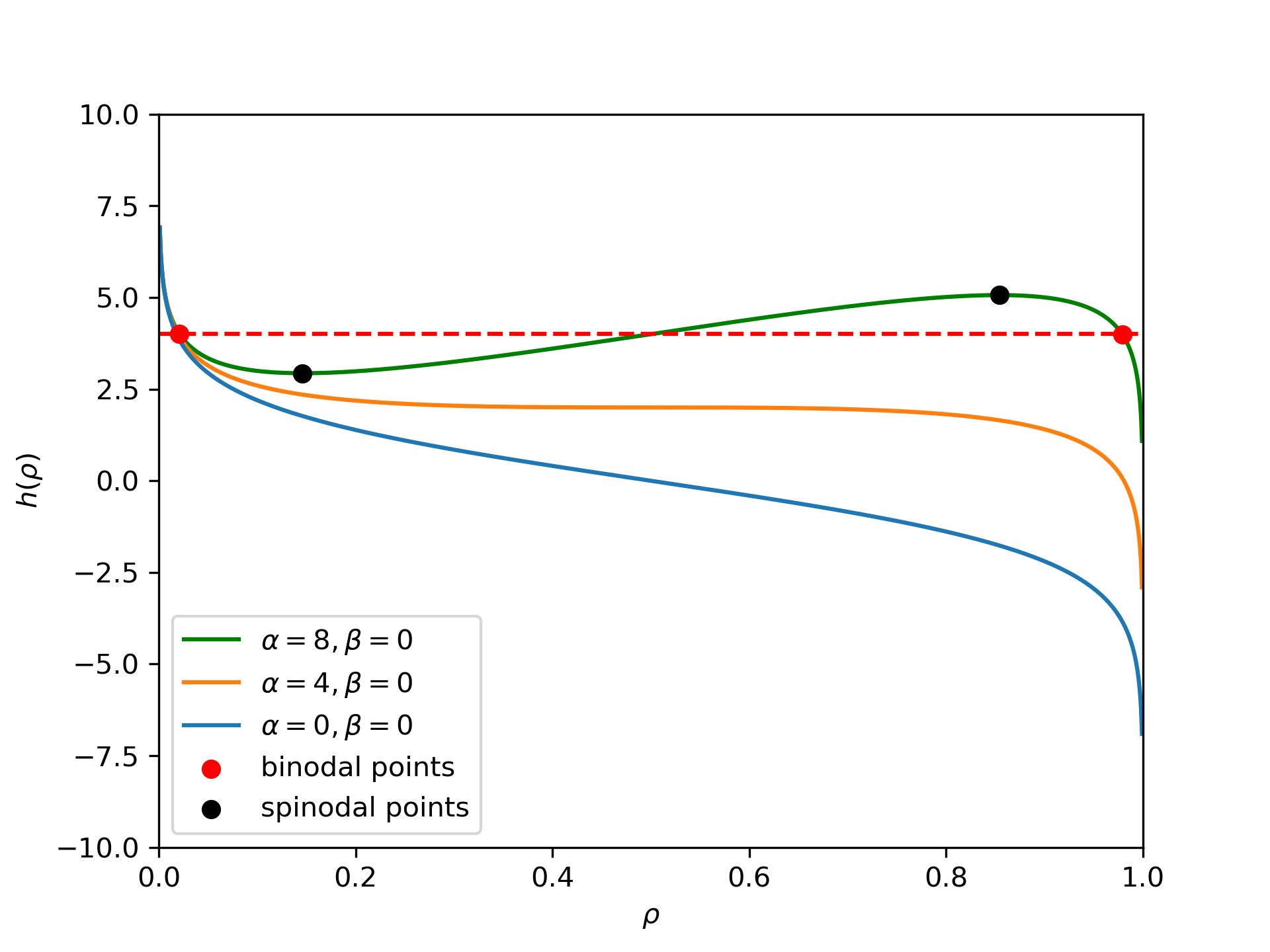
- Deriving the game-theoretic potential function for two-class systems using utility expressions involving density-dependent terms and logarithmic entropy penalties.
- Using the Hessian matrix of the potential function to determine concavity and predict phase separation, with positive eigenvalues indicating non-concave potentials and instability leading to segregation.
- Performing grid sweeps over parameters α and β to map the regime where the potential function is non-concave, signaling the onset of phase separation.
- Validating theoretical predictions via agent-based simulations that reproduce three-phase configurations with exact density matches to analytical predictions.
Experimental results
Research questions
- RQ1Under what conditions does increased population density lead to greater socioeconomic segregation in multi-agent systems?
- RQ2How do affinity (preference for similar others) and density jointly influence the emergence of segregated spatial configurations?
- RQ3What mathematical conditions on utility functions lead to phase separation in one- and two-class Schelling games?
- RQ4How does the concept of arbitrage equilibrium—where all agents achieve equal effective utility—coexist with persistent social segregation?
- RQ5In what parameter regimes does the potential function become non-concave, signaling the onset of phase separation in two-class systems?
Key findings
- Phase separation emerges when the Hessian of the game-theoretic potential function has at least one positive eigenvalue, indicating non-concavity of the potential.
- For α = 5 and β = 0, the simulation results matched theoretical predictions exactly, showing three distinct phases with densities ρ*G,I, ρ*R,I, ρ*G,II, ρ*R,II, ρ*G,III, and ρ*R,III.
- The parametric regime where phase separation occurs is identified as the region in the α–β plane where the Hessian has at least one positive eigenvalue across the full density domain.
- The model predicts that higher density enables more pronounced segregation, contradicting the assumption that urban density promotes integration.
- Arbitrage equilibrium ensures that all agents, regardless of class or location, achieve equal effective utility, suggesting a stable but segregated equilibrium.
- The framework successfully maps the transition from homogeneous to segregated configurations using a continuous potential function and Hessian analysis.
Better researchstarts right now
From reading papers to final review, dramatically reduce your research time.
No credit card · Free plan available
This review was created by AI and reviewed by human editors.