
[Paper Review] Density-matrix-renormalization-group-based downfolding of the three-band Hubbard model: the importance of density-assisted hopping
The paper uses DMRG-computed natural orbitals to downfold the three-band Hubbard (Emery) model to a single-band model, revealing a substantial density-assisted hopping term (t_n) that significantly affects hole-doped pairing and mobility beyond mean-field expectations.
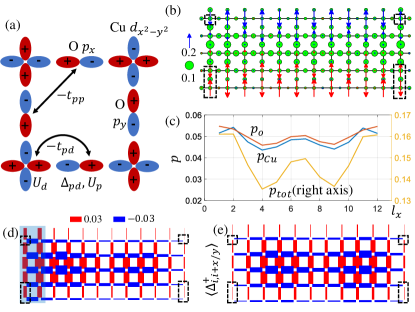
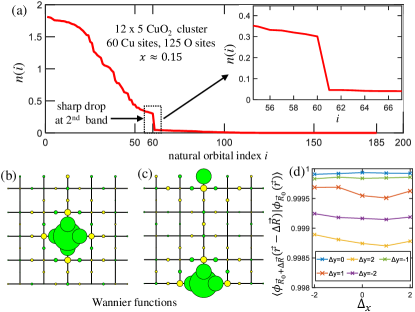
Typical Wannier-function downfolding starts with a mean-field or density functional set of bands to construct the Wannier functions. Here we carry out a controlled approach, using DMRG-computed natural orbital bands, to downfold the three-band Hubbard model to an effective single band model. A sharp drop-off in the natural orbital occupancy at the edge of the first band provides a clear justification for a single-band model. Constructing Wannier functions from the first band, we compute all possible two-particle terms and retain those with significant magnitude. The resulting single-band model includes two-site density-assisted hopping terms with $t_n \sim 0.6 t$. These terms lead to a reduction of the ratio $U/t_{ m eff}$, and are important in capturing the doping-asymmetric carrier mobility, as well as in enhancing the pairing in a single-band model for the hole-doped cuprates.
Motivation & Objective
- Justify downfolding from the three-band Hubbard model to a single-band model using DMRG-derived natural orbitals.
- Identify and retain significant two-particle terms in the Wannier transformation.
- Show that density-assisted hopping terms renormalize effective hopping and influence pairing.
- Demonstrate that these terms are essential for capturing doping asymmetry and superconducting tendencies.
- Assess limitations of mean-field treatments for the density-assisted hopping terms.
Proposed method
- Compute natural orbitals from DMRG for the three-band Hubbard model to identify occupied bands.
- Construct Cu-centered Wannier functions from the first natural band and derive a Wannier Hamiltonian.
- Transform the three-band Hamiltonian into the Wannier basis and truncate to significant single-particle and two-particle terms.
- Retain density-assisted hopping terms t_n and its neighbors (t_n', t_n'') based on magnitude criteria.
- Compare the downfolded single-band model (with t_n) to a mean-field effective Hubbard model (t_eff) to assess impact on mobility and pairing.
- Evaluate superconducting phase stiffness under edge-pair fields to gauge pairing tendencies.
Experimental results
Research questions
- RQ1Can a single-band model accurately reproduce key features of the three-band Hubbard model for cuprates?
- RQ2What is the role and magnitude of density-assisted hopping terms in the downfolded model?
- RQ3How do t_n and related terms affect hole-doped mobility and pairing compared to a mean-field t_eff?
- RQ4Do density-assisted hoppings qualitatively alter superconducting tendencies in hole-doped systems?
- RQ5Is the downfolding robust across different three-band parameter regimes and system sizes?
Key findings
- A sharp drop-off in natural orbital occupancies after the first band justifies a single-band downfolding.
- The resulting Wannier single-band model includes sizable two-site density-assisted hopping terms t_n ~ 0.6 t, and related t_n' and t_n'' terms.
- Density-assisted hopping reduces the effective U/t ratio (via t_eff = t + t_n ⟨n⟩) and enhances hole mobility, promoting pairing.
- Mean-field treatment of t_n underestimates hole-pair mobility and cannot capture the enhanced pairingseen in the full t-t_n-U model.
- Edge-field tests show the t-t_n-U model exhibits substantially larger superconducting phase stiffness in hole-doped cases than the t_eff-U model.
- The downfolded model maintains similar WF overlaps across hole and electron doping, indicating the downfolding is governed by local physics.
Better researchstarts right now
From reading papers to final review, dramatically reduce your research time.
No credit card · Free plan available
This review was created by AI and reviewed by human editors.