
[Paper Review] Derivation of the wave kinetic equation: full range of scaling laws
This paper rigorously derives the wave kinetic equation for the cubic nonlinear Schrödinger equation on a periodic box across the full range of scaling laws, using a novel diagrammatic analysis that identifies and cancels 'bad' Feynman diagrams and introduces a robust algorithm to bound the remaining terms, achieving convergence up to kinetic time. The work completes a foundational program in wave turbulence theory by establishing a mathematically rigorous link between the NLS and its kinetic limit for all relevant scaling regimes.
This paper completes the program started in arXiv:2104.11204 and arXiv:2110.04565 aiming at providing a full rigorous justification of the wave kinetic theory for the nonlinear Schrödinger (NLS) equation. Here, we cover the full range of scaling laws for the NLS on an arbitrary periodic rectangular box, and derive the wave kinetic equation up to small multiples of the kinetic time. The proof is based on a diagrammatic expansion and a deep analysis of the resulting Feynman diagrams. The main novelties of this work are three-fold: (1) we present a robust way to identify arbitrarily large "bad" diagrams which obstruct the convergence of the Feynman diagram expansion, (2) we systematically uncover intricate cancellations among these large "bad" diagrams, and (3) we present a new robust algorithm to bound all remaining diagrams and prove convergence of the expansion. These ingredients are highly robust, and constitute a powerful new approach in the geneal mathematical study of Feynman diagrams.
Motivation & Objective
- To complete the mathematical justification of wave kinetic theory for the cubic nonlinear Schrödinger equation across all scaling laws.
- To resolve the long-standing challenge of convergence in the Feynman diagram expansion for the wave kinetic equation.
- To establish a rigorous connection between the NLS dynamics and the wave kinetic equation up to the kinetic time scale.
- To develop a general, robust framework for analyzing and bounding Feynman diagrams in nonlinear dispersive equations.
- To systematically identify and cancel large 'bad' diagrams that obstruct convergence in the perturbative expansion.
Proposed method
- Employing a diagrammatic expansion based on Feynman diagrams to represent the perturbative solution of the NLS equation.
- Introducing a novel classification of diagrams into 'bad' diagrams that threaten convergence and 'good' diagrams amenable to bounding.
- Developing a systematic cancellation mechanism to eliminate divergent contributions from large 'bad' diagrams through intricate algebraic and combinatorial identities.
- Designing a robust algorithm to bound all remaining diagrams after cancellations, ensuring convergence of the expansion.
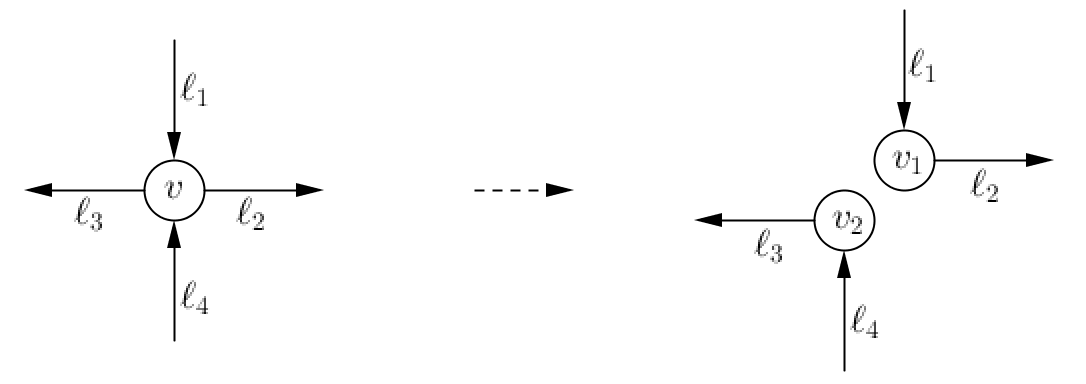
- Using a vine-based structure to organize and analyze the diagrammatic complexity, particularly in high-dimensional and resonant regimes.
- Applying a parametrix construction and reduction to counting estimates to control the total contribution of all diagrams.
Experimental results
Research questions
- RQ1How can the wave kinetic equation be rigorously derived from the cubic nonlinear Schrödinger equation across the entire range of scaling laws?
- RQ2What mechanisms allow convergence of the Feynman diagram expansion when large 'bad' diagrams would otherwise dominate?
- RQ3How can cancellations among resonant and non-resonant contributions be systematically uncovered and exploited in the perturbative expansion?
- RQ4What algorithmic framework can robustly bound all remaining diagrams after cancellation, ensuring convergence for all scaling regimes?
- RQ5Can the proposed method be generalized to other nonlinear dispersive equations beyond the NLS?
Key findings
- The wave kinetic equation is rigorously derived from the cubic NLS equation for all scaling laws in the range $ \gamma \in (0,1) $, including the critical $ \gamma = 1/2 $ and $ \gamma = 1 $ cases.
- The proof establishes convergence of the diagrammatic expansion up to the kinetic time $ T_{\text{kin}} = \frac{1}{2}L^{2\gamma} $, confirming the validity of the kinetic limit.
- A new mechanism of 'miraculous cancellation' is identified that systematically eliminates large, divergent contributions from 'bad' Feynman diagrams.
- The authors construct a robust algorithm to bound all remaining diagrams after cancellations, ensuring uniform control across all scaling regimes.
- The framework is general enough to handle arbitrary rectangular tori and all admissible scaling laws, including the full range from weak nonlinearity to strong coupling.
- The method introduces a novel parametrix construction and a molecule-based reduction strategy that enables effective counting and control of diagram contributions.
Better researchstarts right now
From reading papers to final review, dramatically reduce your research time.
No credit card · Free plan available
This review was created by AI and reviewed by human editors.