
[Paper Review] Detection of Covid-19 From Chest X-ray Images Using Artificial Intelligence: An Early Review
The paper surveys AI approaches using chest X-ray images to detect COVID-19 pneumonia, reporting several deep learning models and their accuracies on small datasets. It discusses challenges in distinguishing COVID-19 pneumonia from other causes.
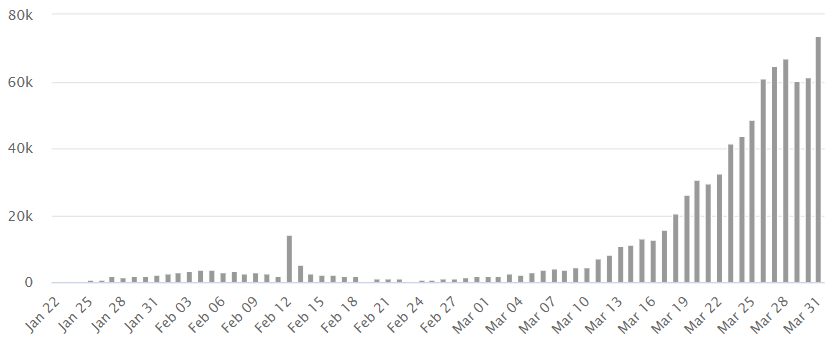
In 2019, the entire world is facing a situation of health emergency due to a newly emerged coronavirus (COVID-19). Almost 196 countries are affected by covid-19, while USA, Italy, China, Spain, Iran, and France have the maximum active cases of COVID-19. The issues, medical and healthcare departments are facing in delay of detecting the COVID-19. Several artificial intelligence based system are designed for the automatic detection of COVID-19 using chest x-rays. In this article we will discuss the different approaches used for the detection of COVID-19 and the challenges we are facing. It is mandatory to develop an automatic detection system to prevent the transfer of the virus through contact. Several deep learning architecture are deployed for the detection of COVID-19 such as ResNet, Inception, Googlenet etc. All these approaches are detecting the subjects suffering with pneumonia while its hard to decide whether the pneumonia is caused by COVID-19 or due to any other bacterial or fungal attack.
Motivation & Objective
- Motivate automatic, contact-free detection of COVID-19 from chest X-ray images to aid rapid isolation and treatment.
- Summarize existing AI/deep learning approaches (e.g., ResNet, Inception, GoogLeNet) used for COVID-19 detection in X-ray data.
- Highlight challenges, data limitations, and the need for larger, multi-class datasets for reliable differentiation of COVID-19 from other pneumonias.
Proposed method
- Literature review of AI-based approaches for COVID-19 detection from chest X-rays.
- Compilation of reported model performances on small datasets and comparison across architectures.
- Discussion of challenges such as distinguishing COVID-19 pneumonia from other pneumonias and data scarcity.
Experimental results
Research questions
- RQ1What deep learning architectures have been explored for detecting COVID-19 from chest X-ray images?
- RQ2What are the reported accuracies and dataset sizes for these approaches, and what limitations do they reveal?
- RQ3What challenges prevent reliable, clinical-grade COVID-19 detection from X-ray images?
Key findings
- Multiple studies report high accuracies (e.g., up to about 98%) on small datasets (50–728 images), using models like ResNet50, InceptionV3, VGG19, and others.
- Transfer learning and deep features are commonly employed to achieve notable performance on limited data.
- A major challenge is differentiating COVID-19 pneumonia from other causes of pneumonia, as many models focus on pneumonia detection rather than COVID-19 specificity.
- The paper emphasizes the need for larger, diverse, multi-class chest X-ray datasets to improve generalization and enable precise COVID-19 vs other pneumonias classification.
- Early AI approaches show promise for rapid screening, but depend heavily on data quality and labeled COVID-19 cases.
- The discussion places COVID-19 detection in X-ray context alongside CT-based AI methods and broader AI-driven pandemic monitoring tools.
Better researchstarts right now
From reading papers to final review, dramatically reduce your research time.
No credit card · Free plan available
This review was created by AI and reviewed by human editors.