
[Paper Review] Detection of presence and number of persons by a Wi-Fi signal: a practical RSSI-based approach
This paper proposes a practical RSSI-based method for detecting the presence and counting the number of people in a room using only Wi-Fi signal strength, without requiring active cooperation from individuals. By analyzing the standard deviation of RSSI time series and applying machine learning (especially Random Forest) on data from as few as four detectors, the method achieves 98% prediction accuracy for person counting, with 99% accuracy using five detectors.
We present experimental results and theoretical methods for the precise determination of the presence and the number of persons in an observed area by using Wi-Fi signals. Our setup does not require active cooperation of persons present in the Wi-Fi field, and relies only on the Received Signal Strength Indicator (RSSI), which is read by the detectors. We first show that the standard deviation of the measured RSSI data can be used as a practical tool to establish the presence of a person (or more persons) with high precision, in particular when the signal source is inside the measurement room. For the more difficult problem of counting the number of persons, we have employed machine learning algorithms to analyze data collected on nine different detectors and up to nine people present in our experiment. We have achieved excellent results (prediction accuracy of $98 \%$ and above) for counting already with only few detectors utilized in the analysis. While generalizations to nontrivial indoor geometries (such as odd shapes, more rooms, and greater size) may be of interest in some applications, where additional care with respect to positioning od detectors can be needed (or even placing additional detectors), this approach may be useful due to its conceptual practicality and solid prediction results.
Motivation & Objective
- To develop a passive, non-cooperative method for detecting and counting people in indoor environments using only Wi-Fi RSSI signals.
- To determine whether the standard deviation of RSSI time series can serve as a reliable indicator of human presence.
- To evaluate the performance of machine learning algorithms in accurately classifying the number of people based on RSSI data from multiple detectors.
- To identify the minimum number of detectors required to achieve high prediction accuracy for person counting.
- To assess the impact of signal source location (inside vs. outside the room) on detection and counting performance.
Proposed method
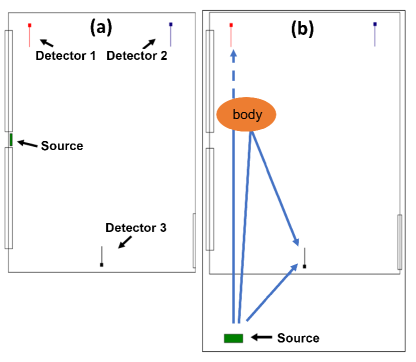
- The study uses RSSI measurements collected from nine fixed detectors placed in an indoor environment to monitor signal strength variations over time.
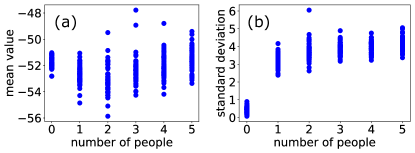
- The standard deviation of the RSSI time series is used as a key feature to detect the presence of one or more people, as it increases significantly when humans are present.
- For person counting, machine learning algorithms—including K-nearest neighbors, decision trees, and Random Forest—are trained on RSSI data to classify the number of people (from 1 to 9).
- The performance of each algorithm is evaluated based on prediction accuracy using varying numbers of detectors, from 1 to 9, to determine the minimal effective setup.
- The analysis includes both scenarios: when the Wi-Fi access point is inside the room and when it is located outside, to assess robustness.
- The Random Forest algorithm is selected as the best-performing model due to its high accuracy and stability across different detector configurations.
Experimental results
Research questions
- RQ1Can the standard deviation of RSSI time series reliably detect the presence of one or more people in a room without active cooperation?
- RQ2What is the minimum number of detectors required to achieve high-accuracy person counting using RSSI signals?
- RQ3How does the placement of the Wi-Fi access point (inside vs. outside the room) affect the detection and counting performance?
- RQ4To what extent can machine learning models trained on RSSI data accurately classify the number of people in a room?
- RQ5How does prediction accuracy improve with an increasing number of detectors, and does it plateau with a small number of detectors?
Key findings
- The standard deviation of RSSI time series is a highly effective feature for detecting the presence of one or more people, achieving high precision even with a single detector.
- When the Wi-Fi access point is located inside the room, the standard deviation-based method enables accurate binary detection of human presence.
- For person counting, machine learning models achieve 98% prediction accuracy using data from only four detectors, and 99% accuracy with five detectors.
- The Random Forest algorithm outperforms other models, reaching 99% average accuracy in classifying the number of people (for odd numbers from 1 to 9).
- Prediction accuracy increases with the number of detectors but plateaus significantly after four to five detectors, indicating that a minimal setup can achieve excellent performance.
- The method remains effective even when the signal source is outside the room, though performance is generally better when the access point is inside.
Better researchstarts right now
From reading papers to final review, dramatically reduce your research time.
No credit card · Free plan available
This review was created by AI and reviewed by human editors.