
[Paper Review] Differential Private Federated Transfer Learning for Mental Health Monitoring in Everyday Settings: A Case Study on Stress Detection
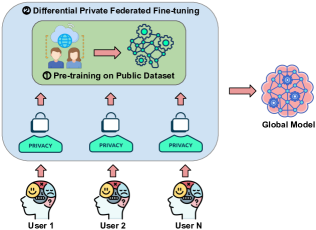
The paper proposes a differential private federated transfer learning framework for mental health monitoring, applied to stress detection, integrating pre-training on public data with federated on-device fine-tuning under DP to improve privacy and performance.
Mental health conditions, prevalent across various demographics, necessitate efficient monitoring to mitigate their adverse impacts on life quality. The surge in data-driven methodologies for mental health monitoring has underscored the importance of privacy-preserving techniques in handling sensitive health data. Despite strides in federated learning for mental health monitoring, existing approaches struggle with vulnerabilities to certain cyber-attacks and data insufficiency in real-world applications. In this paper, we introduce a differential private federated transfer learning framework for mental health monitoring to enhance data privacy and enrich data sufficiency. To accomplish this, we integrate federated learning with two pivotal elements: (1) differential privacy, achieved by introducing noise into the updates, and (2) transfer learning, employing a pre-trained universal model to adeptly address issues of data imbalance and insufficiency. We evaluate the framework by a case study on stress detection, employing a dataset of physiological and contextual data from a longitudinal study. Our finding show that the proposed approach can attain a 10% boost in accuracy and a 21% enhancement in recall, while ensuring privacy protection.
Motivation & Objective
- Address privacy concerns in mental health monitoring while leveraging limited, diverse data.
- Combine differential privacy with federated learning to protect participant data during model updates.
- Use transfer learning to mitigate data scarcity and imbalance by pre-training on a large public dataset and fine-tuning on-user data.
- Evaluate the framework on a stress detection case study using physiological and contextual data.
- Demonstrate privacy-utility trade-offs and robustness against privacy budget variations.
Proposed method
- Pre-train a universal model on a large public dataset using binary cross-entropy loss.
- Distribute the pre-trained model to clients and fine-tune on user-specific data, applying gradient clipping.
- Add Laplacian noise to gradients with scale Delta f / epsilon to achieve differential privacy during client updates.
- Aggregate noisy client updates via Federated Averaging to form a global model.
- Model uses a three-layer MLP with 12 HR/HRV features derived from PPG and motion data.
- Evaluate privacy-utility trade-offs by varying the privacy budget epsilon.
Experimental results
Research questions
- RQ1Can differential privacy integrated with federated learning protect sensitive mental health data without severely harming performance?
- RQ2Does transfer learning via a pre-trained universal model improve performance in data-scarce, personalized stress detection tasks?
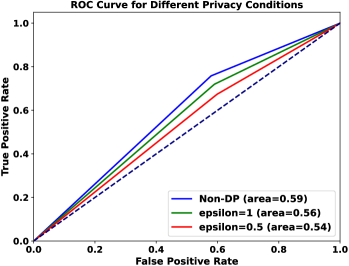
- RQ3What is the impact of the privacy budget (epsilon) on model accuracy, recall, and ROC in this setting?
- RQ4How does the proposed framework compare to non-federated or non-DP baselines in stress detection?
Key findings
- The integrated framework achieves higher accuracy and recall than baselines: 0.53 accuracy, 0.52 F1, 0.75 recall, 0.40 precision for the fine-tuned model.
- Plain model accuracy 0.43, F1 0.39, recall 0.54, precision 0.31; Pre-trained model accuracy 0.51, F1 0.44, recall 0.58, precision 0.36.
- Differential privacy via Laplacian noise with epsilon = 1 maintains ROC while enabling privacy protections.
- Recall improvement indicates better detection of stressed cases, reducing misses.
- Privacy-utility analysis shows DP-FL does not significantly degrade ROC in reported scenarios.
Better researchstarts right now
From reading papers to final review, dramatically reduce your research time.
No credit card · Free plan available
This review was created by AI and reviewed by human editors.