
[Paper Review] Dis-inhibitory neuronal circuits can control the sign of synaptic plasticity
This paper proposes a biologically plausible learning rule in which top-down dis-inhibitory circuits encode error signals that control the sign of synaptic plasticity. By deriving a Hebbian rule dependent on recurrent inhibition, the model naturally implements gradient-based learning without explicit error neurons, achieving performance comparable to backpropagation on vision benchmarks while reconciling functional theories with experimental plasticity rules.
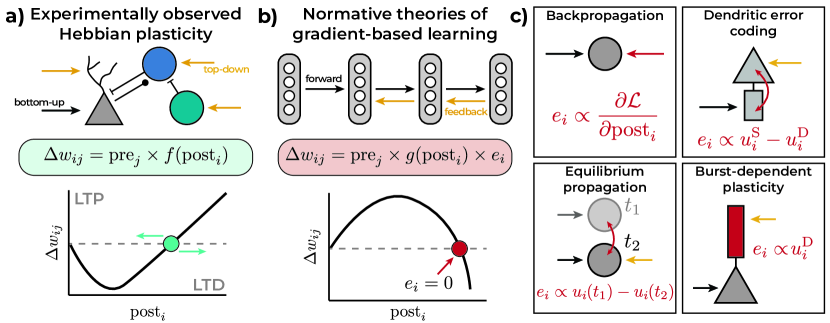
How neuronal circuits achieve credit assignment remains a central unsolved question in systems neuroscience. Various studies have suggested plausible solutions for back-propagating error signals through multi-layer networks. These purely functionally motivated models assume distinct neuronal compartments to represent local error signals that determine the sign of synaptic plasticity. However, this explicit error modulation is inconsistent with phenomenological plasticity models in which the sign depends primarily on postsynaptic activity. Here we show how a plausible microcircuit model and Hebbian learning rule derived within an adaptive control theory framework can resolve this discrepancy. Assuming errors are encoded in top-down dis-inhibitory synaptic afferents, we show that error-modulated learning emerges naturally at the circuit level when recurrent inhibition explicitly influences Hebbian plasticity. The same learning rule accounts for experimentally observed plasticity in the absence of inhibition and performs comparably to back-propagation of error (BP) on several non-linearly separable benchmarks. Our findings bridge the gap between functional and experimentally observed plasticity rules and make concrete predictions on inhibitory modulation of excitatory plasticity.
Motivation & Objective
- To resolve the discrepancy between normative theories of gradient-based learning and phenomenological Hebbian plasticity rules in the brain.
- To demonstrate how error signals can be encoded in top-down dis-inhibitory inputs rather than explicit local error neurons.
- To develop a biologically plausible learning rule that accounts for experimentally observed plasticity dynamics while enabling effective credit assignment in deep networks.
- To show that inhibition-dependent plasticity can stabilize runaway Hebbian learning and support non-linearly separable tasks.
Proposed method
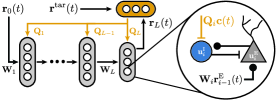
- The authors extend the Deep Feedback Control (DFC) framework to a dis-inhibitory microcircuit motif, where top-down inputs target inhibitory interneurons to modulate excitation.
- A Hebbian plasticity rule is derived with explicit dependence on inhibitory current, allowing the sign of plasticity to be controlled by dis-inhibitory feedback.
- The learning rule is implemented using a control-theoretic framework that computes feedback weights from the network Jacobian, with both instantaneous and averaged Jacobian-based feedback for biological plausibility.
- Numerical simulations use Tsitouras' 5th-order Runge-Kutta method with adaptive step size to solve dynamical equations until equilibrium, followed by weight updates via ADAM optimizer.
- Classification tasks use a linear output layer with cross-entropy loss and soft targets (0.99 for correct class, 0.01/(n−1) for others) to avoid issues with Softmax saturation.
- Feedback weights are calculated as normalized Jacobians, with both input-dependent and average-Jacobian variants tested for biological plausibility.
Experimental results
Research questions
- RQ1Can dis-inhibitory microcircuits naturally encode error signals to control the sign of synaptic plasticity without explicit error neurons?
- RQ2How can a Hebbian plasticity rule with inhibition dependence reproduce experimentally observed plasticity dynamics?
- RQ3Can such a rule achieve performance comparable to backpropagation in deep networks?
- RQ4Is the learning rule stable and capable of handling non-linearly separable tasks?
Key findings
- The dis-inhibitory learning rule achieved validation accuracy of 97.5±0.19% on MNIST with a 3-layer network using the exact inverse feedback rule, comparable to BP's 98.2±0.14%.
- With averaged Jacobian feedback, the rule achieved 96.9±1.6% accuracy on 3-layer MNIST, demonstrating robustness to biologically implausible input-dependent feedback.
- On Fashion-MNIST, the rule reached 90.0±0.38% accuracy with exact inverse feedback, matching BP's 90.3±0.34% on the same task.
- The model successfully stabilized runaway Hebbian plasticity through inhibition-dependent learning, preventing uncontrolled weight growth.
- The derived learning rule qualitatively matched phenomenological plasticity models under simulated experimental conditions, resolving a key inconsistency in the literature.
- The framework predicts that top-down dis-inhibitory inputs to specific interneurons can gate excitatory plasticity, offering testable hypotheses for experimental validation.
Better researchstarts right now
From reading papers to final review, dramatically reduce your research time.
No credit card · Free plan available
This review was created by AI and reviewed by human editors.