
[Paper Review] Discovery of the missing intermediate-mass helium stars stripped in binaries
This paper identifies a long-sought population of intermediate-mass helium stars (2–8 M⊙) stripped of their hydrogen envelopes via binary interactions, using excess ultraviolet emission in the Large and Small Magellanic Clouds. The discovery of 25 systems with high temperatures (60–100 kK), high surface gravities (log g ≈ 5), and radial velocity variations confirms their existence and fills a critical gap in massive star evolution models.
The theory of binary evolution predicts that many massive stars should lose their hydrogen-rich envelopes via interaction with a companion -- revealing hot helium stars with masses of $\sim$2--8M$_{\odot}$. However, only one candidate system had been identified, leaving a large discrepancy between theory and observation. Here, we present a new sample of stars -- identified via excess ultraviolet emission -- whose luminosities, colors, and spectral morphologies are consistent with predictions for the missing population. We detect radial velocity variations indicative of binary motion and measure high temperatures ($T_{ m eff}\sim60-100$kK), high surface gravities ($\log(g)\sim5$) and depleted surface hydrogen mass fractions ($X_{ m{H,surf}}\lesssim0.3$), which match expectations for stars with initial masses between 8--25 M$_{\odot}$ that have been stripped via binary interaction. These systems fill the helium star mass gap between subdwarfs and Wolf-Rayet stars, and are thought to be of large astrophysical significance as ionizing sources, progenitors of stripped-envelope supernovae and merging double neutron stars.
Motivation & Objective
- Address the long-standing discrepancy between binary evolution theory and observations, which predicted a large population of intermediate-mass helium stars (2–8 M⊙) stripped via binary interaction but only one candidate had been observed.
- Overcome observational bias in detecting these stars, which are often obscured by bright main-sequence companions and exhibit weak wind features.
- Identify a new detection method using excess ultraviolet emission in UV-optical color-magnitude diagrams to isolate binary systems with stripped helium cores.
- Confirm the existence of a population of massive stars with initial masses of 8–25 M⊙ that have undergone binary stripping, filling the gap between low-mass subdwarfs and high-mass Wolf-Rayet stars.
- Establish the astrophysical significance of these stars as progenitors of stripped-envelope supernovae and merging double neutron stars, and as sources of hard ionizing photons.
Proposed method
- Conducted deep UV photometry using Swift-UVOT on the Large and Small Magellanic Clouds (LMC/SMC), covering ~39 deg² in three UV filters (1928–2600 Å) with 2.5″ resolution.
- Applied forward modeling with The Tractor to perform forced PSF photometry at known star positions from the Magellanic Cloud Photometric Survey, improving source extraction in crowded fields.
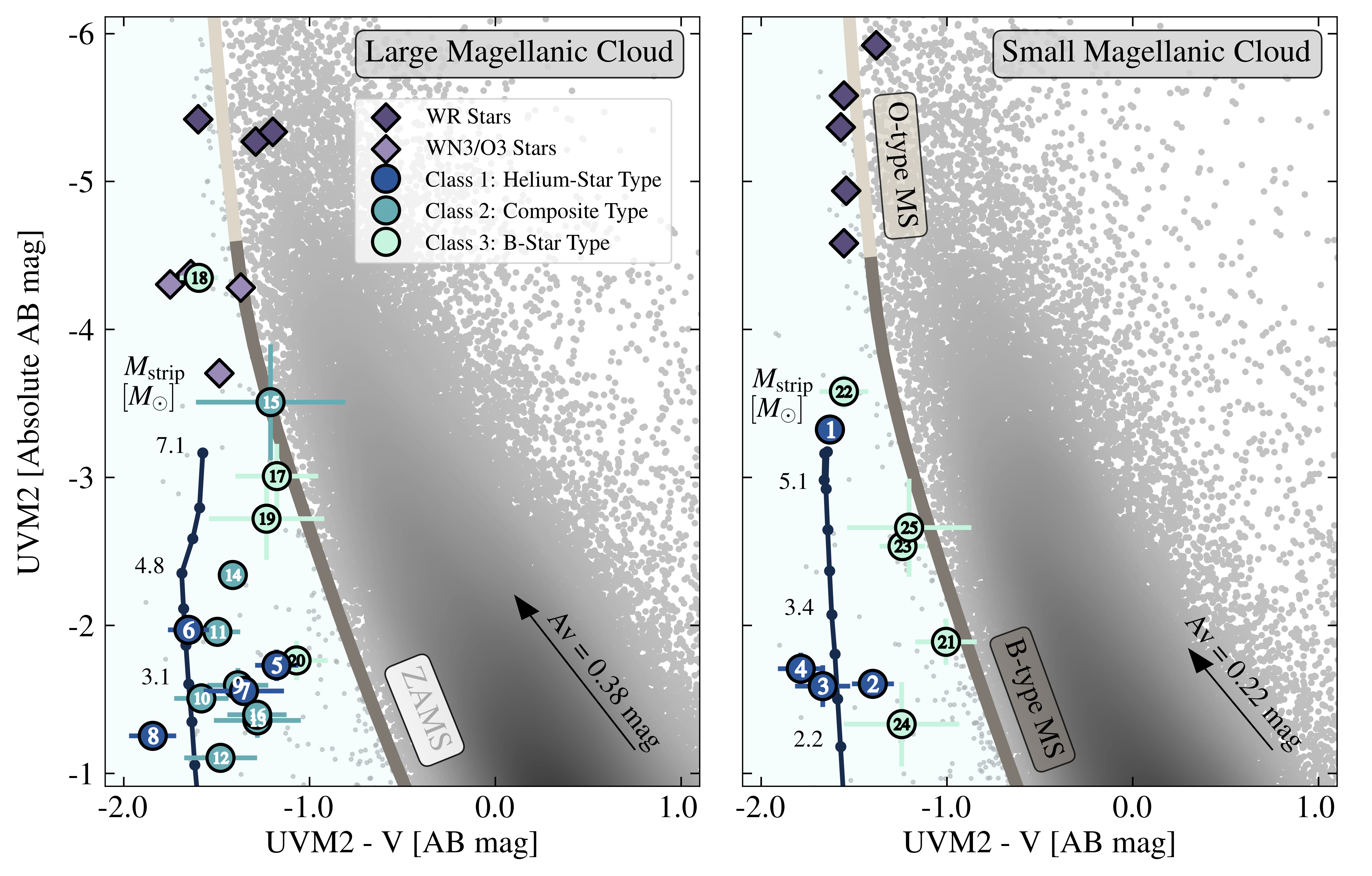
- Identified candidate systems via their location in UV-optical color-magnitude diagrams—blueward of the main sequence at intermediate luminosities (−1 mag > M_UV > −4 mag), a signature of binary systems with intermediate-mass helium stars.
- Obtained 1–30 spectroscopic observations per system with the MagE spectrograph on the 6.5m Magellan-Baade telescope to measure radial velocities and confirm binary motion.
- Used Gaia DR3 astrometry (parallax and proper motions) to validate radial velocity consistency and 3D kinematics, rejecting foreground contaminants.
- Synthesized theoretical spectra for stripped star + main-sequence binary systems to predict UV-optical colors and guide the search.
Experimental results
Research questions
- RQ1Why has the predicted population of intermediate-mass helium stars (2–8 M⊙) stripped via binary interaction remained undetected despite theoretical predictions of their ubiquity?
- RQ2Can excess ultraviolet emission in UV-optical color-magnitude diagrams serve as a reliable diagnostic for identifying binary systems hosting intermediate-mass helium stars?
- RQ3Do radial velocity variations and kinematic consistency with Magellanic Cloud stars confirm the binary nature and distance of candidate systems?
- RQ4What are the physical properties (temperature, gravity, surface composition) of these candidate stars, and do they match predictions for stripped stars from 8–25 M⊙ initial mass progenitors?
- RQ5To what extent do these stars contribute to key astrophysical processes such as ionizing photon production, stripped-envelope supernovae, and double neutron star formation?
Key findings
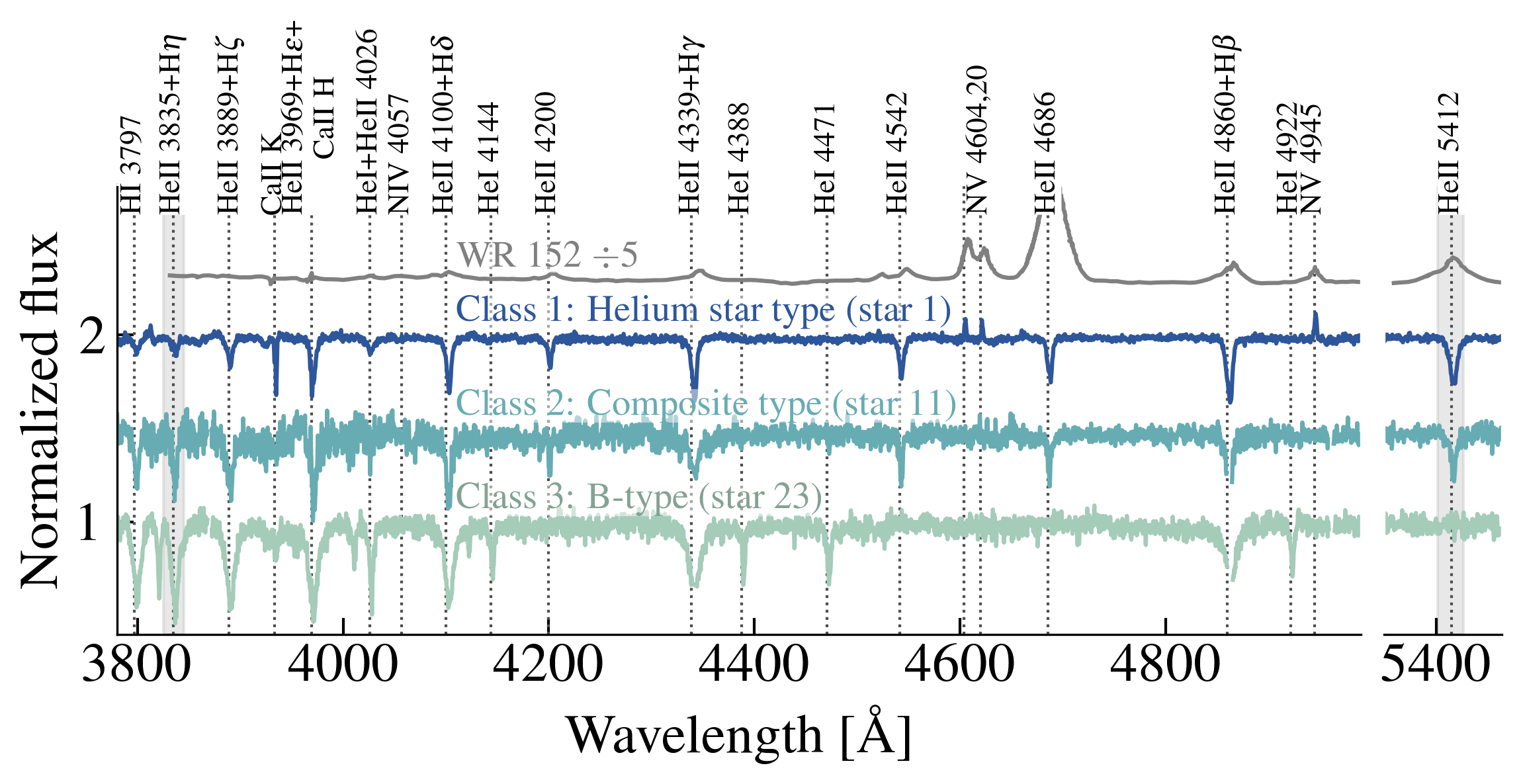
- The study identifies 25 candidate systems with excess UV emission, luminosities, colors, and spectral morphologies consistent with intermediate-mass helium stars (2–8 M⊙) stripped via binary interaction.
- All 16 systems with multiple spectroscopic epochs show radial velocity variations, confirming their binary nature and orbital motion.
- Measured effective temperatures of 60–100 kK and surface gravities of log g ≈ 5, consistent with hot, compact helium cores.
- Surface hydrogen mass fractions are depleted (X_H,surf ≲ 0.3), confirming helium-core dominance and stripping via binary interaction.
- Kinematic analysis using Gaia DR3 shows that 23 of the 25 systems have 3D motions consistent with O/B-type stars in the LMC and SMC, supporting their membership in the Magellanic Clouds.
- The discovery fills the critical mass gap between low-mass subdwarfs (≲1.5 M⊙) and high-mass Wolf-Rayet stars (≳8 M⊙), resolving a long-standing discrepancy in massive star evolution models.
Better researchstarts right now
From reading papers to final review, dramatically reduce your research time.
No credit card · Free plan available
This review was created by AI and reviewed by human editors.