
[Paper Review] Discrete Event Simulation: It's Easy with SimPy!
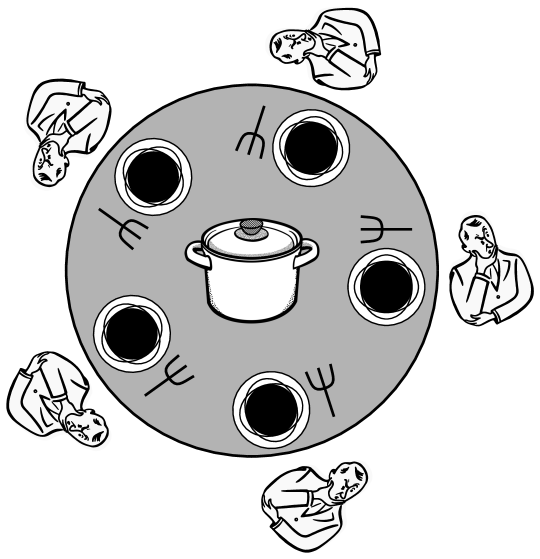
This paper demonstrates how to build and analyze discrete event simulation models using SimPy in Python, illustrated with the Dining Philosophers problem and extensions for resources, statistics, and customer-service-like interactions.
This paper introduces the practicalities and benefits of using SimPy, a discrete event simulation (DES) module written in Python, for modeling and simulating complex systems. Through a step-by-step exploration of the classical Dining Philosophers Problem, we demonstrate how SimPy enables the efficient construction of discrete event models, emphasizing system states, transitions, and event handling. We extend the scenario to introduce resources, such as chopsticks, to model contention and deadlock conditions, and showcase SimPy's capabilities in managing these scenarios. Furthermore, we explore the integration of SimPy with other Python libraries for statistical analysis, showcasing how simulation results inform system design and optimization. The versatility of SimPy is further highlighted through additional modeling scenarios, including resource constraints and customer service interactions, providing insights into the process of building, debugging, simulating, and optimizing models for a wide range of applications. This paper aims to make DES accessible to practitioners and researchers alike, emphasizing the ease with which complex simulations can be constructed, analyzed, and visualized using SimPy and the broader Python ecosystem.
Motivation & Objective
- Introduce SimPy as a practical tool for discrete event simulation in Python.
- Show how to model a classical concurrency problem (Dining Philosophers) with resources and processes in SimPy.
- Demonstrate integration of SimPy simulations with Python data analysis and visualization libraries.
- Explore extensions such as containers, impatient processes, and direct process communication to model more realistic scenarios.
- Provide guidance on debugging, running, and interpreting simulation results for design optimization.
Proposed method
- Create a SimPy Environment and define resources (e.g., chopsticks as Resource objects) to model contention and mutual exclusion.
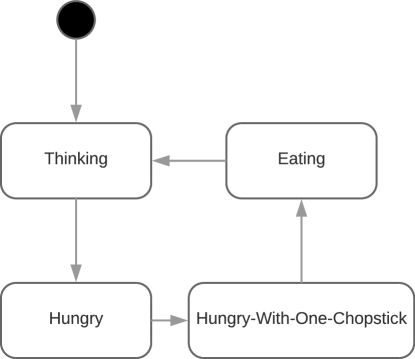
- Represent active entities (philosophers) as Python generator-based processes that yield events like timeout, request, and release.
- Use subprocesses (get_hungry) to encapsulate sub-tasks and return resource handles for later release.
- Instrument simulations to measure performance metrics (e.g., waiting time) and integrate with NumPy, Pandas, SciPy, and matplotlib for analysis and visualization.
- Extend the model with a container (rice bowl) and a replenishing mechanism (chef) to study resource consumption and replenishment effects.
- Demonstrate handling of deadlock, alternatives for deadlock avoidance, and impatient behavior using combined events (AnyOf) and timeouts.
Experimental results
Research questions
- RQ1How can SimPy be used to model discrete event systems in Python with clear state and event handling?
- RQ2What are the effects of resource contention and deadlock in the Dining Philosophers scenario when implemented in SimPy?
- RQ3How can simulation results be gathered, analyzed, and visualized using Python libraries to inform design decisions?
- RQ4What extensions (containers, impatience, direct communication) can make DES models more realistic and robust?
- RQ5How do changes in model parameters (e.g., number of philosophers, replenishment rate) impact performance metrics like waiting time?
Key findings
- SimPy enables stepping through DES models by defining environments, resources, and processes, and yields control via events.
- In the classical Dining Philosophers setup, increasing the number of philosophers raises waiting times, with a plateau-like behavior for three or more philosophers in the basic model.
- Adding a rice bowl container and a replenishing chef introduces a realistic bottleneck that affects waiting times, especially as party size grows.
- Impatient philosophers and timeout mechanisms can mitigate deadlock effects and alter waiting times, particularly under high contention.
- Direct communication patterns (interrupts and event-based synchronization) illustrate practical customer-service-like interactions and process coordination.
- SimPy models can be seamlessly integrated with statistics and visualization libraries to analyze performance metrics like waiting time.
Better researchstarts right now
From reading papers to final review, dramatically reduce your research time.
No credit card · Free plan available
This review was created by AI and reviewed by human editors.