
[Paper Review] Doubly Coupled Designs for Computer Experiments with both Qualitative and Quantitative Factors
This paper proposes doubly coupled designs (DCDs) for computer experiments with both qualitative and quantitative factors, ensuring optimal stratification between quantitative factors and every individual qualitative factor as well as every pair of qualitative factors. By extending marginally coupled designs, DCDs achieve superior space-filling properties through algebraic constructions based on orthogonal arrays and permutations, with existence conditions and three distinct construction methods established for practical implementation.
Computer experiments with both qualitative and quantitative input variables occur frequently in many scientific and engineering applications. How to choose input settings for such experiments is an important issue for accurate statistical analysis, uncertainty quantification and decision making. Sliced Latin hypercube designs are the first systematic approach to address this issue. However, it comes with the increasing cost associated with an increasing large number of level combinations of the qualitative factors. For the reason of run size economy, marginally coupled designs were proposed in which the design for the quantitative factors is a sliced Latin hypercube design with respect to each qualitative factor. The drawback of such designs is that the corresponding data may not be able to capture the effects between any two (and more) qualitative factors and quantitative factors. To balance the run size and design efficiency, we propose a new type of designs, doubly coupled designs, where the design points for the quantitative factors form a sliced Latin hypercube design with respect to the levels of any qualitative factor and with respect to the level combinations of any two qualitative factors, respectively. The proposed designs have the better stratification property between the qualitative and quantitative factors compared with marginally coupled designs. The existence of the proposed designs is established. Several construction methods are introduced, and the properties of the resulting designs are also studied.
Motivation & Objective
- To address the limitation of marginally coupled designs (MCDs), which fail to capture interaction effects between multiple qualitative factors and quantitative factors.
- To develop a new class of designs that maintain strong stratification between quantitative factors and all individual qualitative factors, as well as all pairwise combinations of qualitative factors.
- To balance run size economy with improved design efficiency for emulating complex computer simulators involving mixed factor types.
- To establish existence conditions and provide systematic construction methods for doubly coupled designs (DCDs) with guaranteed structural and statistical properties.
Proposed method
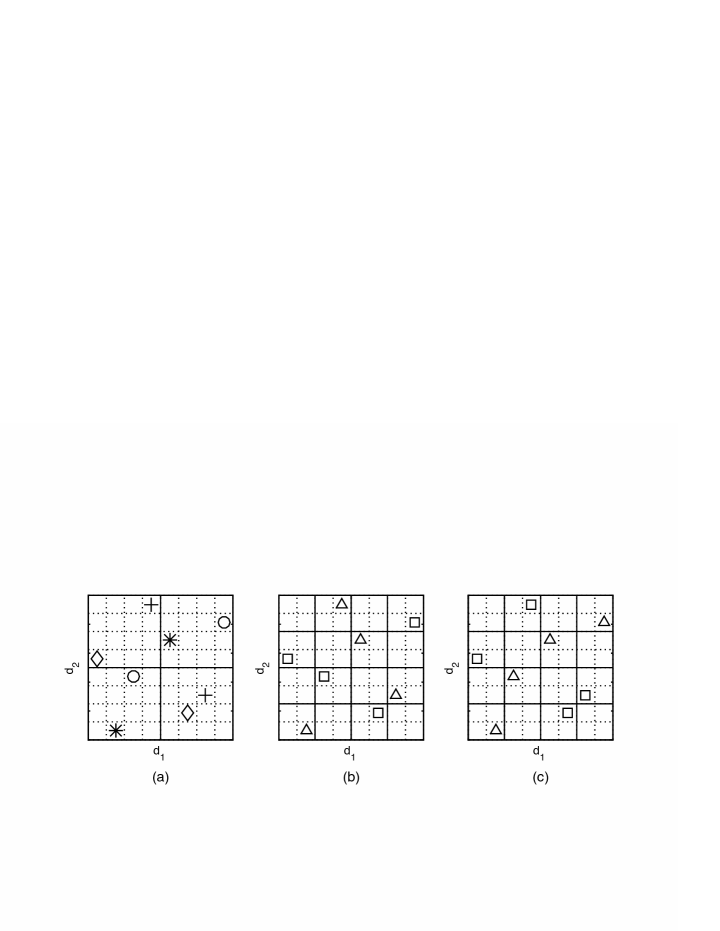
- Proposes doubly coupled designs (DCDs) where the quantitative factor design forms a sliced Latin hypercube (SLHD) with respect to each individual qualitative factor and every pair of qualitative factors.
- Employs orthogonal arrays (OAs) as the design for qualitative factors, specifically using an OA(n, q, s, 2) as the base structure for the qualitative factor design D₁.
- Introduces three algebraic construction methods: Construction 1 and 2 use permutations to generate the quantitative factor design D₂, with different approaches to arranging blocks and permutations.
- Construction 3 uses a pair of arrays A and B satisfying specific orthogonality and combinatorial conditions, with two cases provided based on orthogonal array properties.
- Ensures that for every level of a qualitative factor and every level combination of two qualitative factors, the corresponding projection of D₂ is an LHD, guaranteeing one-dimensional stratification.
- Leverages combinatorial designs such as completely resolvable orthogonal arrays and strong orthogonal arrays to ensure theoretical space-filling and structural properties.
Experimental results
Research questions
- RQ1Can a design be constructed such that the quantitative factor design maintains optimal one-dimensional stratification not only with respect to each individual qualitative factor but also with respect to every pair of qualitative factors?
- RQ2What are the necessary and sufficient conditions for the existence of such doubly coupled designs when the qualitative factor design is an orthogonal array of strength two?
- RQ3How can doubly coupled designs be systematically constructed using algebraic and combinatorial methods while preserving desirable space-filling and stratification properties?
- RQ4What trade-offs exist between the number of qualitative factors and the number of quantitative factors in DCDs due to the increased design constraints?
- RQ5Can the resulting designs guarantee better space-filling properties than marginally coupled designs in the presence of multiple qualitative factor interactions?
Key findings
- The proposed doubly coupled designs (DCDs) achieve superior stratification between quantitative factors and both individual qualitative factors and all pairwise combinations of qualitative factors, outperforming marginally coupled designs in design efficiency.
- Existence of DCDs is established under the condition that the qualitative factor design is an orthogonal array of strength two, with a tight upper bound on the number of qualitative factors provided.
- Three distinct construction methods are proposed: two based on permutations and block arrangements, and one based on a pair of arrays A and B satisfying specific combinatorial conditions.
- Construction 3 produces designs with guaranteed space-filling properties for the quantitative factors when the arrays B and R are orthogonal arrays, ensuring better performance in high-dimensional settings.
- The number of qualitative factors is limited by the design constraints, and for a given run size, DCDs can accommodate fewer qualitative factors than MCDs due to the stronger coupling requirements.
- All constructions are algebraic and computationally efficient, with no need for iterative optimization, enabling fast generation of DCDs for practical use.
Better researchstarts right now
From reading papers to final review, dramatically reduce your research time.
No credit card · Free plan available
This review was created by AI and reviewed by human editors.