
[Paper Review] Doubly Regularized Entropic Wasserstein Barycenters
This paper introduces doubly regularized entropic Wasserstein barycenters, a unified framework that combines inner (entropic) and outer (differential entropy) regularization to improve stability, smoothness, and approximation of unregularized Wasserstein barycenters. For the choice τ = λ/2, the method achieves a suboptimality gap of order λ², demonstrating debiasing, and enables grid-free optimization via noisy particle gradient descent with global convergence.
We study a general formulation of regularized Wasserstein barycenters that enjoys favorable regularity, approximation, stability and (grid-free) optimization properties. This barycenter is defined as the unique probability measure that minimizes the sum of entropic optimal transport (EOT) costs with respect to a family of given probability measures, plus an entropy term. We denote it $(λ,τ)$-barycenter, where $λ$ is the inner regularization strength and $τ$ the outer one. This formulation recovers several previously proposed EOT barycenters for various choices of $λ,τ\geq 0$ and generalizes them. First, in spite of -- and in fact owing to -- being \emph{doubly} regularized, we show that our formulation is debiased for $τ=λ/2$: the suboptimality in the (unregularized) Wasserstein barycenter objective is, for smooth densities, of the order of the strength $λ^2$ of entropic regularization, instead of $\max\{λ,τ\}$ in general. We discuss this phenomenon for isotropic Gaussians where all $(λ,τ)$-barycenters have closed form. Second, we show that for $λ,τ>0$, this barycenter has a smooth density and is strongly stable under perturbation of the marginals. In particular, it can be estimated efficiently: given $n$ samples from each of the probability measures, it converges in relative entropy to the population barycenter at a rate $n^{-1/2}$. And finally, this formulation lends itself naturally to a grid-free optimization algorithm: we propose a simple \emph{noisy particle gradient descent} which, in the mean-field limit, converges globally at an exponential rate to the barycenter.
Motivation & Objective
- To unify and generalize existing entropic optimal transport barycenters under a single framework with both inner and outer regularization.
- To establish theoretical properties such as regularity, stability, and convergence rates for the proposed barycenter formulation.
- To demonstrate that the (λ, λ/2)-barycenter achieves a debiased approximation of the unregularized Wasserstein barycenter with suboptimality O(λ²).
- To develop a grid-free optimization algorithm—noisy particle gradient descent—that converges globally to the barycenter in the mean-field limit.
- To show that the barycenter has a smooth density and converges in relative entropy at rate n⁻¹ᐟ² under sampling from the input measures.
Proposed method
- The (λ, τ)-barycenter is defined as the minimizer of Fλ,τ(μ) = Gλ(μ) + τH(μ), where Gλ(μ) is the sum of entropic optimal transport costs and H(μ) is the differential entropy.
- Inner regularization (λ) ensures finite and well-behaved EOT costs via relative entropy with respect to μ⊗ν, while outer regularization (τ) promotes smoothness and stability.
- The formulation is shown to be equivalent to a standard EOT barycenter with a modified reference measure σref = [(dμ/dx)^α dx] ⊗ [(dν/dy)^α dy], where α = 1 − τ/λ.
- A noisy particle gradient descent (NPGD) algorithm is proposed for grid-free optimization, which converges globally in the mean-field limit at an exponential rate.
- Theoretical analysis leverages PDEs and mean-field limits to establish convergence and stability, with a focus on the critical case τ = λ/2.
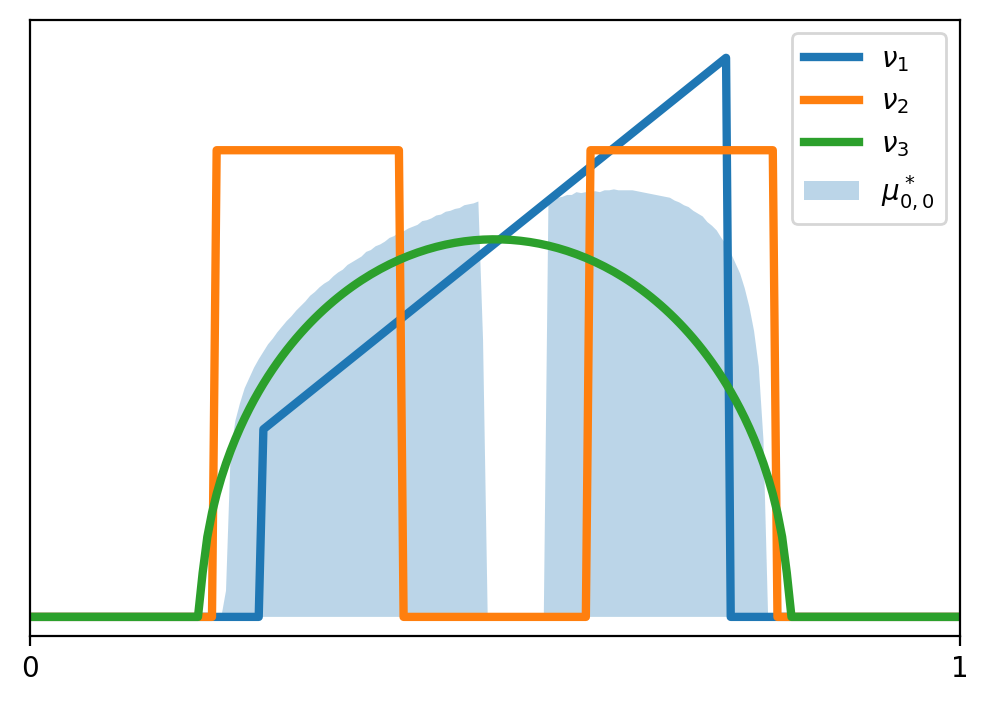
- Numerical validation uses gradient ascent on the dual problem and compares with Sinkhorn divergence and unregularized barycenters on 1D and 2D examples.
Experimental results
Research questions
- RQ1How does combining inner and outer entropic regularization affect the approximation quality of Wasserstein barycenters?
- RQ2Can the (λ, τ)-barycenter achieve a suboptimality gap of O(λ²) instead of O(max{λ, τ}) when τ = λ/2, indicating debiasing?
- RQ3Does the doubly regularized formulation ensure smoothness and strong stability of the barycenter under perturbations of the input measures?
- RQ4Can a grid-free optimization method like noisy particle gradient descent achieve global convergence to the barycenter?
- RQ5What is the statistical convergence rate of the empirical barycenter to the population barycenter under i.i.d. sampling?
Key findings
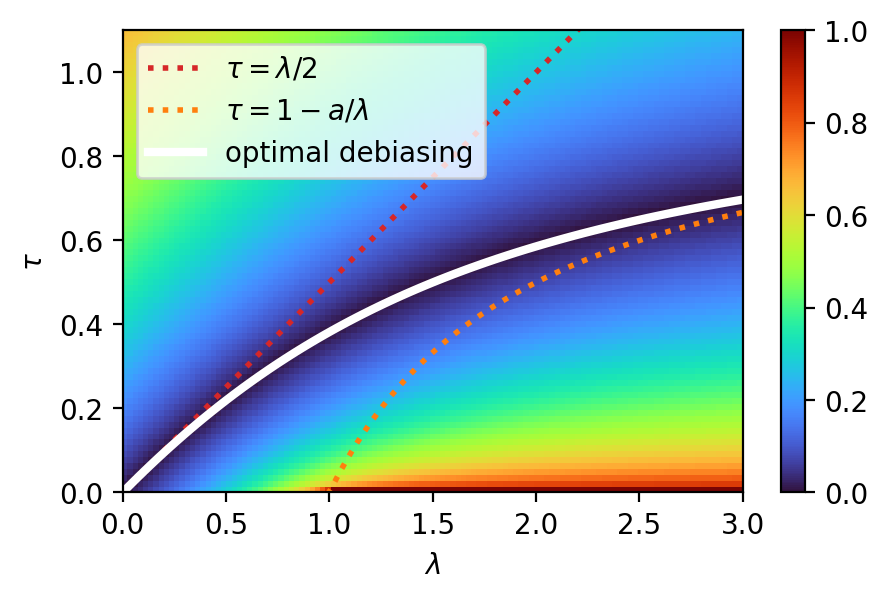
- For τ = λ/2, the (λ, τ)-barycenter achieves a suboptimality gap of O(λ²) in the unregularized Wasserstein barycenter objective, demonstrating debiasing for smooth densities.
- When λ, τ > 0, the barycenter has a smooth density and is strongly stable under perturbations of the input measures.
- Given n i.i.d. samples from each input measure, the empirical barycenter converges to the population barycenter in relative entropy at rate n⁻¹ᐟ².
- The (λ, τ)-barycenter can be interpreted as a standard EOT barycenter with a modified reference measure σref involving power-weighted densities.
- Noisy particle gradient descent converges globally to the barycenter in the mean-field limit at an exponential rate, escaping local minima.
- Numerical experiments confirm that τ = λ/2 yields the best approximation of the unregularized Wasserstein barycenter, outperforming Sinkhorn divergence barycenters which exhibit oscillatory behavior.
Better researchstarts right now
From reading papers to final review, dramatically reduce your research time.
No credit card · Free plan available
This review was created by AI and reviewed by human editors.