
[Paper Review] DreamPose: Fashion Image-to-Video Synthesis via Stable Diffusion
DreamPose is a diffusion-based method that generates photorealistic fashion videos from a single still image and a sequence of human body poses by adapting Stable Diffusion with pose and image conditioning. It achieves state-of-the-art results in temporal consistency, appearance fidelity, and motion realism through a dual CLIP-VAE encoder, 5-pose conditioning, and subject-specific fine-tuning of the UNet and VAE decoder.
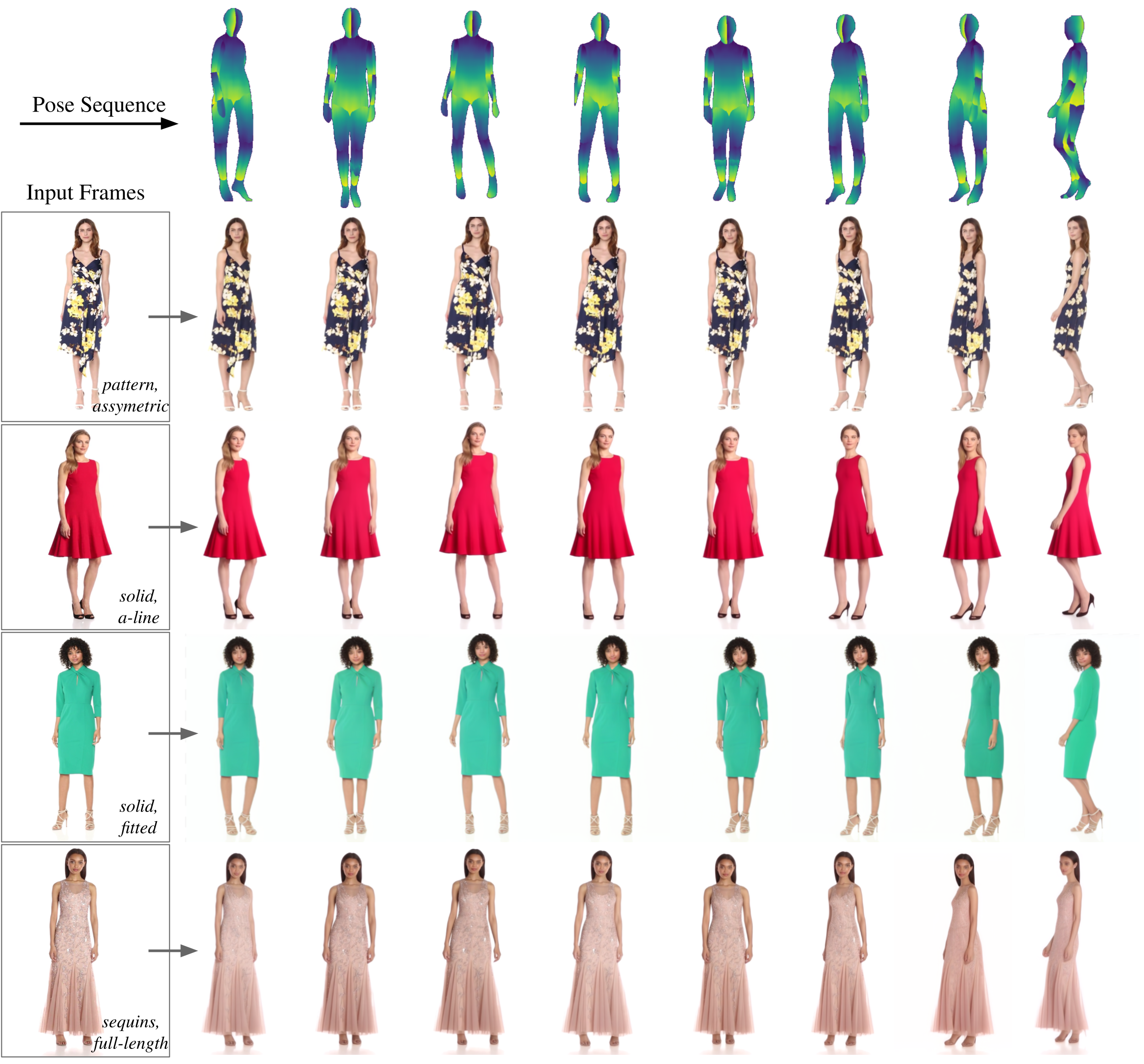
We present DreamPose, a diffusion-based method for generating animated fashion videos from still images. Given an image and a sequence of human body poses, our method synthesizes a video containing both human and fabric motion. To achieve this, we transform a pretrained text-to-image model (Stable Diffusion) into a pose-and-image guided video synthesis model, using a novel fine-tuning strategy, a set of architectural changes to support the added conditioning signals, and techniques to encourage temporal consistency. We fine-tune on a collection of fashion videos from the UBC Fashion dataset. We evaluate our method on a variety of clothing styles and poses, and demonstrate that our method produces state-of-the-art results on fashion video animation.Video results are available on our project page.
Motivation & Objective
- To address the lack of realistic, temporally consistent fashion videos despite the prevalence of fashion photography.
- To enable high-fidelity image animation with precise control over human motion and fabric dynamics using only a single input image and pose sequence.
- To overcome limitations of existing video diffusion models, such as poor temporal consistency and reliance on text-only conditioning.
- To improve appearance fidelity and motion smoothness in fashion video synthesis by integrating pose and image conditioning into a pretrained diffusion model.
- To achieve subject-specific animation without requiring extensive data or complex multi-stage networks.
Proposed method
- Fine-tunes a pretrained text-to-image Stable Diffusion model using a novel two-stage strategy: first on the UBC Fashion dataset, then with subject-specific fine-tuning on a single input image.
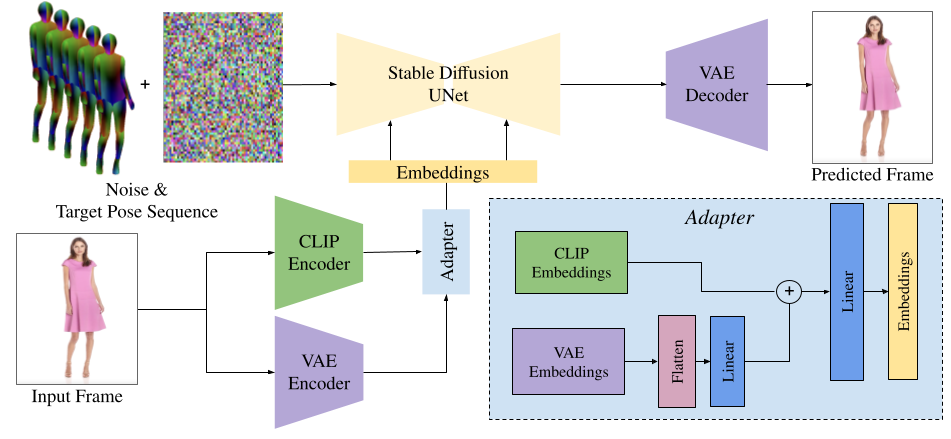
- Replaces the CLIP text encoder with a dual CLIP-VAE image encoder and adapter module to jointly model and reshape image and latent embeddings for improved appearance fidelity.
- Conditions the denoising U-Net on a sequence of five consecutive poses centered on the target frame, enhancing temporal consistency.
- Introduces a novel architecture that supports both image and pose conditioning by modifying the attention mechanisms and input injection pathways.
- Performs subject-specific fine-tuning of the UNet, adapter module, and VAE decoder to preserve identity and texture details across frames.
- Employs a noise injection mechanism where the pose representation is concatenated to the input noise at each denoising step.
Experimental results
Research questions
- RQ1Can a pretrained image diffusion model be effectively adapted to generate high-quality, photorealistic fashion videos from a single image and pose sequence?
- RQ2How does pose conditioning with multiple sequential poses improve temporal consistency compared to single-pose conditioning?
- RQ3To what extent does subject-specific fine-tuning of both the UNet and VAE decoder enhance appearance fidelity and reduce flickering?
- RQ4How does the dual CLIP-VAE encoder compare to a standard CLIP image encoder in preserving fine details of clothing and identity?
- RQ5What are the failure modes of the method, and can they be mitigated with improved pose estimation or additional supervision?
Key findings
- The full DreamPose model achieves the best performance across all metrics: L1 (0.019), SSIM (0.900), VGG (0.207), and LPIPS (0.056), outperforming ablated variants.
- The ablation with only a CLIP image encoder (Ours_CLIP) shows significant appearance degradation, indicating the necessity of the dual CLIP-VAE encoder for detail preservation.
- Subject-specific fine-tuning of the VAE decoder significantly improves sharpness and reduces overfitting, as shown by the improved metrics in Ours_No-VAE-FT compared to Ours_CLIP.
- Using only one pose (Ours_1-pose) leads to flickering and motion instability, despite similar quantitative scores, highlighting the importance of multi-frame pose context.
- Temporal smoothing applied to the 1-pose variant (Ours_smooth) drastically degrades performance, indicating that motion artifacts are better resolved by architectural design than post-processing.
- Failure cases include limb merging into fabric, hallucinated features, and directional misalignment in back-facing poses, suggesting limitations in pose estimation and geometric reasoning.
Better researchstarts right now
From reading papers to final review, dramatically reduce your research time.
No credit card · Free plan available
This review was created by AI and reviewed by human editors.