
[Paper Review] Dust modeling of the combined ALMA and SPHERE datasets of HD163296. Is HD163296 really a Meeus group II disk?
This study models HD 163296's dust distribution using combined ALMA (millimeter continuum) and SPHERE (polarized scattered light) data, revealing that the outer disk lacks small dust grains on its surface, explaining its intermediate SED. Two mechanisms—enhanced dust settling or small-grain depletion—account for the lack of scattered light beyond 100 AU, suggesting HD 163296 is more similar to group I protoplanetary disks than traditionally classified group II sources.
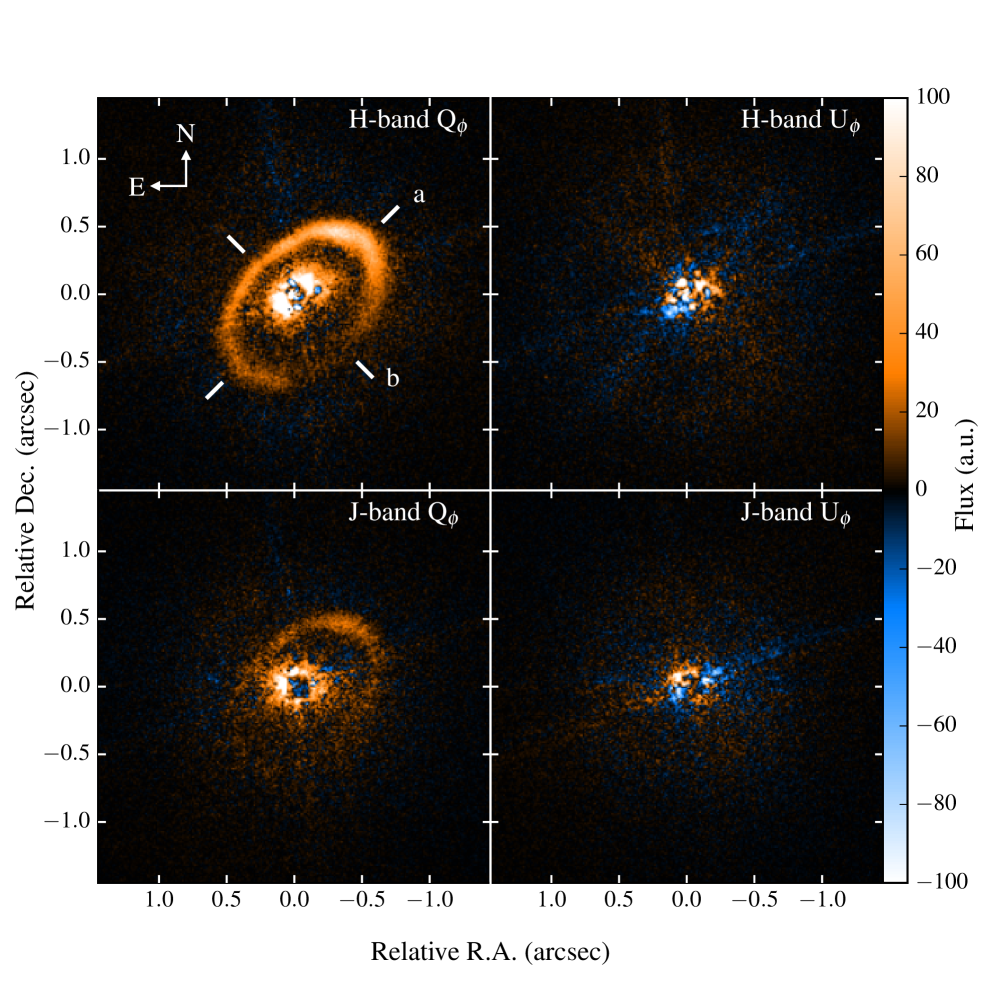
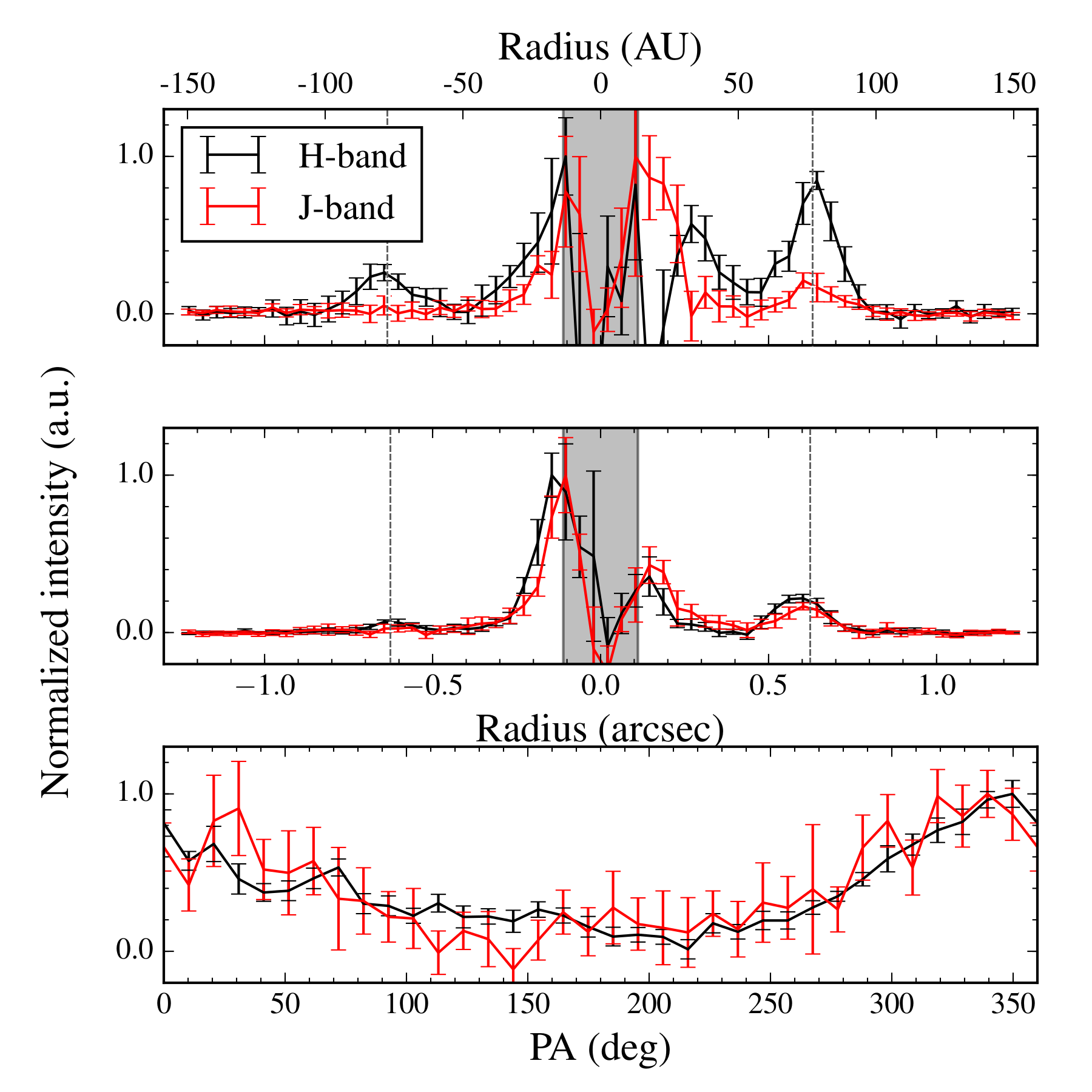
Context. Multi-wavelength observations are indispensable in studying disk geometry and dust evolution processes in protoplanetary disks. Aims. We aimed to construct a 3-dimensional model of HD 163296 capable of reproducing simultaneously new observations of the disk surface in scattered light with the SPHERE instrument and thermal emission continuum observations of the disk midplane with ALMA. We want to determine why the SED of HD 163296 is intermediary between the otherwise well-separated group I and group II Herbig stars. Methods. The disk was modelled using the Monte Carlo radiative transfer code MCMax3D. The radial dust surface density profile was modelled after the ALMA observations, while the polarized scattered light observations were used to constrain the inclination of the inner disk component and turbulence and grain growth in the outer disk. Results. While three rings are observed in the disk midplane in millimeter thermal emission at $\sim$80, 124 and 200 AU, only the innermost of these is observed in polarized scattered light, indicating a lack of small dust grains on the surface of the outer disk. We provide two models capable of explaining this difference. The first model uses increased settling in the outer disk as a mechanism to bring the small dust grains on the surface of the disk closer to the midplane, and into the shadow cast by the first ring. The second model uses depletion of the smallest dust grains in the outer disk as a mechanism for decreasing the optical depth at optical and NIR wavelengths. In the region outside the fragmentation-dominated regime, such depletion is expected from state-of-the-art dust evolution models. We studied the effect of creating an artificial inner cavity in our models, and conclude that HD 163296 might be a precursor to typical group I sources.
Motivation & Objective
- To reconcile the discrepancy between HD 163296’s intermediate SED and its classification as a Meeus group II source.
- To model the 3D dust distribution in HD 163296 using multi-wavelength observations from ALMA and SPHERE.
- To determine whether the lack of scattered light in the outer disk (beyond 100 AU) is due to dust settling or grain depletion.
- To assess whether HD 163296 is a precursor to typical group I Herbig Ae/Be stars.
- To evaluate the role of disk geometry, turbulence, and grain growth in shaping the observed SED and morphologies.
Proposed method
- Used the Monte Carlo radiative transfer code MCMax3D to simulate 3D dust distribution and radiative transfer in HD 163296.
- Fitted the radial dust surface density profile to ALMA 1.3 mm continuum data, identifying three rings at ~80, 124, and 200 AU.
- Constrained the inclination and turbulence of the inner disk using polarized scattered light from SPHERE IRDIS.
- Explored two dust evolution mechanisms: increased settling (α ~ 1×10⁻⁵) and depletion of grains smaller than 3 µm in the outer disk.
- Simulated the effects of artificial inner cavities to test transitionary disk behavior.
- Validated models against observed brightness asymmetries using misalignment of the inner and outer disk components (~1.3°–3°).
Experimental results
Research questions
- RQ1Why does HD 163296’s SED lie between group I and group II Herbig Ae/Be stars despite being classified as group II?
- RQ2What causes the non-detection of scattered light beyond 100 AU in SPHERE images, despite the presence of dust rings in ALMA data?
- RQ3Can enhanced dust settling or small-grain depletion explain the absence of small grains on the disk surface in the outer regions?
- RQ4Is HD 163296 a transitional object evolving toward a group I source, and what observational features support this?
- RQ5How do disk geometry and grain evolution processes jointly shape the multi-wavelength appearance of HD 163296?
Key findings
- The outer disk lacks small dust grains on its surface, as evidenced by the absence of scattered light beyond 100 AU despite millimeter-bright rings.
- A dust settling scenario with α ~ 1×10⁻⁵ in the outer disk can explain the shadowing of small grains by the first ring, reducing their scattering contribution.
- A model with complete depletion of grains smaller than 3 µm in the outer disk produces a similar observational effect, consistent with state-of-the-art dust evolution models.
- The FIR excess in HD 163296 arises nearly equally from the resolved inner disk and the first dust ring, not from a large, flaring outer disk.
- The lack of a strongly illuminated inner wall and the presence of a gap between the inner disk and first ring suggest HD 163296 is a precursor to group I sources.
- Brightness asymmetries in SPHERE images are well reproduced by a small misalignment (~1.3°–3°) between the inner and outer disk components, combined with polarization and phase function effects.
Better researchstarts right now
From reading papers to final review, dramatically reduce your research time.
No credit card · Free plan available
This review was created by AI and reviewed by human editors.