
[Paper Review] Dynamic mass generation on two-dimensional electronic hyperbolic lattices
This study demonstrates that nearest-neighbor (V) and on-site (U) Coulomb repulsions induce charge-density-wave (CDW) and antiferromagnetic (AFM) orderings in two-dimensional electronic hyperbolic lattices with even-p-gon tessellations. Using self-consistent Hartree-Fock calculations, it shows that Dirac materials on hyperbolic lattices exhibit quantum phase transitions at finite V and U, with critical interactions decreasing under increasing curvature—indicating curvature-induced weak coupling quantum phase transitions and dynamically generated mass gaps near the charge neutrality point.
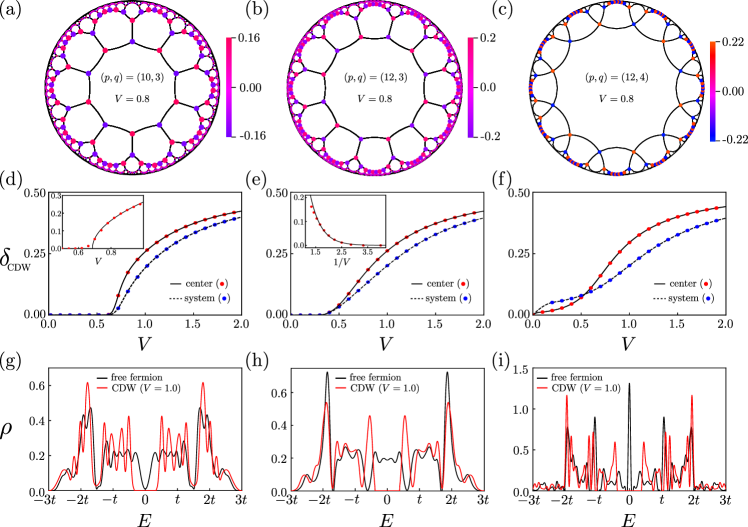
Free electrons hopping on hyperbolic lattices embedded on a negatively curved space can foster (a) Dirac liquids, (b) Fermi liquids, and (c) flat bands, respectively characterized by a vanishing, constant, and divergent density of states near the half filling. From numerical self-consistent mean-field Hartree analyses, we show that nearest-neighbor Coulomb and on-site Hubbard repulsions respectively give rise to charge-density-wave and antiferromagnetic orders featuring staggered patterns of average electronic density and magnetization in all these systems, when the hyperbolic tessellation is accomplished by periodic arrangements of even $p$-gons. Both quantum orders dynamically open mass gaps near the charge neutrality point via spontaneous symmetry breaking. Only on hyperbolic Dirac materials these orderings take place via quantum phase transitions (QPTs) beyond critical interactions, which however decrease with increasing curvature, showcasing curvature-induced weak-coupling QPTs. We present scaling of these masses with the corresponding interaction strengths.
Motivation & Objective
- To investigate the impact of electron-electron interactions on electronic properties in two-dimensional hyperbolic lattices with negative curvature.
- To determine whether CDW and AFM orders emerge in hyperbolic lattices hosting Dirac, Fermi, or flat-band states at half-filling.
- To examine the role of curvature (via increasing p in (p,q) lattices) in modulating critical interaction strengths for quantum phase transitions.
- To explore the emergence of dynamically generated mass gaps in hyperbolic Dirac materials due to symmetry-breaking orders.
- To establish a framework for testing these quantum phases in designer electronic materials and ultracold atomic systems.
Proposed method
- Employed a spinless, nearest-neighbor hopping tight-binding Hamiltonian on hyperbolic lattices with (p,q) tessellations, where p is even and q ≥ 3.
- Applied the Hartree-Fock mean-field approximation to self-consistently solve for CDW and AFM order parameters under NN (V) and on-site (U) Coulomb repulsions.
- Used numerical simulations on finite-sized third-generation hyperbolic lattices (e.g., (10,3), (12,3), (12,4)) with 2880 to 13,080 sites to compute electronic density, magnetization, and density of states.
- Tracked the spatial variation of CDW and AFM order parameters and analyzed their scaling with interaction strength V and U.
- Calculated critical coupling strengths (V_c and U_c) for quantum phase transitions via order parameter onset and BCS-like scaling fits.
- Compared critical interactions across lattices with varying p (curvature) to assess curvature dependence, particularly in Dirac materials (p=10,12; q=3).
Experimental results
Research questions
- RQ1Do nearest-neighbor and on-site Coulomb repulsions induce CDW and AFM orderings in half-filled bipartite hyperbolic lattices with even-p-gon structures?
- RQ2How do the critical interaction strengths (V_c and U_c) for CDW and AFM orderings depend on the curvature of the hyperbolic lattice?
- RQ3What is the nature of the quantum phase transition in hyperbolic Dirac materials, and how does it differ from systems with finite or divergent density of states?
- RQ4Can the formation of a mass gap near the charge neutrality point be attributed to the onset of CDW or AFM order in these systems?
- RQ5To what extent does increasing lattice curvature (via larger p) reduce the critical interaction strength required for ordering in Dirac materials?
Key findings
- CDW and AFM orders are induced by NN (V) and on-site (U) Coulomb repulsions in half-filled hyperbolic lattices with even-p-gon tessellations.
- In Dirac materials (e.g., (10,3) and (12,3) lattices), CDW and AFM orderings emerge via quantum phase transitions at finite V and U, with V_c ≈ 0.69 and U_c ≈ 1.68 respectively.
- For Fermi liquids and flat bands, CDW and AFM orders nucleate even at infinitesimal V and U, due to finite or divergent density of states at half-filling.
- Critical interaction strengths (V_c and U_c) for CDW and AFM orders decrease monotonically with increasing p (curvature) in Dirac materials, indicating curvature-induced weak coupling quantum phase transitions.
- The ratio U_c/V_c ≈ 2.4 in hyperbolic lattices is smaller than the mean-field prediction of 3, likely due to edge effects from sites with only two nearest neighbors.
- Both CDW and AFM orderings open a mass gap near the charge neutrality point, as confirmed by the density of states showing a gap in the presence of long-range order.
![Figure 2: On-site Hubbard repulsion ( $U$ ) mediated antiferromagnet (AFM) ordering on hyperbolic lattices. All the details are the same as in Fig. 1 , but for the AFM order [Eq. ( 9 )]. Top row: Self-consistent solutions of magnetization at each site measured from its value at half-filling (zero),](https://ar5iv.labs.arxiv.org/html/2302.04864/assets/x2.png)
Better researchstarts right now
From reading papers to final review, dramatically reduce your research time.
No credit card · Free plan available
This review was created by AI and reviewed by human editors.