
[Paper Review] Effective model and pairing tendency in bilayer Ni-based superconductor La$_3$Ni$_2$O$_7$
The paper builds a bilayer two-orbital model for La3Ni2O7 and analyzes pairing tendencies using FRG and a multi-orbital t-J framework, finding an s±-wave pairing driven by dz2 orbitals.
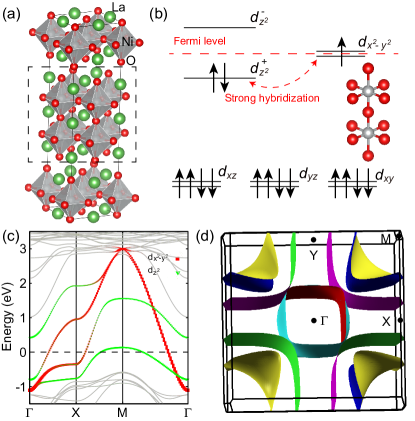
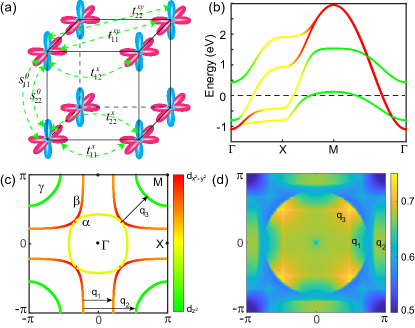
Since the discovery of cuprate, the origin of high-T$_c$ superconductivity has been an outstanding puzzle. Recently, high-T$_c$ superconductivity was observed in a bilayer nickelate La$_3$Ni$_2$O$_7$ under pressure, whose structure hosts the apical oxygen between two layers, distinct from multi-layer cuprates. Motivated by this discovery, we investigate its electronic structure using first-principle calculations and superconducting instabilities from both weak-coupling and strong-coupling perspective. Based on the first-principle band structures, we construct a bilayer two-orbital model on a square lattice, consisting of $d_{x^2-y^2}$ and $d_{z^2}$ orbitals, which accurately captures the low-energy electronic properties. Within this model, we study pairing instability using both functional renormalization group approach and multi-orbital t-J model. An $s_{\pm}$-wave pairing with sign-reversal gaps on different Fermi surfaces is revealed, reminiscent of iron based superconductors. The Ni-$d_{z^2}$ orbital and its associated interlayer and intralayer exchange couplings are found to be crucial for the high-T$_c$ superconductivity. Our study provides valuable insights into unique nature of electronic structure and superconductivity in La$_3$Ni$_2$O$_7$ and contributes to the understanding of unconventional superconductors.
Motivation & Objective
- Motivate the search for high-Tc mechanisms beyond cuprates in bilayer nickelates under pressure.
- Construct a bilayer two-orbital model capturing low-energy electronic structure near the Fermi level.
- Investigate superconducting instabilities using weak-to-intermediate coupling FRG and strong-coupling t-J approaches.
- Identify pairing symmetry and the role of dz^2 orbitals in promoting superconductivity.
Proposed method
- Use first-principles band structures to build a bilayer two-orbital tight-binding model on a square lattice for d_x2-y2 and d_z2 orbitals.
- Neglect the high-energy dz2 antibonding state to obtain a simplified three-band picture when needed.
- Apply functional renormalization group to track the evolution of the effective vertex function and identify leading instabilities.
- Use a multi-orbital t-J model to study pairing from strong coupling and perform mean-field decoupling to obtain gap structures.
- Analyze spin-fluctuation mediated pairing and extract gap symmetries and momentum dependence.
- Discuss three-dimensional effects and doping on pairing tendencies.
Experimental results
Research questions
- RQ1What is the low-energy electronic structure of La3Ni2O7 under high pressure?
- RQ2What pairing tendencies emerge from weak-to-intermediate coupling in a bilayer two-orbital framework?
- RQ3How does the dz^2 orbital contribute to superconductivity and what is the resulting gap symmetry?
- RQ4How do interlayer and intralayer exchange couplings influence pairing in the dz^2 and dx^2−y^2 channels?
- RQ5How does electron or hole doping affect Tc and pairing symmetry?
Key findings
- An s±-wave pairing with sign-reversal gaps on different Fermi surfaces is found in both FRG and t-J analyses.
- The dz^2 orbital and its interlayer and intralayer exchange couplings are crucial for high Tc superconductivity.
- The gamma pocket from dz^2 bonding states and the beta pocket from interlayer dx^2−y^2 antibonding states drive the dominant pairing channel.
- A subdominant dx^2−y^2-wave pairing appears with nodes along the diagonals.
- Electron doping can enhance Tc without changing the pairing symmetry, while sign structure is preserved across pockets.
- The s± state involves sign changes between alpha, beta, and gamma pockets consistent with inter-pocket scattering patterns.
Better researchstarts right now
From reading papers to final review, dramatically reduce your research time.
No credit card · Free plan available
This review was created by AI and reviewed by human editors.