
[Paper Review] Efficient Globally Optimal 2D-to-3D Deformable Shape Matching
This paper proposes a globally optimal, polynomial-time algorithm for 2D-to-3D deformable shape matching, modeling the problem as finding the shortest circular path on the product 3-manifold of the 2D and 3D shapes. It achieves a worst-case complexity of 𝒪(mn² log n) and provides both exact and ε-approximate solutions, enabling efficient sketch-based 3D shape retrieval with state-of-the-art performance on deformable shapes including humans and cats with topological changes.
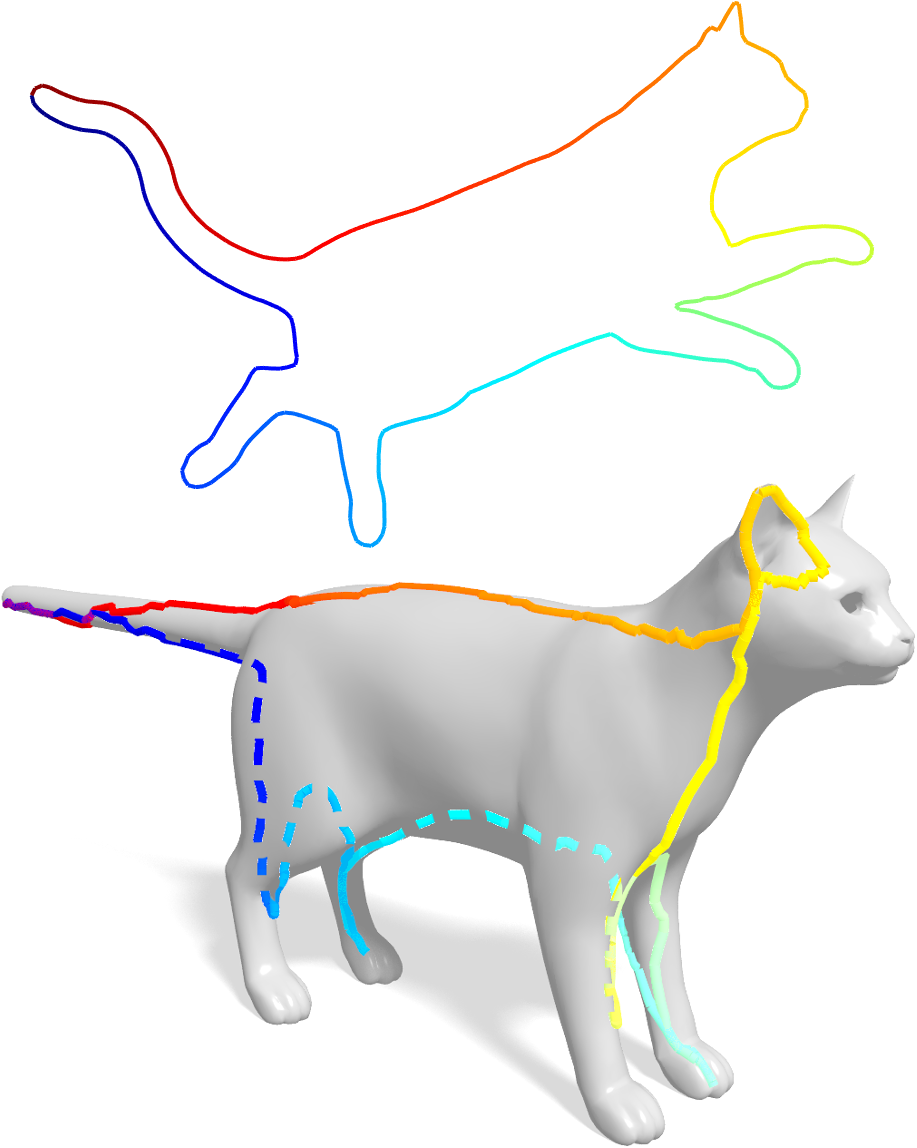
We propose the first algorithm for non-rigid 2D-to-3D shape matching, where the input is a 2D shape represented as a planar curve and a 3D shape represented as a surface; the output is a continuous curve on the surface. We cast the problem as finding the shortest circular path on the product 3-manifold of the surface and the curve. We prove that the optimal matching can be computed in polynomial time with a (worst-case) complexity of $O(mn^2\log(n))$, where $m$ and $n$ denote the number of vertices on the template curve and the 3D shape respectively. We also demonstrate that in practice the runtime is essentially linear in $m\!\cdot\! n$ making it an efficient method for shape analysis and shape retrieval. Quantitative evaluation confirms that the method provides excellent results for sketch-based deformable 3D shape retrieval.
Motivation & Objective
- To address the lack of methods for non-rigid 2D-to-3D shape matching, particularly for deformable shapes such as humans and animals with topological changes.
- To develop a globally optimal algorithm that computes continuous, closed matching curves on 3D surfaces from 2D query contours.
- To ensure computational efficiency for large-scale shapes (up to 40,000 vertices) while maintaining high retrieval accuracy.
- To support sketch-based 3D shape retrieval by providing a robust 2D-to-3D similarity criterion based on learned correspondences.
Proposed method
- The problem is formulated as minimizing an energy functional representing the shortest circular path on the product 3-manifold of the 2D and 3D shapes.
- The method uses a discrete formulation based on a graph representation of the product manifold, where nodes represent pairs of 2D and 3D vertices.
- It applies Dijkstra’s algorithm to compute shortest paths on this graph, ensuring globally optimal solutions via branch-and-bound when needed.
- An ε-approximate variant is introduced to reduce runtime by limiting the search space, trading off minimal precision for significant speedup.
- The method supports different local feature descriptors for 2D and 3D data, including spectral features, enabling semantically meaningful correspondences.
- The matching energy is used as a similarity measure for 3D shape retrieval, enabling efficient k-NN search in embedding space.
Experimental results
Research questions
- RQ1Can a globally optimal 2D-to-3D matching method be designed for deformable shapes with non-rigid transformations and topological changes?
- RQ2What is the computational complexity of computing globally optimal 2D-to-3D correspondences, and can it be made practical for large-scale shapes?
- RQ3How does the use of an ε-approximate solution affect retrieval performance and runtime in sketch-based 3D shape retrieval?
- RQ4Can spectral features from 2D and 3D shapes be effectively compared to enable semantically meaningful matching?
- RQ5To what extent can the matching energy serve as a reliable similarity metric for 3D shape retrieval?
Key findings
- The proposed method achieves a worst-case time complexity of 𝒪(mn² log n), where m and n are the number of vertices on the 2D and 3D shapes, respectively.
- The global algorithm achieves a mean average precision (MAP) of 0.9984 on the extended 2D-to-3D retrieval dataset, outperforming Shape DNA (0.4720) and consensus segmentation (0.5907).
- The ε-approximate variant reduces runtime significantly while maintaining high accuracy, achieving a MAP of 0.9597 on the same dataset.
- For hand-drawn sketches, the method maintains strong performance, with a MAP of 0.9462 for human shapes and 0.9772 for cat shapes.
- Embedding of 3D models using matching energies successfully separates all classes in 2D space, with only one outlier (horse near centaurs), demonstrating the method’s discriminative power.
- The method successfully handles topological changes, such as limbs in human poses, by maintaining continuous, semantically meaningful correspondences even when parts are occluded or missing.

Better researchstarts right now
From reading papers to final review, dramatically reduce your research time.
No credit card · Free plan available
This review was created by AI and reviewed by human editors.