
[Paper Review] Electronic and magnetic excitations in La$_3$Ni$_2$O$_7$
This study uses X-ray absorption spectroscopy and resonant inelastic X-ray scattering to investigate electronic and magnetic excitations in ambient-pressure La₃Ni₂O₇. It identifies Ni 3dₓ²⁻ᵧ², Ni 3d_z², and O 2p orbitals as dominant in low-energy physics with a small charge-transfer energy, and discovers softening optical-like magnetic excitations into a quasi-static spin-density wave (SDW) order at ~150 K, indicating strong electronic correlations and a dominant inter-layer superexchange interaction.
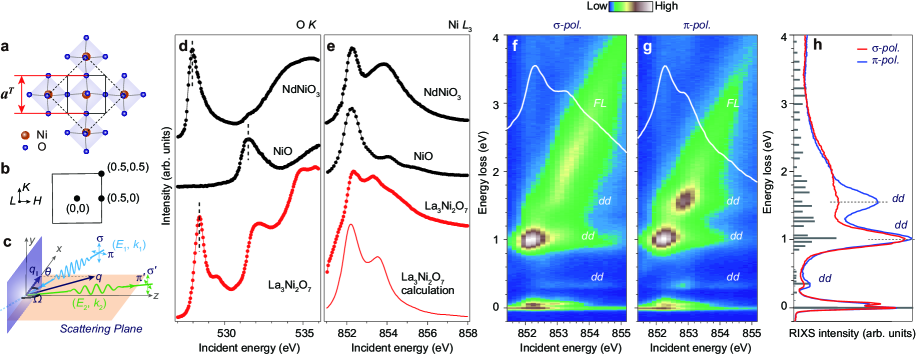
The striking discovery of high-temperature superconductivity (HTSC) of 80 K in a bilayer nickelate La$_3$Ni$_2$O$_7$ under a moderately high pressure of about 14 GPa ignited a new wave of studying HTSC in nickelates. The properties of the parental phase at ambient pressure may contain key information on basic interactions therein and bosons that may mediate pairing giving birth to superconductivity. Moreover, the bilayer structure of La$_3$Ni$_2$O$_7$ may suggest a distinct minimal model in comparison to cuprate superconductors. Here using X-ray absorption spectroscopy and resonant inelastic X-ray scattering, we studied La$_3$Ni$_2$O$_7$ at ambient pressure, and found that Ni 3$d_{x^2-y^2}$, Ni 3$d_{z^2}$, and ligand oxygen 2$p$ orbitals dominate the low-energy physics with a small charge-transfer energy. Remarkably, well-defined optical-like magnetic excitations were found to soften into a quasi-static spin-density-wave ordering, evidencing the strong electronic correlations and rich magnetic properties. Based on a Heisenberg spin model, we found that the inter-layer effective magnetic superexchange interaction is much larger than the intra-layer ones, and proposed two viable magnetic structures. Our results set the foundation for further exploration of La$_3$Ni$_2$O$_7$ superconductor.
Motivation & Objective
- To understand the electronic and magnetic excitations in the parent compound of the high-temperature superconducting bilayer nickelate La₃Ni₂O₇ at ambient pressure.
- To determine the orbital character and charge-transfer energy in the low-energy electronic structure of La₃Ni₂O₇.
- To investigate the nature of magnetic excitations and identify the dominant magnetic exchange interactions in the bilayer system.
- To establish a foundation for constructing a minimal model of La₃Ni₂O₇ relevant to its high-temperature superconductivity under pressure.
Proposed method
- Performed X-ray absorption spectroscopy (XAS) at the O K-edge and Ni L₃-edge to probe unoccupied electronic states and orbital occupancy.
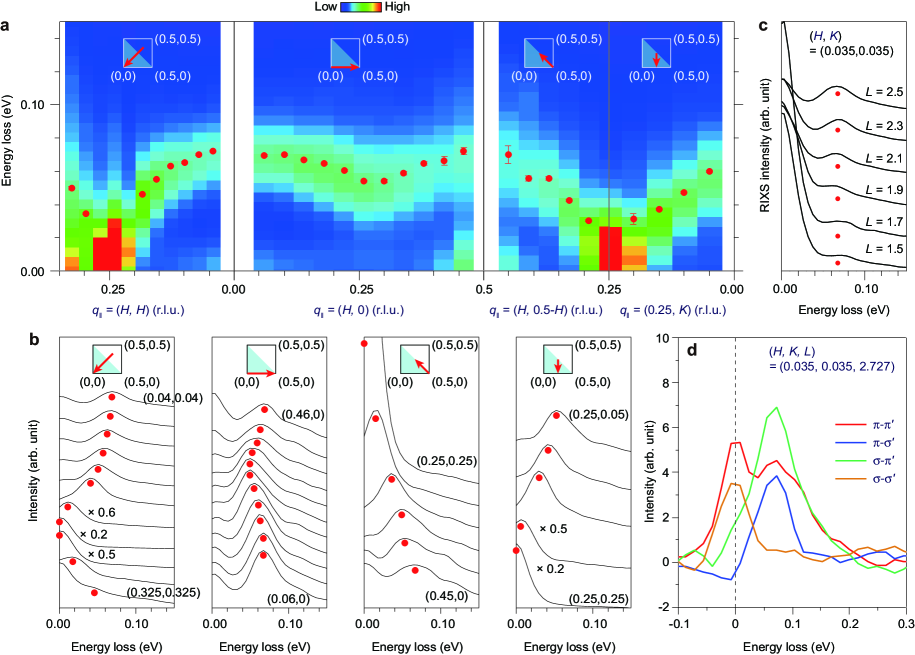
- Conducted resonant inelastic X-ray scattering (RIXS) with polarization-dependent measurements to map magnetic excitations and spin dynamics.
- Used incident-energy-dependent RIXS maps to extract spectral features and identify dispersive magnon modes and SDW order.
- Applied polarimetric RIXS analysis to decompose scattering channels (ππ′, πσ′, σσ′, σπ′) and isolate magnetic response.
- Fitted SDW peak intensity and momentum dependence to extract wavevector, correlation length, and temperature evolution.
- Constructed a Heisenberg spin model to analyze inter- and intra-layer superexchange interactions based on experimental data.
Experimental results
Research questions
- RQ1What are the dominant orbitals and charge-transfer energy in the low-energy electronic structure of ambient-pressure La₃Ni₂O₇?
- RQ2What is the nature of the magnetic excitations in La₃Ni₂O₇, and how do they evolve with temperature?
- RQ3Which magnetic exchange interaction—inter-layer or intra-layer—is dominant in the bilayer NiO₂ system?
- RQ4Does the system exhibit spin-density wave (SDW) order, and if so, what is its wavevector and temperature dependence?
- RQ5How do the observed electronic and magnetic properties inform the minimal model for high-temperature superconductivity in this nickelate?
Key findings
- Ni 3dₓ²⁻ᵧ², Ni 3d_z², and O 2p orbitals dominate the low-energy physics of La₃Ni₂O₇, with a charge-transfer energy less than 2 eV.
- Well-defined optical-like magnetic excitations were observed to soften into a quasi-static spin-density wave (SDW) order below ~150 K.
- The SDW order has a wavevector of ~0.25 r.l.u. along the (H,H) direction, with a half-width at half-maximum of 0.0022 r.l.u.
- The SDW peak area and correlation length decrease with increasing temperature above ~150 K, indicating the thermal suppression of long-range magnetic order.
- The inter-layer effective magnetic superexchange interaction is significantly larger than the intra-layer interactions, as confirmed by Heisenberg spin model analysis.
- Two viable magnetic structures are proposed based on the dominant inter-layer coupling, suggesting a strong tendency toward spin-charge order and possible charge-density-wave instability.
Better researchstarts right now
From reading papers to final review, dramatically reduce your research time.
No credit card · Free plan available
This review was created by AI and reviewed by human editors.