
[Paper Review] Electronic structure and magnetic properties of La$_{3}$Ni$_{2}$O$_{7}$ under pressure: active role of the Ni-$d_{x^2-y^2}$ orbitals
The paper analyzes how pressure and electronic correlations induce a spin-state transition in La3Ni2O7 and shows that Ni-dx2-y2 orbitals actively govern the low-energy physics, not Ni-dz2, even under high pressure. This is explored via DFT+U across Amam to Fmmm transitions and oxygen stoichiometry variations.
Following the recent report of superconductivity in the bilayer nickelate La$_{3}$Ni$_{2}$O$_{7}$ under pressure, we present an analysis of the electronic and magnetic properties of La$_{3}$Ni$_{2}$O$_{7}$ as a function of pressure using correlated density functional theory methods (DFT+$U$). At the bare DFT level, the electronic structure of the ambient and high-pressure phases of La$_{3}$Ni$_{2}$O$_{7}$are qualitatively similar. Upon including local correlation effects within DFT+$U$ and allowing for magnetic ordering, we find a delicate interplay between pressure and electronic correlations. Within the pressure-correlations phase space, we identify a region (at $U$ values consistent with constrained RPA) characterized by a high spin to low spin transition with increasing pressure. In contrast to previous theoretical work that only highlights the crucial role of the Ni-$d_{z^2}$ orbitals in this material, we find that the Ni-$d_{x^{2}-y^{2}}$ orbitals are active upon pressure and drive this rich magnetic landscape. This picture is preserved in the presence of oxygen deficiencies.
Motivation & Objective
- Motivate understanding of electronic and magnetic structure of La3Ni2O7 under pressure in the context of emergent superconductivity
- Investigate how pressure and electronic correlations interact to shape magnetic order and orbital activity
- Determine which Ni-3d orbitals dominate near the Fermi level and how this changes with structural phase transitions
- Assess the role of oxygen stoichiometry in the electronic structure and magnetism of La3Ni2O7
Proposed method
- Perform structural relaxations under pressure for La3Ni2O7 in Amam and Fmmm space groups using DFT with GGA and a 500 eV cutoff
- Compute electronic structure with DFT and DFT+U using AMF and FLL double-counting schemes
- Explore magnetic orderings (FM, AFM-A, AFM-G) across a U range of 1–5 eV and J_H = 0.7 eV
- Identify spin-state transitions (HS to LS) and track orbital-resolved contributions of Ni-dz2 and Ni-dx2-y2 near the Fermi level
- Analyze the evolution of bonding/antibonding Ni-dz2 splitting, dx2-y2 bandwidths, and charge-transfer energy Δ
- Examine the impact of oxygen deficiencies on the electronic structure
Experimental results
Research questions
- RQ1Does La3Ni2O7 undergo a pressure-induced spin-state transition, and if so, what are its characteristics?
- RQ2Which Ni-3d orbitals dominate the low-energy electronic structure near the Fermi level across Amam to Fmmm transitions?
- RQ3How do different DFT+U double-counting schemes (AMF vs FLL) affect predicted magnetic ground states under pressure?
- RQ4What is the role of oxygen stoichiometry in the electronic structure and magnetism of La3Ni2O7 under pressure?
Key findings
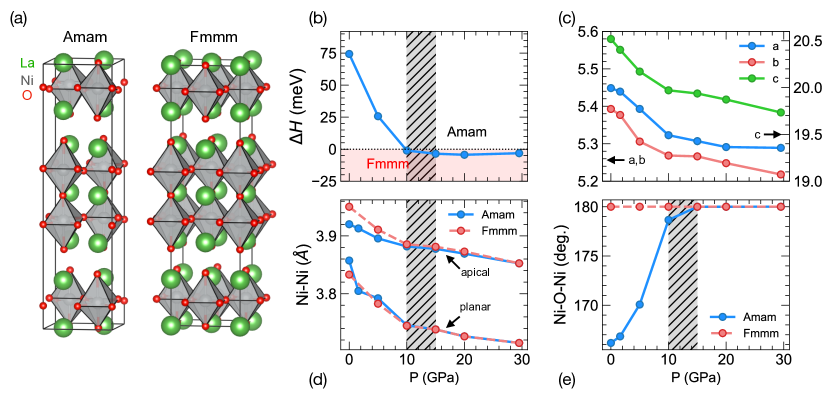
- A pressure-induced spin-state transition from high-spin to low-spin occurs within a range of U (2–4 eV) consistent with cRPA, near the Amam-to-Fmmm transition around 10 GPa
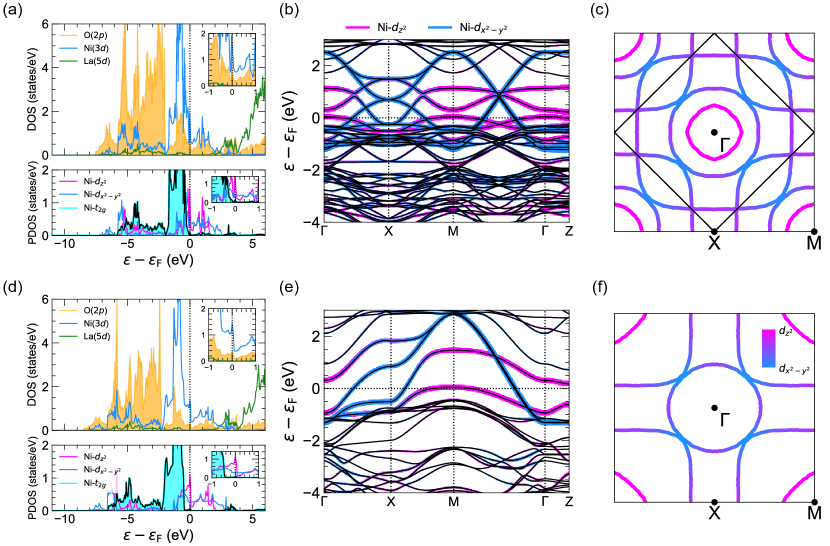
- Across the pressure-correlations phase space, Ni-dx^2−y^2 orbitals remain actively involved and drive the magnetic behavior, even when Ni-dz^2 states are present at the Fermi level
- In the ambient HS phase, Ni-dz^2 bonding/antibonding splitting and Ni-dx^2−y^2 bandwidths are modified under pressure, with LS states showing dx^2−y^2 dominance at the Fermi level
- The LS ground state at high pressure (where superconductivity is observed experimentally) is dominated by Ni-dx^2−y^2 orbitals and may share similarities with cuprates, while HS states are less favorable for superconductivity
- Oxygen deficiencies do not remove the active role of Ni-dx^2−y^2, preserving the dx^2−y^2–driven electronic structure across stoichiometry variations
- The structural transition from Amam to Fmmm (suppression of NiO6 tilts) is reproduced, with a possible tendency toward I4/mmm under full relaxation, consistent with recent experiments
Better researchstarts right now
From paper design to paper writing, dramatically reduce your research time.
No credit card · Free plan available
This review was created by AI and reviewed by human editors.