
[Paper Review] Enhanced Sub-kpc Scale Star-formation: Results From A JWST Size Analysis of 341 Galaxies At 5
This study analyzes 341 high-redshift galaxies (5 < z < 14) from JWST Cycle 1 fields using deep NIRCam imaging and spectroscopic data, revealing a slow size evolution with redshift and identifying compact, sub-kpc-scale star-forming galaxies with extreme star formation surface densities (>10 M☉ yr⁻¹ kpc⁻²), suggesting intense early star formation activity without evidence of AGN feedback.
We present a comprehensive search and analysis of high-redshift galaxies in a suite of nine public JWST extragalactic fields taken in Cycle 1, covering a total effective search area of $\sim358{ m arcmin^2}$. Through conservative ($8σ$) photometric selection, we identify 341 galaxies at $51.5\,σ$ below the derived size-mass slope. These compact sources exhibit a high star formation surface density $Σ_{ m SFR}>10\,M_\odot\,{ m yr^{-1}\,kpc^{-2}}$, a range in which only $<0.01\,\%$ of the local star-forming galaxy sample is found. For those with available NIRSpec data, no evidence of ongoing supermassive black hole accretion is observed. A potential explanation for the observed high [OIII]-to-Hbeta ratios could be high shock velocities, likely originating within intense star-forming regions characterized by high $Σ_{ m SFR}$. Lastly, we find that the rest-frame UV and optical sizes of our sample are comparable. Our results are consistent with these early galaxies building up their structures inside-out and yet to exhibit the strong color gradient seen at lower redshift.
Motivation & Objective
- To characterize the rest-frame UV size-stellar mass relation of high-redshift galaxies (5 < z < 14) using JWST data.
- To investigate the evolution of galaxy sizes across cosmic time at z > 5, particularly the rate of size growth.
- To identify and analyze compact, sub-kpc-scale star-forming galaxies with extreme star formation surface densities.
- To assess the role of star formation and feedback processes in shaping early galaxy structures, particularly in the absence of AGN activity.
- To test whether early galaxies exhibit color gradients or structural features typical of lower-redshift systems.
Proposed method
- Conducted a conservative photometric selection (8σ) of 341 galaxies in nine public JWST extragalactic fields covering ~358 arcmin².
- Used rest-frame UV and optical photometry from NIRCam to measure effective radii (Reff) and stellar masses (M*) for the sample.
- Applied regression analysis to derive the Reff ∝ M*^0.19±0.03 size-mass relation and size-redshift evolution (Reff ∝ (1+z)^-0.4±0.2).
- Identified compact sources via residual analysis, flagging those >1.5σ below the size-mass relation (13% of sample).
- Evaluated star formation surface density (ΣSFR) using UV luminosities and effective radii, comparing to local galaxy samples.
- Analyzed available NIRSpec spectroscopy to search for AGN signatures (e.g., high-ionization lines) and assessed [O iii]/Hβ ratios for shock or starburst origins.
Experimental results
Research questions
- RQ1How does the rest-frame UV size-stellar mass relation of galaxies at 5 < z < 14 compare to lower-redshift populations?
- RQ2What is the rate of size evolution of high-redshift galaxies over cosmic time, and how does it compare to prior literature estimates?
- RQ3What fraction of high-redshift galaxies are compact (sub-kpc scale) and exhibit extreme star formation surface densities?
- RQ4Is there evidence of active galactic nucleus (AGN) activity in the most compact, high-SFR galaxies?
- RQ5What physical mechanisms could explain the high [O iii]/Hβ line ratios observed in some compact, high-SFR galaxies?
Key findings
- The size-stellar mass relation for high-redshift star-forming galaxies follows Reff ∝ M*^0.19±0.03, similar to z ~ 3 star-forming galaxies but scaled down by ~0.7 dex in size.
- The size evolution is slower than previously thought, with Reff ∝ (1+z)^-0.4±0.2, indicating minimal size growth over the redshift range 5 < z < 14.
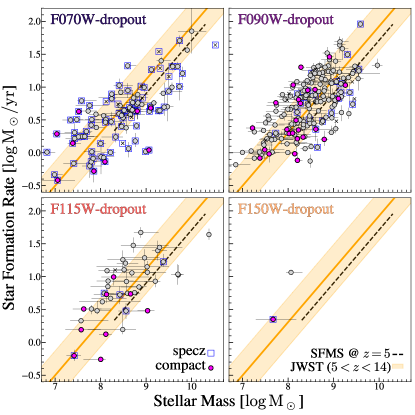
- Approximately 13% of the sample are compact sources with effective radii <100 pc, located >1.5σ below the size-mass relation.
- These compact galaxies exhibit extreme star formation surface densities (ΣSFR > 10 M☉ yr⁻¹ kpc⁻²), a regime found in less than 0.01% of local star-forming galaxies.
- No evidence of ongoing supermassive black hole accretion was found in compact sources with available NIRSpec data.
- High [O iii]/Hβ ratios in some compact galaxies may be driven by high shock velocities from intense star formation, not AGN activity.
Better researchstarts right now
From reading papers to final review, dramatically reduce your research time.
No credit card · Free plan available
This review was created by AI and reviewed by human editors.