
[Paper Review] Enhanced Superconducting Diode Effect due to coexisting Phases
This paper proposes a mechanism for enhancing the superconducting diode effect (SDE) in junction-free superconductors with spontaneously broken time-reversal symmetry (TRS). By demonstrating a mutual coupling between the supercurrent and a TRS-breaking order parameter—particularly when their energy scales are comparable—it shows that this back-action effect can significantly amplify current asymmetry, explaining large diode efficiencies observed in twisted trilayer graphene and enabling design principles for high-performance zero-field superconducting diodes.
The superconducting diode effect refers to an asymmetry in the critical supercurrent $J_c(\hat{n})$ along opposite directions, $J_c(\hat{n}) eq J_c(-\hat{n})$. While the basic symmetry requirements for this effect are known, it is, for junction-free systems, difficult to capture within current theoretical models the large current asymmetries $J_c(\hat{n})/J_c(-\hat{n})$ recently observed in experiment. We here propose and develop a theory for an enhancement mechanism of the diode effect arising from spontaneous symmetry breaking. We show - both within a phenomenological and a microscopic theory - that there is a coupling of the supercurrent and the underlying symmetry-breaking order parameter. This coupling can enhance the current asymmetry significantly. Our work might not only provide a possible explanation for recent experiments on trilayer graphene but also pave the way for future realizations of the superconducting diode effect with large current asymmetries.
Motivation & Objective
- To explain the experimentally observed large diode efficiency in junction-free superconducting trilayer graphene, where critical current asymmetry exceeds theoretical expectations.
- To develop a theoretical framework for the superconducting diode effect (SDE) in systems with spontaneously broken time-reversal symmetry (TRS), beyond external field or current-induced effects.
- To identify and characterize a feedback mechanism where the supercurrent couples back to the TRS-breaking order parameter, enhancing current asymmetry.
- To provide a microscopic and phenomenological theory that unifies the role of symmetry-breaking order and supercurrent in enabling high-efficiency SDE.
- To offer design principles for future materials and devices with large, tunable SDE efficiencies without external magnetic fields.
Proposed method
- Formulates a phenomenological Ginzburg-Landau-like theory incorporating both superconducting order parameter Δ and a time-reversal-odd order parameter Φ, with a coupling term that breaks TRS.
- Derives the effective action and self-consistent equations for Δ and Φ, showing that the supercurrent induces a non-uniform modulation of the order parameter, leading to current asymmetry.
- Performs a microscopic BdG (Bogoliubov-de Gennes) calculation using a Hamiltonian with momentum-space coupling between electron and hole states, including the effects of the TRS-breaking field.
- Computes the supercurrent using the linear response formula involving the derivative of the normal-state energy with respect to momentum q, projected through the Nambu spinor and quasiparticle occupation functions.
- Uses the full quasiparticle wavefunction amplitudes (u and v) to compute the current, accounting for the non-trivial mixing between electron and hole components due to the order parameter coupling.
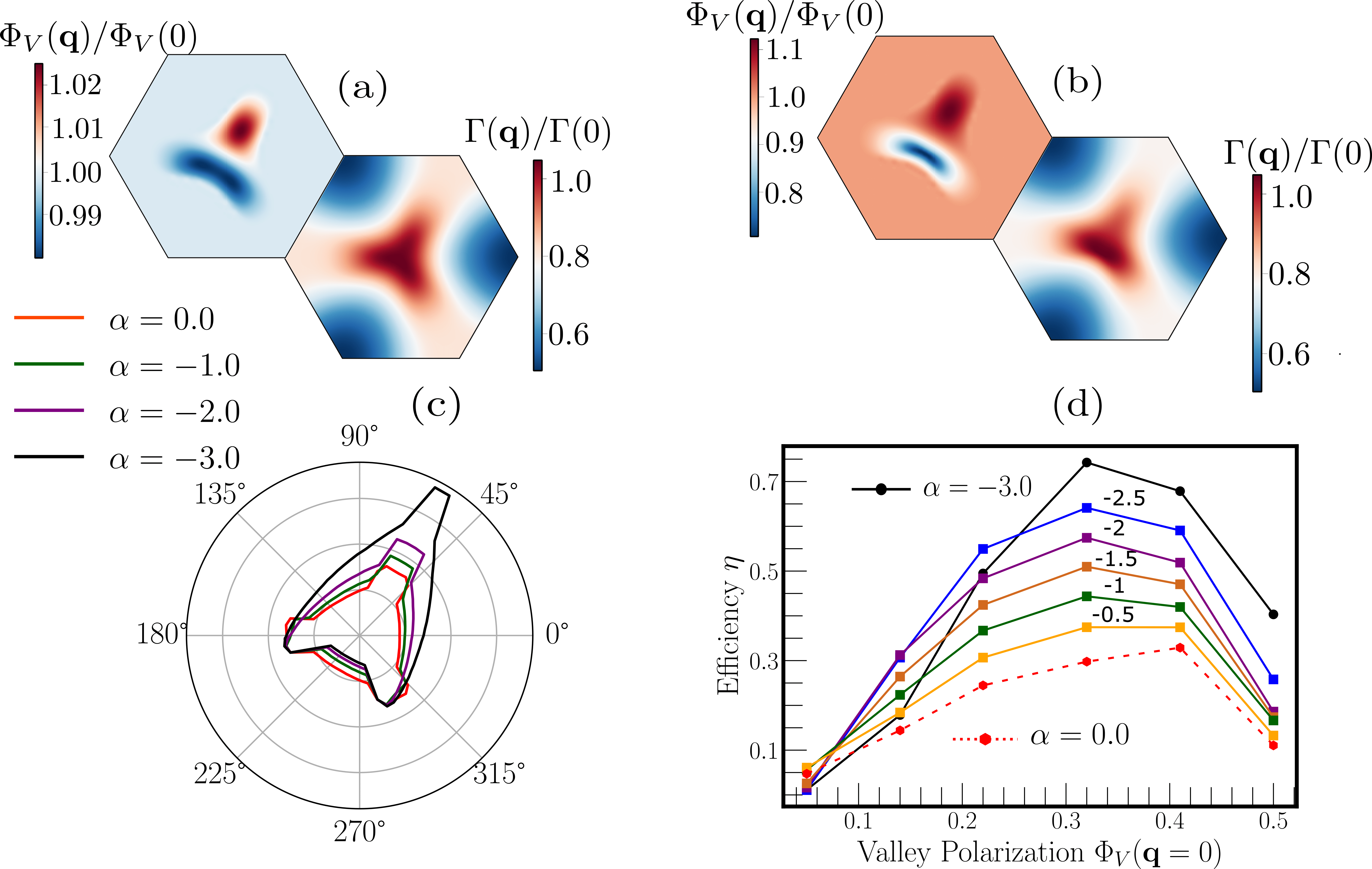
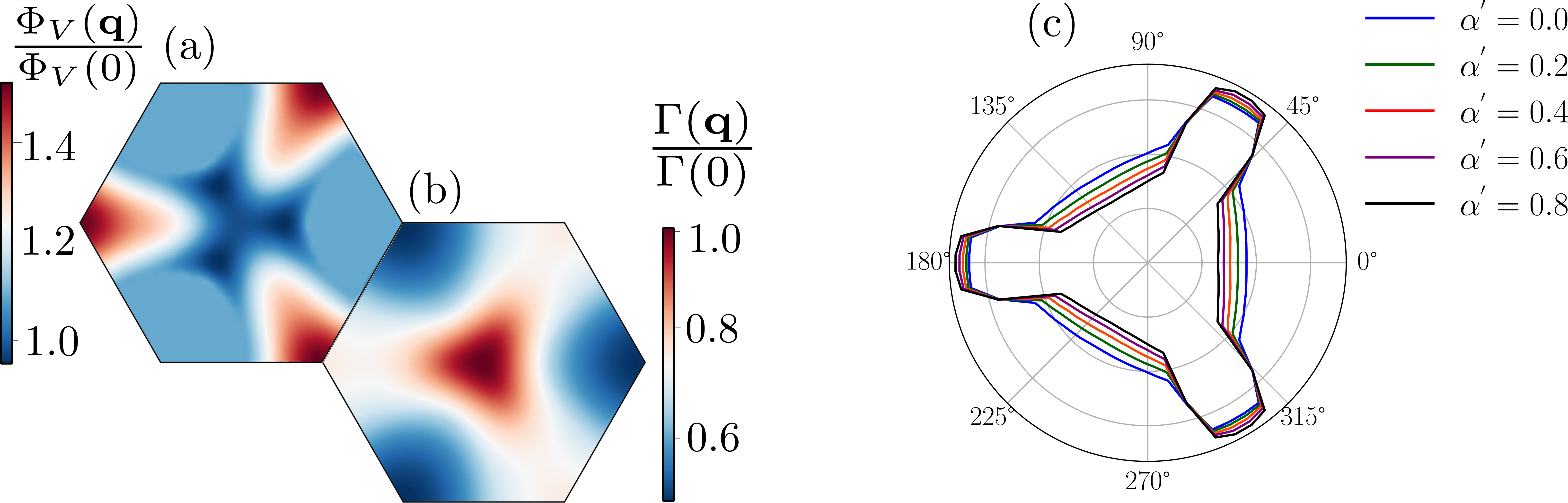
- Numerically solves the self-consistent equations for Δ(q) and Φ(q), showing that the maximum of Δ(q) is pinned at q=0 due to the back-action, even when C3z symmetry is broken.
Experimental results
Research questions
- RQ1How can the large current asymmetry observed in zero-field trilayer graphene be theoretically explained?
- RQ2What is the role of the mutual coupling between supercurrent and time-reversal-odd order parameter in enhancing the superconducting diode effect?
- RQ3Can a back-action mechanism from the supercurrent to the order parameter significantly increase the diode efficiency η?
- RQ4Under what conditions does the coupling between supercurrent and order parameter lead to maximal current asymmetry?
- RQ5How does the energy scale of the TRS-breaking order parameter relative to superconductivity affect the enhancement of the SDE?
Key findings
- The supercurrent couples back to the time-reversal-odd order parameter, creating a feedback mechanism that enhances current asymmetry beyond what is expected from symmetry alone.
- When the energy scales of superconductivity and the TRS-breaking order are comparable, the back-action effect becomes strong and leads to a significant increase in diode efficiency η.
- Numerical solutions show that the maximum of the superconducting order parameter Δ(q) is pinned at q=0 even when C3z symmetry is broken, due to the non-local coupling with the current.
- The model reproduces the observed large diode efficiency in twisted trilayer graphene, with η approaching values close to 1, explaining experimental results from Lin et al. (2022).
- The theory predicts that the current asymmetry can be tuned by adjusting the relative strength of the supercurrent-order parameter coupling, enabling design of high-efficiency SDE devices.
- The mechanism is robust and general, applicable to various systems with spontaneous TRS breaking, not limited to graphene-based materials.
Better researchstarts right now
From reading papers to final review, dramatically reduce your research time.
No credit card · Free plan available
This review was created by AI and reviewed by human editors.