
[Paper Review] Entanglement and charge-sharpening transitions in U(1) symmetric monitored quantum circuits
This paper studies U(1) symmetric monitored quantum circuits, revealing a novel charge-sharpening transition that distinguishes scrambling phases with volume-law entanglement, where measurements can or cannot efficiently reveal total charge. Using exact numerics and a mapping to constrained hard-core random walkers, it shows Rényi entropies grow ballistically with time under any finite measurement rate, and identifies critical behavior with emergent Lorentz invariance and scalable local ancilla probes for diagnosis.
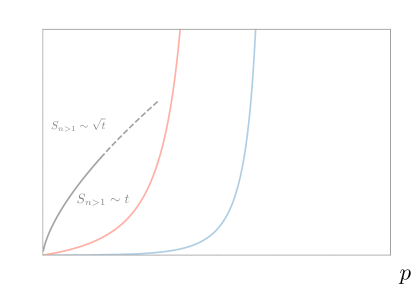
Monitored quantum circuits can exhibit an entanglement transition as a function of the rate of measurements, stemming from the competition between scrambling unitary dynamics and disentangling projective measurements. We study how entanglement dynamics in non-unitary quantum circuits can be enriched in the presence of charge conservation, using a combination of exact numerics and a mapping onto a statistical mechanics model of constrained hard-core random walkers. We uncover a charge-sharpening transition that separates different scrambling phases with volume-law scaling of entanglement, distinguished by whether measurements can efficiently reveal the total charge of the system. We find that while Rényi entropies grow sub-ballistically as $\sqrt{t}$ in the absence of measurement, for even an infinitesimal rate of measurements, all average Rényi entropies grow ballistically with time $\sim t$. We study numerically the critical behavior of the charge-sharpening and entanglement transitions in U(1) circuits, and show that they exhibit emergent Lorentz invariance and can also be diagnosed using scalable local ancilla probes. Our statistical mechanical mapping technique readily generalizes to arbitrary Abelian groups, and offers a general framework for studying dissipatively-stabilized symmetry-breaking and topological orders.
Motivation & Objective
- To understand how charge conservation enriches entanglement dynamics in non-unitary quantum circuits.
- To identify and characterize a new charge-sharpening transition in U(1) symmetric monitored circuits.
- To determine whether measurements can efficiently reveal the total charge in different scrambling phases.
- To establish critical behavior and universality class of the charge-sharpening and entanglement transitions.
- To develop scalable diagnostic tools using local ancilla probes for emergent critical dynamics.
Proposed method
- Mapping the monitored U(1) circuit to a statistical mechanics model of constrained hard-core random walkers.
- Using exact numerical simulations to compute Rényi entropies, charge variance, and ancilla dynamics in finite-size systems.
- Applying finite-size scaling with the ansatz R(p,L) = a_R + b_R(p−p_0)L^{1/ν} + c_R(p−p_0)^2L^{2/ν} + d_R/L^ω to extract critical points and exponents.
- Employing non-linear fitting of the scaling ansatz to extract critical parameters, including p_0, ν, and ω, with error bars from confidence intervals.
- Using local ancilla probes to diagnose critical dynamics and extract universal scaling functions A_O(x) and B(x).
- Analyzing long-time decay rates of observables to confirm exponential relaxation and universal scaling at criticality.
Experimental results
Research questions
- RQ1How does U(1) charge conservation modify the entanglement and charge-sharpening transitions in monitored quantum circuits?
- RQ2What distinguishes the scrambling phases with volume-law entanglement in terms of measurability of total charge?
- RQ3Does the charge-sharpening transition exhibit emergent Lorentz invariance and universal scaling behavior?
- RQ4Can local ancilla probes reliably diagnose the critical dynamics of the charge-sharpening and entanglement transitions?
- RQ5What is the nature of the critical point, and how do finite-size effects influence the extraction of critical exponents?
Key findings
- Even an infinitesimal measurement rate causes all average Rényi entropies to grow ballistically with time, scaling as ∼t, in contrast to √t growth in the absence of measurements.
- The charge-sharpening transition separates phases where measurements can or cannot efficiently reveal the total charge, with distinct entanglement scaling behavior.
- The transition exhibits emergent Lorentz invariance, as evidenced by universal scaling of decay rates and collapse of data using ν = 2.15 and p_# = 0.088.
- The long-time critical dynamics is governed by exponential relaxation with a single decay rate ξ_t, indicating a universal exponential decay law.
- Local ancilla probes saturate to critical behavior earlier than global observables like N_0, enabling scalable diagnosis of criticality.
- Finite-size scaling analysis confirms the existence of a non-negligible irrelevant scaling field v, which shifts crossing points and necessitates higher-order fitting in the scaling ansatz.

Better researchstarts right now
From reading papers to final review, dramatically reduce your research time.
No credit card · Free plan available
This review was created by AI and reviewed by human editors.