
[Paper Review] Entanglement-magic separation in hybrid quantum circuits
This paper demonstrates a measurement-induced phase transition in magic—quantified by stabilizer entropy—in a hybrid quantum circuit with controlled T-gate injection and projective measurements. Unlike entanglement, which exhibits a volume-to-area law transition at a different measurement rate, magic shows an independent phase transition, revealing that non-Clifford resources can be protected from measurement-induced suppression, highlighting a new layer in the resource theory of quantum advantage beyond entanglement.
Magic describes the distance of a quantum state to its closest stabilizer state. It is -- like entanglement -- a necessary resource for a potential quantum advantage over classical computing. We study magic, quantified by stabilizer entropy, in a hybrid quantum circuit with projective measurements and a controlled injection of non-Clifford resources. We discover a phase transition between a (sub)-extensive and area law scaling of magic controlled by the rate of measurements. The same circuit also exhibits a phase transition in entanglement that appears, however, at a different critical measurement rate. This mechanism shows how, from the viewpoint of a potential quantum advantage, hybrid circuits can host multiple distinct transitions where not only entanglement, but also other non-linear properties of the density matrix come into play.
Motivation & Objective
- To investigate whether magic, like entanglement, undergoes measurement-induced phase transitions in hybrid quantum circuits.
- To determine if the critical measurement rate for magic transitions differs from that of entanglement transitions.
- To explore the role of non-Clifford resources (via T-gates) in stabilizing magic against measurement-induced suppression.
- To establish a phase diagram for magic scaling in relation to measurement rate and T-gate density.
- To clarify the implications of separate magic and entanglement transitions for quantum advantage and quantum error correction.
Proposed method
- The study employs a one-dimensional hybrid quantum circuit with random Clifford gates, projective measurements, and controlled injection of T-gates at a tunable density.
- Magic is quantified using stabilizer entropy, a measure of non-stabilizer resource content.
- The system is simulated via Monte Carlo sampling over many stochastic trajectories to compute steady-state magic and entanglement entropy.
- The T-gate density is scaled as $ \eta/N^\beta $, allowing analysis of the thermodynamic limit for varying $ \beta $, including $ \beta = 1 $ and $ \beta < 1 $.
- For analytical tractability, a separable model with single-site Clifford gates is introduced, enabling exact derivation of magic scaling as $ \bar{\mathcal{M}}_{\mathrm{ss}} \propto N^{1-\beta} $.
- Phase transitions are identified by analyzing scaling behavior: (sub)extensive vs. area law, with critical rates determined numerically and analytically.
Experimental results
Research questions
- RQ1Does magic in hybrid quantum circuits exhibit a measurement-induced phase transition distinct from entanglement transitions?
- RQ2At what measurement rate does magic transition from (sub)extensive to area-law scaling, and how does this compare to the entanglement transition rate?
- RQ3How does the density of T-gates, scaled as $ \eta/N^\beta $, affect the scaling of magic in the thermodynamic limit?
- RQ4Can the stabilizer formalism or tensor network methods simulate circuits where magic remains (sub)extensive despite high measurement rates?
- RQ5What is the role of entangling two-qubit Clifford gates in protecting magic from measurement-induced suppression?
Key findings
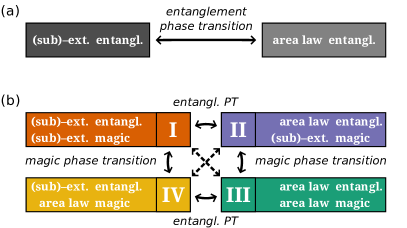
- The paper identifies a distinct measurement-induced phase transition in magic, with a critical measurement rate $ p_c^{\text{magic}} $ that differs from the entanglement transition rate $ p_c^{\text{ent}} $, demonstrating that magic and entanglement are governed by different mechanisms.
- In the regime of low measurement rates, both entanglement and magic scale (sub)extensively, indicating a phase where both resources are robust.
- For intermediate measurement rates, entanglement transitions to an area law while magic remains (sub)extensive, defining a phase where quantum advantage may still be accessible despite reduced entanglement.
- For high measurement rates, both entanglement and magic transition to area law scaling, placing the system in a classically simulable regime.
- Analytical results for a separable model confirm that magic scales as $ \bar{\mathcal{M}}_{\mathrm{ss}} \propto N^{1-\beta} $ for $ \beta < 1 $, remains constant at $ \beta = 1 $, and vanishes for $ \beta > 1 $, indicating a critical dependence on T-gate density scaling.
- The presence of two-qubit Clifford gates in the full circuit enhances magic protection, suggesting that entanglement can shield non-Clifford resources from measurement-induced degradation.

Better researchstarts right now
From reading papers to final review, dramatically reduce your research time.
No credit card · Free plan available
This review was created by AI and reviewed by human editors.