
[Paper Review] Entanglement Transition due to particle losses in a monitored fermionic chain
This paper investigates measurement-induced entanglement transitions in a monitored fermionic chain with local particle losses, using a non-Hermitian effective Hamiltonian and Gaussian state dynamics. It reveals a transition from logarithmic to area-law entanglement scaling by tuning pairing and loss rates, with exact results on waiting-time distributions and entanglement statistics in the presence of linear jump operators.
Recently, there has been interest in the dynamics of monitored quantum systems using linear jump operators related to the creation or annihilation of particles. Here, we study the dynamics of the entanglement entropy under quantum jumps that induce local particle losses in a model of free fermions with hopping and $\mathbb{Z}_2$ pairing. We solve the non-unitary dynamics using the recently developed Faber Polynomial method and explore the different steady-state entanglement regimes by tuning the pairing strength, thus interpolating between monitored free fermions coherently driven by a particle number conserving Hamiltonian to a parity conserving one. In the absence of pairing, all quantum trajectories approach the vacuum at long times, with the entanglement entropy showing non-monotonic behavior over time that we capture with a phenomenological quasiparticle \emph{ansatz}. In this regime, quantum jumps play a key role, and we highlight this by exactly computing their waiting-time distribution. On the other hand, the interplay between losses and pairing gives rise to quantum trajectories with entangled steady-states. We show that by tuning the system parameters, a measurement-induced entanglement transition occurs where the entanglement entropy scaling changes from logarithmic to area-law. We compare this transition with the one derived in the no-click limit and observe qualitative agreement in most of the phase diagram. Furthermore, the statistics of entanglement gain and loss are analyzed to better understand the impact of the linear jump operators.
Motivation & Objective
- To understand how particle loss via local quantum jumps affects entanglement dynamics in a fermionic chain with U(1) and Z2 symmetries.
- To investigate the emergence of measurement-induced entanglement transitions (MIPT) in non-interacting fermionic systems with linear jump operators.
- To analyze the role of pairing and loss rates in driving a transition between logarithmic and area-law entanglement scaling.
- To compute exact waiting-time distributions for quantum jumps and characterize entanglement gain and loss statistics.
Proposed method
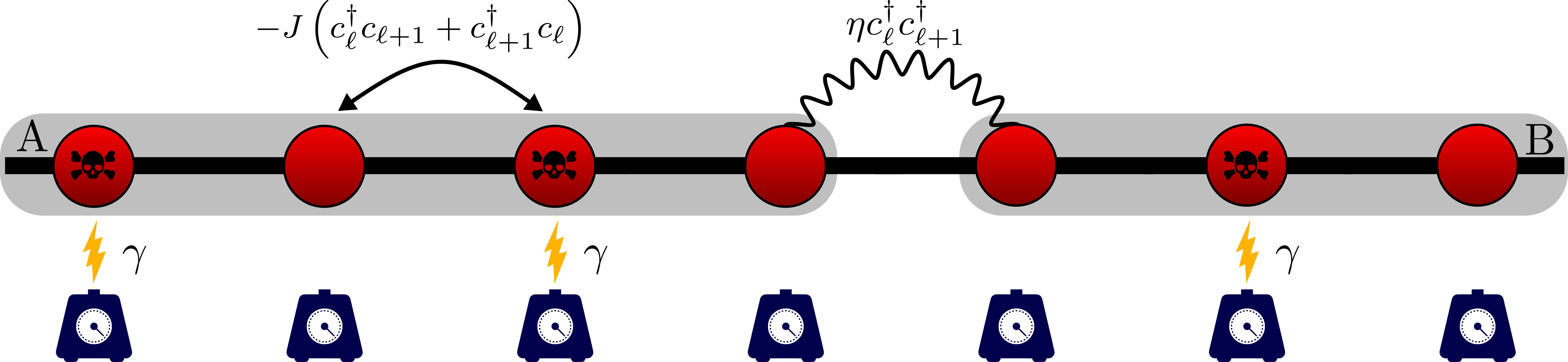
- The system is modeled using a non-Hermitian effective Hamiltonian in the Nambu basis to describe coherent evolution with particle losses.
- Quantum jump dynamics are simulated via stochastic unraveling of the Lindblad master equation, with jumps corresponding to local particle annihilation at each site.
- The Gaussian nature of the state is exploited to evolve the correlation matrices (G and F) efficiently using recurrence relations for Faber polynomials.
- Post-jump updates to the correlation functions are computed using Wick’s theorem and exact formulas for G and F after a jump at site ℓ.
- The entanglement entropy is computed via the reduced density matrix from the correlation matrix, using the standard formula for Gaussian states.
- The waiting-time distribution for quantum jumps is computed exactly using the survival probability and the non-Hermitian evolution.
Experimental results
Research questions
- RQ1How does the interplay between particle losses and pairing in a fermionic chain affect the steady-state entanglement structure?
- RQ2What is the nature of the entanglement transition when tuning the pairing strength and loss rate in a monitored fermionic system?
- RQ3Can the entanglement entropy scaling transition from logarithmic to area-law behavior be observed in a non-interacting fermionic chain with linear jump operators?
- RQ4How do the statistics of entanglement gain and loss evolve during the quantum trajectory, and what is their relation to the jump process?
- RQ5What is the exact waiting-time distribution for quantum jumps in this monitored fermionic chain, and how does it reflect the dynamics of particle loss?
Key findings
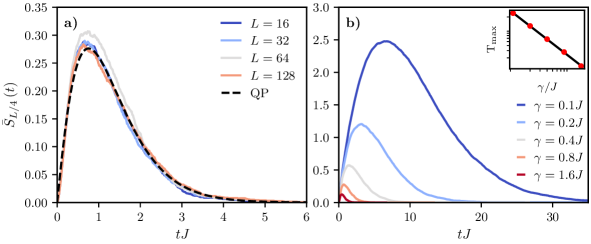
- In the U(1) symmetric case without pairing, the system evolves toward the vacuum, and the entanglement entropy exhibits non-monotonic time evolution, captured by a phenomenological quasiparticle ansatz.
- The exact waiting-time distribution for quantum jumps is computed, revealing the role of non-unitary dynamics in shaping the entanglement evolution.
- In the Z2 pairing case, a measurement-induced entanglement transition occurs, with entanglement entropy scaling changing from logarithmic to area-law upon tuning system parameters.
- The transition is qualitatively consistent with the no-click limit, indicating robustness of the critical behavior across different measurement protocols.
- The statistics of entanglement gain and loss are analyzed, showing that jump-induced changes in correlations drive the transition between entanglement phases.
- The post-jump update rules for correlation functions are derived exactly using Wick’s theorem, enabling efficient simulation of the full quantum trajectory.
Better researchstarts right now
From reading papers to final review, dramatically reduce your research time.
No credit card · Free plan available
This review was created by AI and reviewed by human editors.