
[Paper Review] EPOCHS VIII. An Insight into MIRI-selected Galaxies in SMACS-0723 and the Benefits of Deep MIRI Photometry in Revealing AGN and the Dusty Universe
This study leverages deep James Webb Space Telescope (JWST) MIRI photometry in the SMACS-0723 field to improve photometric redshifts, stellar population modeling, and AGN detection in 181 galaxies at z = 0–3.5. MIRI data reduce photometric redshift errors by 20%, lower SFR estimates by 0.1 dex, and significantly improve AGN fraction constraints by capturing PAH features and dust emission.
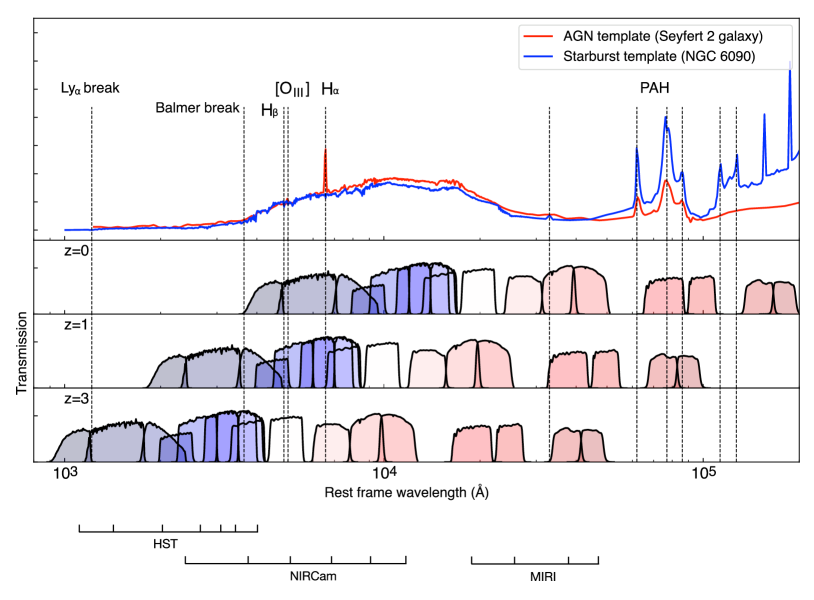
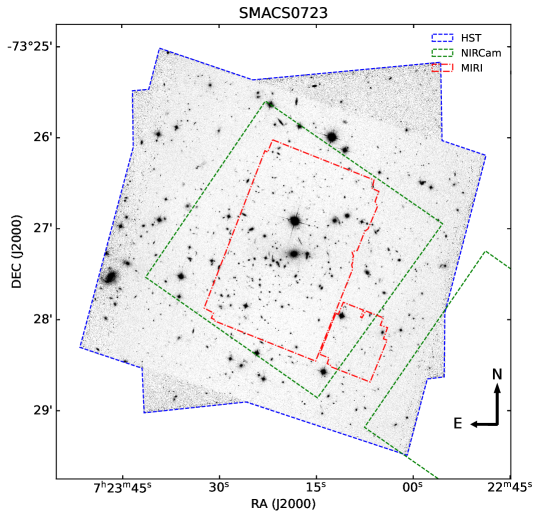
We present the analysis of the stellar population and star formation history of 181 MIRI selected galaxies at redshift 0-3.5 in the massive galaxy cluster field SMACS J0723.3-7327, commonly referred to as SMACS0723, using the James Webb Space Telescope (JWST) Mid-Infrared Instrument (MIRI). We combine the data with the JWST Near Infrared Camera (NIRCam) catalogue, in conjunction with the Hubble Space Telescope (HST) WFC3/IR and ACS imaging. We find that the MIRI bands capture PAH features and dust emission, significantly enhancing the accuracy of photometric redshift and measurements of the physical properties of these galaxies. The median photo-z's of galaxies with MIRI data are found to have a small 0.1% difference from spectroscopic redshifts and reducing the error by 20 percent. With MIRI data included in SED fits, we find that the measured stellar masses are unchanged, while the star formation rate is systematically lower by 0.1 dex. We also fit the median SED of active galactic nuclei (AGN) and star forming galaxies (SFG) separately. MIRI data provides tighter constraints on the AGN contribution, reducing the typical AGN contributions by ~14 percent. In addition, we also compare the median SED obtained with and without MIRI, and we find that including MIRI data yields steeper optical and UV slopes, indicating bluer colours, lower dust attenuation, and younger stellar populations. In the future, MIRI/MRS will enhance our understanding by providing more detailed spectral information and allowing for the study of specific emission features and diagnostics associated with AGN.
Motivation & Objective
- To improve photometric redshift accuracy for galaxies in the SMACS-0723 field using deep MIRI photometry.
- To assess the impact of MIRI data on stellar population and star formation rate (SFR) measurements.
- To evaluate the role of MIRI in constraining active galactic nucleus (AGN) contributions and dust properties.
- To compare SEDs with and without MIRI data to quantify improvements in UV/optical slope, dust attenuation, and stellar population age.
- To demonstrate the benefits of deep MIRI observations for revealing dusty and AGN-dominated galaxies previously obscured in optical data.
Proposed method
- Combined MIRI, NIRCam, and HST WFC3/IR/ACS imaging to create multi-wavelength photometric catalogs across 2.3 arcmin² in SMACS-0723.
- Performed SED fitting using full photometric data (HST, NIRCam, MIRI) to derive photometric redshifts, stellar masses, SFRs, and AGN fractions.
- Calibrated photometric redshifts against spectroscopic redshifts to validate accuracy and quantify systematic offsets.
- Used PAH feature detection at 8–15 μm (rest-frame) in MIRI bands to identify dust emission and constrain dust attenuation.
- Compared median SEDs with and without MIRI data to assess changes in UV/optical slopes, dust content, and stellar population age.
- Applied χ² minimization to identify best-fit SEDs and categorized galaxies as AGN-dominated if frac AGN > 0.1.
Experimental results
Research questions
- RQ1How does the inclusion of MIRI photometry improve photometric redshift accuracy compared to HST and NIRCam alone?
- RQ2To what extent does MIRI data refine estimates of stellar mass and star formation rate (SFR) in high-redshift galaxies?
- RQ3How does MIRI data improve the constraint on AGN contributions in composite SEDs?
- RQ4What is the impact of MIRI data on the inferred UV and optical slopes, and what does this imply for dust attenuation and stellar population age?
- RQ5How do PAH features and dust emission in the MIRI bands enhance the detection and characterization of obscured galaxies and AGN?
Key findings
- The inclusion of MIRI data reduces the median photometric redshift error by 20% and decreases the average difference between photometric and spectroscopic redshifts by 0.1%.
- Galaxies with MIRI data show a median photometric redshift difference of only 0.1% from spectroscopic redshifts, compared to a 3% higher difference without MIRI.
- Stellar masses remain unchanged with MIRI, but SFR estimates are systematically reduced by 0.1 dex when MIRI data are included.
- The mean AGN fraction (frac AGN) is reduced to 0.11 ± 0.15 with MIRI, and its uncertainty is reduced by Δμ_err = 0.17, indicating tighter constraints.
- Including MIRI data yields steeper UV and optical slopes, indicating bluer colors, lower dust attenuation, and younger stellar populations.
- MIRI captures strong PAH features at rest-frame 8–15 μm, which are critical for identifying dust emission and AGN activity, especially in high-redshift galaxies.
Better researchstarts right now
From reading papers to final review, dramatically reduce your research time.
No credit card · Free plan available
This review was created by AI and reviewed by human editors.