
[Paper Review] Ergodicity breaking in rapidly rotating C60 fullerenes
This study reports the first observation of icosahedral ro-vibrational fine structure in C60 fullerenes, revealing rotational ergodicity breaking at angular momenta well below the vibrational ergodicity threshold. Using high-sensitivity infrared spectroscopy, the authors identify multiple transitions between ergodic and non-ergodic regimes due to avoided crossings and tensor interactions, demonstrating that high-symmetry, rigid molecules can exhibit complex non-equilibrium dynamics governed by 6th- and 10th-rank tensor interactions.
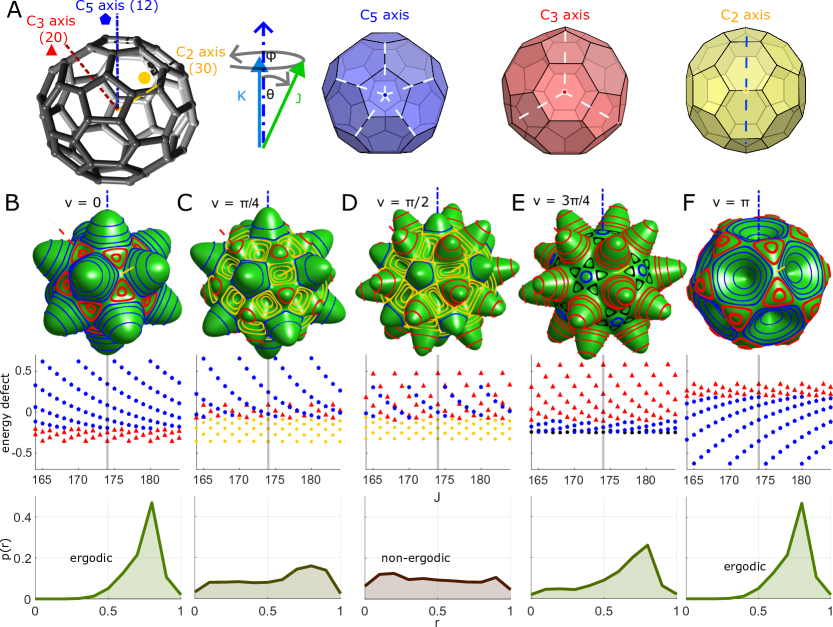
Ergodicity, the central tenet of statistical mechanics, requires that an isolated system will explore all of its available phase space permitted by energetic and symmetry constraints. Mechanisms for violating ergodicity are of great interest for probing non-equilibrium matter and for protecting quantum coherence in complex systems. For decades, polyatomic molecules have served as an intriguing and challenging platform for probing ergodicity breaking in vibrational energy transport, particularly in the context of controlling chemical reactions. Here, we report the observation of rotational ergodicity breaking in an unprecedentedly large and symmetric molecule, 12C60. This is facilitated by the first ever observation of icosahedral ro-vibrational fine structure in any physical system, first predicted for 12C60 in 1986. The ergodicity breaking exhibits several surprising features: first, there are multiple transitions between ergodic and non-ergodic regimes as the total angular momentum is increased, and second, they occur well below the traditional vibrational ergodicity threshold. These peculiar dynamics result from the molecules' unique combination of symmetry, size, and rigidity, highlighting the potential of fullerenes to uncover emergent phenomena in mesoscopic quantum systems.
Motivation & Objective
- To observe icosahedral ro-vibrational fine structure in C60, long predicted but never before detected.
- To investigate ergodicity breaking in rotational dynamics of a large, symmetric molecule under high angular momentum.
- To determine whether rotational ergodicity transitions occur below the vibrational energy redistribution (IVR) threshold.
- To characterize the role of tensor interactions (6th and 10th rank) in shaping the rotational energy surface and level statistics.
- To establish a link between avoided crossings and non-monotonic ergodicity behavior in high-J C60.
Proposed method
- High-sensitivity continuous-wave infrared spectroscopy of the P-branch in the 1185 cm⁻¹ region of C60.
- Nearest-neighbor peak assignment and defect analysis to extract rotational energy level shifts from a rigid-rotor reference.
- Unwrapping of spectral defects using a systematic procedure based on rigid-rotor spacing and J-assignment rules.
- Calculation of energy defect spectra using a general field-free molecular Hamiltonian incorporating scalar and tensor interactions: $ H = H_{\text{scalar}} + H_{\text{tensor}} $.
- Fitting of observed peak intensities to nuclear spin weights to validate J assignments and detect perturbations.
- Aggregation of gap ratio statistics $ p(r) $ to distinguish ergodic (level repulsion) from non-ergodic (no repulsion) regimes.
Experimental results
Research questions
- RQ1Does rotational ergodicity breaking occur in C60 at angular momenta below the vibrational IVR threshold?
- RQ2What is the role of icosahedral symmetry in enabling higher-order tensor interactions that lift rotational degeneracy?
- RQ3How do avoided crossings between rotational states influence the transition between ergodic and non-ergodic dynamics?
- RQ4Can the observed fine structure be explained by a 6th- and 10th-rank tensor interaction model?
- RQ5What is the statistical signature of ergodicity breaking in the energy level spacing distribution?
Key findings
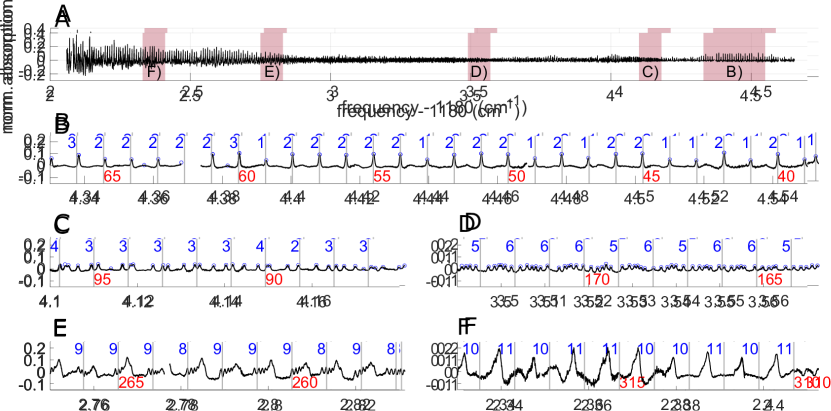
- The first experimental observation of icosahedral ro-vibrational fine structure in any system was achieved in C60, confirming a 1986 prediction.
- Multiple transitions between ergodic and non-ergodic regimes were observed as total angular momentum $ J $ increased, with no monotonic trend.
- Ergodicity breaking occurred at $ J \approx 174 $, well below the vibrational ergodicity threshold, indicating a distinct mechanism from IVR.
- The non-ergodic regime was characterized by energy barriers separating distinct J trajectories, with no level repulsion in gap ratio statistics.
- The 6th- and 10th-rank tensor interactions were identified as the origin of the fine structure, with avoided crossings at $ J \approx 80, 110, 160, 220 $.
- Good agreement between measured peak counts and calculated nuclear spin weights confirmed the validity of J assignments and the presence of strong perturbations.
Better researchstarts right now
From reading papers to final review, dramatically reduce your research time.
No credit card · Free plan available
This review was created by AI and reviewed by human editors.