
[Paper Review] ESO Imaging Survey. Deep Public Survey: Multi-Color Optical Data for the Chandra Deep Field South
This paper presents deep, multi-color optical imaging of the Chandra Deep Field South (CDF-S) using the ESO/MPG 2.2m telescope and Wide-Field Imager, achieving 5σ limiting magnitudes of U′_AB=26.0 to I_AB=24.7 across six filters. The data, processed via automated, multi-resolution pipeline techniques with sub-0.1 arcsec astrometric accuracy, are publicly released as calibrated pixel maps and source lists, forming a key resource for multi-wavelength cosmological studies.
This paper presents multi-passband optical data obtained from observations of the Chandra Deep Field South (CDF-S), located at alpha ~ 3h 32m, delta ~ -27d 48m. The observations were conducted at the ESO/MPG 2.2m telescope at La Silla using the 8kx8k Wide-Field Imager (WFI). This data set, taken over a period of one year, represents the first field to be completed by the ongoing Deep Public Survey (DPS) being carried out by the ESO Imaging Survey (EIS) project. This paper describes the optical observations, the techniques employed for un-supervised pipeline processing and the general characteristics of the final data set. The paper includes data taken in six different filters U'UBVRI. The data cover an area of about 0.25 square degrees reaching 5 sigma limiting magnitudes of U'_AB=26.0, U_AB=25.7, B_AB=26.4$, V_AB=25.4, R_AB=25.5 and I_AB= 24.7 mag, as measured within a 2xFWHM aperture. The optical data covers the area of ~ 0.1
Motivation & Objective
- To produce a deep, multi-passband optical survey of the Chandra Deep Field South (CDF-S) to support high-redshift galaxy studies.
- To develop and validate an automated, unsupervised image processing pipeline for large-scale survey data.
- To deliver publicly accessible, fully calibrated optical data with high astrometric and photometric accuracy for multi-wavelength science.
- To complement existing X-ray and near-infrared data in the CDF-S region for comprehensive cosmological analysis.
- To enable photometric redshift studies and pre-selection of high-redshift galaxy candidates using deep, multi-band photometry.
Proposed method
- Observations conducted with the ESO/MPG 2.2m telescope and 8k×8k Wide-Field Imager (WFI) over a one-year period.
- Multi-resolution image decomposition techniques applied to the pipeline for efficient cosmic ray and defect removal.
- Automated processing including bias correction, flat-fielding, satellite track removal, de-fringing, sky subtraction, and image stacking.
- Pixel-based astrometry used in image stacking to achieve sub-arcsecond accuracy and improve dynamic range.
- Final astrometry calibrated using a pre-release of the Guide Star Catalog II, achieving ~0.10 arcsec accuracy.
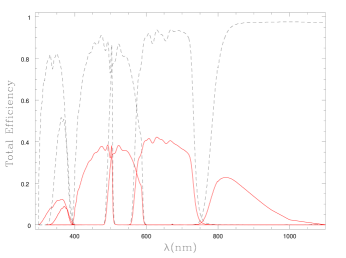
- Photometric calibration performed in six filters: U′, U, B, V, R, I, with AB magnitudes reported for 5σ limits.
Experimental results
Research questions
- RQ1What is the photometric depth and dynamic range of the deep optical survey in the CDF-S field?
- RQ2How accurate is the astrometric solution for the processed optical images across all filters?
- RQ3Can automated, unsupervised image processing techniques effectively handle complex artifacts like cosmic rays and satellite trails?
- RQ4How do the limiting magnitudes of this survey compare to previous surveys in the same field?
- RQ5To what extent can the optical data complement existing X-ray and near-infrared datasets in the CDF-S for multi-wavelength studies?
Key findings
- The survey covers approximately 0.25 square degrees in the CDF-S, with 5σ limiting magnitudes of U′_AB=26.0, U_AB=25.7, B_AB=26.4, V_AB=25.4, R_AB=25.5, and I_AB=24.7 within a 2×FWHM aperture.
- The final astrometric solution has an estimated intrinsic accuracy of ~0.10 arcsec, with all filters sharing the same solution.
- Image stacking using pixel-based astrometry effectively removes cosmic rays and image defects, yielding exceptionally clean final images.
- The optical data fully encompass the region of the deep Chandra X-ray observations, enabling multi-wavelength analysis.
- The data are publicly available through the ESO EIS portal as calibrated pixel maps, weight maps, and source lists.
- The survey's limiting magnitudes are comparable or superior to earlier EIS-DEEP surveys, supporting the detection of high-redshift Lyman-break galaxy candidates.
Better researchstarts right now
From reading papers to final review, dramatically reduce your research time.
No credit card · Free plan available
This review was created by AI and reviewed by human editors.